Why Is the World Talking About India's FCRA Amendment Bill : International Reactions Explained!
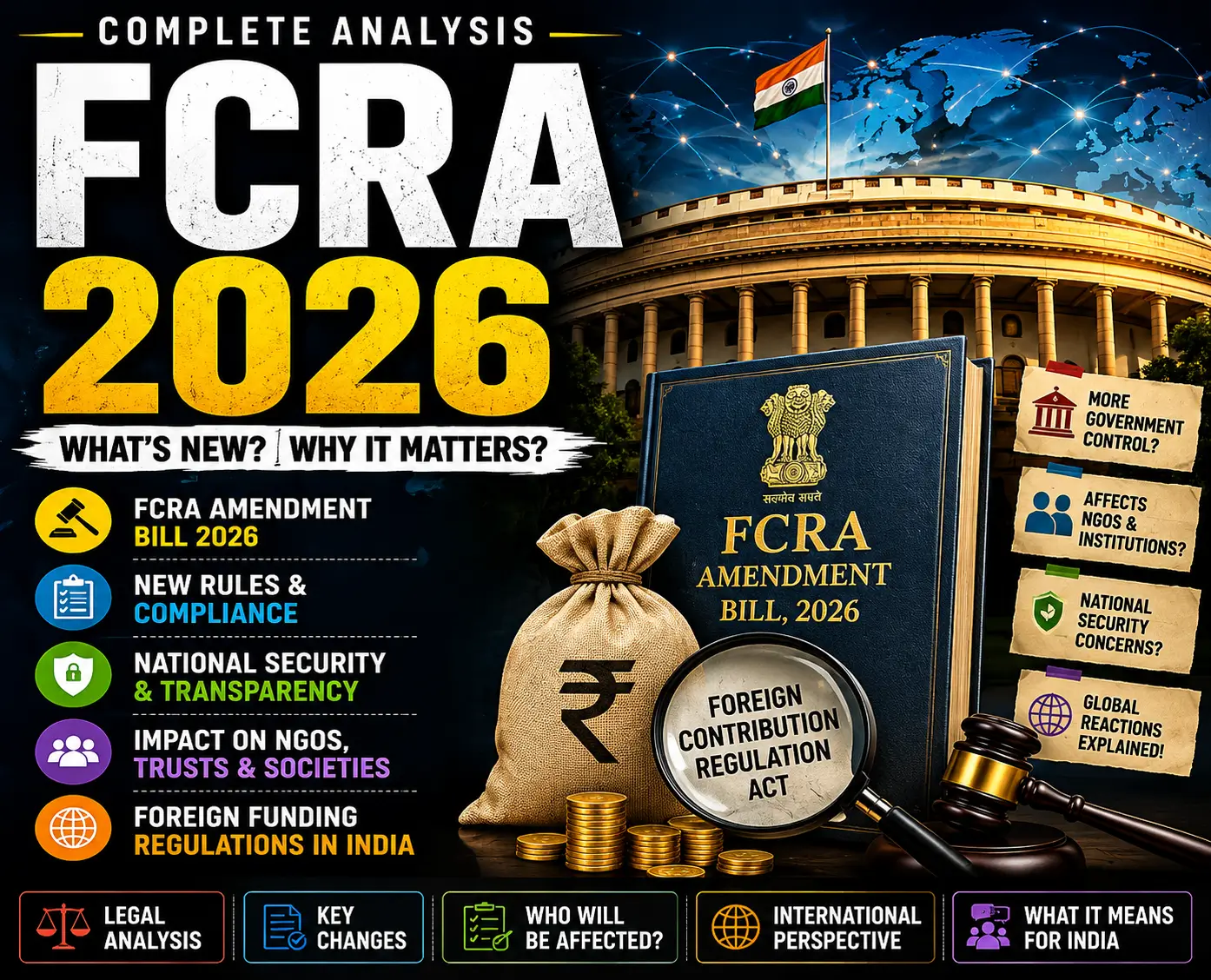
The FCRA Amendment Bill 2026 would let the government seize NGO assets when foreign-funding registration lapses, and Parliament is split over whether that's reform or overreach.
The FCRA Amendment Bill 2026 would let the government seize NGO assets when foreign-funding registration lapses, and Parliament is split over whether that's reform or overreach.
"Can a proposed Indian law become a global talking point?" Usually, it takes something extraordinary. But over the past few weeks, India's FCRA Amendment Bill has done exactly that.
The FCRA Amendment Bill has moved from a domestic legislative debate into an international discussion after criticism from an American lawmaker and objections from Indian opposition parties and church bodies. The core issue is what should happen to foreign-funded money and assets when an organisation no longer holds a valid FCRA certificate.
Enjoying this story? Get TUI's free newsletter: the news that matters, straight to your inbox. No spam, unsubscribe anytime. Subscribe free →
The proposal could affect how schools, hospitals, charities, religious institutions and other organisations manage assets created with overseas donations. It also tests how India balances foreign-funding oversight with the autonomy of civil society.
What the FCRA Amendment Bill Changes?
The Foreign Contribution (Regulation) Act, 2010 regulates the acceptance and use of foreign contributions in India. Organisations covered by the law must meet registration and compliance requirements before receiving foreign funds.
PRS Legislative Research says 14,449 FCRA certificates were active as of July 15, 2026. It also cites Home Ministry data showing that 13,520 organisations received ₹55,741 crore in foreign contributions between 2019 and 2022. That three-year figure shows the scale of funding under the regulatory system.
The 2026 proposal was introduced in the Lok Sabha on March 25. Its central change is a statutory framework for the supervision, management and disposal of foreign contributions and assets when an organisation's certificate is cancelled, surrendered or deemed to have ceased.
A Designated Authority Would Manage Affected Assets
Under the proposal, foreign contributions and assets created from those contributions would provisionally vest in a government-appointed Designated Authority when an organisation loses its valid certificate.
PRS says the Authority could supervise, manage and preserve those assets. If the organisation later receives a fresh certificate or has its registration renewed or restored within the prescribed period, unused funds and covered assets would be returned.
If registration is not restored within that period, the vesting could become permanent. The Authority could transfer assets to government ministries, departments or agencies. Assets that cannot be used for a public purpose may be sold, with proceeds going to the Consolidated Fund of India.
The Bill also covers assets created partly from foreign contributions. PRS has flagged this as an important issue because an institution may have been built with a mix of foreign and domestic money.
What “Cessation” Means?
The proposal introduces a clearer concept of cessation. An FCRA certificate may be treated as ceased when an organisation does not apply for renewal, its renewal is denied, or renewal is not secured before the certificate expires.
Cessation would trigger the new asset-management process, extending the vesting framework beyond formal cancellation or voluntary surrender.
PRS also notes another change: the proposal would reduce the maximum imprisonment for certain violations of the Act from five years to one year.
Opposition parties and civil society groups argue that the asset provisions could give the executive too much control over independent institutions.
Congress leader K.C. Venugopal called the proposal “completely unconstitutional” while objecting to its impact on NGOs and minority-run organisations. TMC leader Derek O'Brien has also described the proposed changes as “draconian” and argued that they could create excessive executive control over educational and charitable institutions.
The Kerala Catholic Bishops' Council has asked for parliamentary committee scrutiny. It has argued that the proposal may affect constitutional and minority rights and could expose charitable, educational and religious institutions to government control if their registration ends.
The government says the mechanism applies to foreign contributions and assets created from those funds, not an organisation's entire property. That distinction is central to the dispute over how broadly the new powers could operate in practice.
What The Government Says?
The government says the FCRA Amendment Bill is intended to close administrative gaps, improve transparency and prevent misuse of foreign funding.
Minister of State for Home Affairs Nityanand Rai said while introducing the proposal that it aims to ensure proper use of funds received from abroad. He also said authorities would act against the use of foreign contributions for unlawful purposes, including forced religious conversion.
The Press Information Bureau has stressed that vesting would initially be provisional. If registration is restored within the prescribed period, the covered assets and unused funds would be returned. If vesting becomes permanent, the government says the assets should continue to serve public purposes where possible.
The official clarification also states that a Designated Authority must preserve the religious character of a place of worship. That provision is important because some critics have argued that the amendments could allow the state to repurpose churches or other religious institutions.
Why U.S. Congressman Riley MooreEntered The Debate?
U.S. Congressman Riley Moore, a Republican representing West Virginia's 2nd Congressional District, criticised the proposed changes and argued that they could affect churches and Christian charities supported through foreign contributions. He also suggested the issue could become a concern in India US relations.
His remarks helped move the debate beyond Parliament, but they should be read in context. U.S. Congressman Riley Moore was speaking as an individual member of Congress; his comments were not an official statement by the U.S. administration.
The available reporting reviewed for this update does not show an official change in bilateral policy. Still, the comments demonstrate how laws affecting international donations, religious institutions and civil society can enter wider conversations about India US relations.
What Happens Next?
The proposal has not yet become law. It was introduced in the Lok Sabha on March 25, 2026 and remains pending in Parliament. No new asset-vesting regime under this proposal is currently in force.
On August 6, Mizoram Chief Minister Lalduhoma said after meeting Union Home Minister Amit Shah that the legislation was likely to be taken up for discussion on August 12. Reports also said Shah assured stakeholders that the measure would not be applied retrospectively. Until Parliament debates and passes the proposal, its final wording and implementation remain unsettled.
As of August 7, the accurate description is that the proposal remains pending and is expected to come up for discussion.
The Bottom Line
The FCRA Amendment Bill addresses a real regulatory question: who manages foreign-funded assets after an organisation loses the legal authority to receive or use foreign contributions? The government says a Designated Authority would protect those assets and keep them serving public purposes. Critics fear the same mechanism could expand executive control over independent institutions.
The final impact will depend on the text Parliament adopts, the safeguards attached to the Designated Authority and the rules governing restoration or permanent vesting. For now, the proposal remains a contested Indian legislative measure with growing international visibility, not a change already in force.
Final Thoughts
The FCRA Amendment Bill has become more than just a proposed legal reform—it has sparked an important conversation about transparency, national security, and the role of civil society in India. While the government sees it as a step towards stronger oversight, critics worry about its impact on NGOs and institutional autonomy. As Parliament debates the Bill, its final shape and implementation will determine how it influences India's democratic institutions and global partnerships in the years ahead.
What does the FCRA Amendment Bill 2026 propose for NGO assets?
It creates a government-appointed Designated Authority that can take provisional and later permanent control of an NGO's foreign contributions and any assets built from them if the organisation's FCRA registration is cancelled, surrendered, or not renewed, according to ICNL and The Indian Express.
When was the FCRA Amendment Bill 2026 introduced and is it law yet?
It was introduced in the Lok Sabha on March 25, 2026, by Minister of State for Home Affairs Nityanand Rai. As of the latest tracking by PRS Legislative Research, it remains under parliamentary review and has not been enacted.
Why is the bill controversial?
The government calls it a transparency and national security measure. The Opposition, per The Tribune, says it could be used to curb minority institutions and expand state control over foreign-funded NGOs, and critics note the asset-transfer process would happen without prior judicial review.
TUI
The United Indian Editorial Team
Independent · Fact-Checked · Est. 2021
Our editorial team covers India’s most important developments across environment, technology, governance, economy and society. Every story is independently researched, fact-checked, and written without advertiser influence.















Comments (0)
Be the first to comment!