
Bhagat Singh: From a Revolutionary Childhood to Shaheed-e-Azam
The Young Revolutionary Whose Ideas Still Inspire India
 IN
Mon, Sep 21, 2026 | 12:07 PM IST
IN
Mon, Sep 21, 2026 | 12:07 PM IST


What makes a 23-year-old revolutionary remain alive in the memory of millions, nearly a century after his death? Was it his courage, his sacrifice, his powerful ideas - or the fact that he questioned everything, including the meaning of freedom itself?
Bhagat Singh was not just a young man who challenged British rule. He was a reader, writer, thinker, socialist and revolutionary who believed that political freedom meant little without social and economic justice. His life was short, but his ideas travelled far beyond the prison walls where he spent his final days.
From the streets of Lahore to the Central Legislative Assembly in Delhi, his journey continues to offer important lessons about courage, resistance and the price of standing by one’s beliefs.
Bhagat Singh was born in September 1907 in Banga, in the Lyallpur district of undivided Punjab, now in Pakistan. His father, Kishan Singh, and uncle, Ajit Singh, were involved in nationalist activities. Growing up in a politically active family exposed him to stories of British oppression and India’s freedom struggle from an early age.
The Jallianwala Bagh massacre of 1919 deeply affected the young revolutionary. The incident showed him the brutal nature of colonial rule and strengthened his belief that India needed a stronger response to British injustice.
He later joined the National College in Lahore, an institution founded to encourage nationalist education. Unlike many students of his time, he was not interested only in academic success. He read widely, studied world revolutions and explored ideas related to socialism, liberty and equality.
His interest in writing also grew during these years. He contributed articles to publications such as Pratap and Kirti, using journalism to spread political awareness.
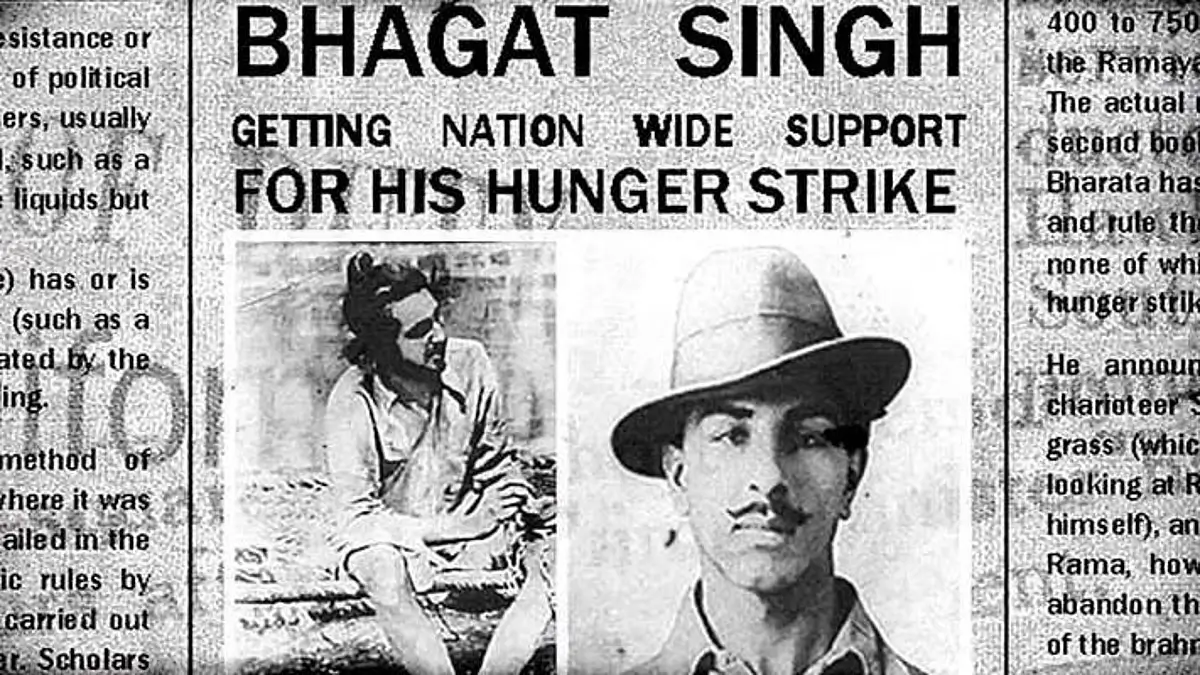
Img Src : National Herald
In 1926, Bhagat Singh became one of the principal organisers of the Naujawan Bharat Sabha, a youth organisation that promoted anti-colonial awareness, communal unity and revolutionary ideas.
He later became associated with the Hindustan Republican Association, which was reorganised as the Hindustan Socialist Republican Association, or HSRA, in 1928. The organisation believed that India’s freedom should lead to a society free from exploitation and inequality.
The death of Lala Lajpat Rai became a major turning point in Bhagat Singh’s life. Rai had suffered serious injuries during a protest against the Simon Commission in Lahore and died on 17 November 1928.
The revolutionaries planned to target James A. Scott, the police officer believed to have ordered the lathi charge. However, due to mistaken identity, Assistant Superintendent of Police John P. Saunders was shot dead in Lahore on 17 December 1928. Bhagat Singh and Rajguru were involved in the shooting, while Chandrashekhar Azad helped protect their escape.
During the escape, Head Constable Channan Singh pursued the revolutionaries and was shot dead by Azad. These events later became central to the Lahore Conspiracy Case.
Following Saunders’ assassination, Lahore was placed under strict police surveillance. Bhagat Singh changed his appearance by cutting his hair and shaving his beard - an important decision for someone raised in a Sikh family.
With the help of Durga Bhabhi, whose real name was Durgawati Devi, he escaped Lahore in disguise. She travelled with him while pretending to be his wife, and Rajguru accompanied them as their servant.
This carefully planned escape helped Bhagat Singh avoid immediate arrest and demonstrated the role women also played in the revolutionary movement.
On 8 April 1929, Bhagat Singh and Batukeshwar Dutt threw two low-intensity bombs inside the Central Legislative Assembly in Delhi.
The action was planned as a protest against the Public Safety Bill and the Trade Disputes Bill, which the revolutionaries believed were designed to restrict political activity and weaken workers’ movements.
The purpose was not to carry out a mass attack. The bombs were thrown in an area chosen to limit casualties, although some people suffered minor injuries. After the explosion, Bhagat Singh and Dutt raised revolutionary slogans and distributed leaflets carrying the message “To Make the Deaf Hear.”
Most importantly, they did not try to escape. They stayed at the scene and allowed themselves to be arrested because they wanted to use the courtroom as a platform to explain their political ideas.
The Bhagat Singh history often focuses on guns, bombs and courtroom statements. However, his intellectual journey was equally important.
Bhagat Singh believed that independence should not simply replace British rulers with Indian rulers. He wanted a society where workers, farmers and ordinary citizens could live with dignity.
His association with the HSRA reflected his growing interest in socialism. He opposed exploitation based on class, wealth and power. For him, revolution meant a complete change in the social and economic structure - not merely a change of government.
Bhagat Singh openly identified himself as an atheist. In his essay “Why I Am an Atheist,” written in jail in 1930, he explained that his position developed through questioning, reading and independent thought.
His atheism was not simply a rejection of religion for the sake of rebellion. It was connected to his belief that people should think critically instead of accepting ideas without examination.
The essay remains one of his most widely discussed writings because it reveals the thoughtful and questioning side of the revolutionary.
After his arrest, Bhagat Singh and other prisoners demanded better treatment for Indian political prisoners. Their demands included improved food, access to books, newspapers and clothing suitable for prisoners.
The hunger strike drew public attention, especially after fellow revolutionary Jatin Das died following a prolonged fast in September 1929. The protest turned the prison into another site of resistance and showed that Bhagat Singh’s struggle was not limited to armed action.
Bhagat Singh, Rajguru and Sukhdev were sentenced to death in the Lahore Conspiracy Case. They were executed at Lahore Central Jail on 23 March 1931.
They were only in their early twenties, but their courage and clarity of purpose had already made them national figures. The date is now observed as Shaheed Diwas, while the Hussainiwala National Martyrs Memorial in Punjab remains closely associated with their memory.
The legacy of Shaheed Bhagat Singh goes beyond patriotic slogans. He continues to inspire conversations about freedom, equality, secularism, youth participation and the responsibility to question injustice.
His story also reminds us that revolution is not always about dramatic action. Sometimes, it begins with reading, asking difficult questions and refusing to accept an unfair system as permanent.
Several films have introduced Bhagat Singh’s life and ideas to new generations:
The most powerful part of the Bhagat Singh history is not only how he died, but how consciously he lived & his journey as a freedom fighter. He understood the risks of his choices, studied the world around him and continued to question power until the end.
That is why his name still carries meaning. He was not simply a symbol of sacrifice. He is a reminder that freedom demands courage, awareness and the willingness to imagine a more equal society.
Everything you need to know
Bhagat Singh was an Indian revolutionary, writer and political thinker who fought against British colonial rule and was executed on 23 March 1931.
Bhagat Singh is remembered for his courage, revolutionary activities, political ideas and sacrifice for India’s freedom.
Bhagat Singh and Batukeshwar Dutt carried out the bombing on 8 April 1929 to protest British policies and make their revolutionary message heard.
Yes. Bhagat Singh believed in socialism and openly identified himself as an atheist. His essay Why I Am an Atheist explains his views on religion and independent thinking.
Bhagat Singh was executed alongside Rajguru and Sukhdev on 23 March 1931, a day remembered as Shaheed Diwas.




Sep 19, 2026
TUI Staff
Sep 19, 2026
TUI Staff
Sep 19, 2026
TUI Staff
Sep 19, 2026
TUI Staff
Sep 19, 2026
TUI Staff
Sep 17, 2026
TUI Staff
Sep 17, 2026
TUI Staff

Stay informed with independent, fact-checked journalism on technology, environment, government, economy and more. India’s most trusted digital news platform.




Comments (0)
Be the first to comment!