
Inside Tawang Monastery : India's Largest Monastery in India Hidden 10,000 Feet in the Himalayas
Where Himalayan Heights Meet Centuries Of Buddhist History
 IN
Tue, Oct 27, 2026 | 01:16 PM IST


What if we told you that one of India’s most extraordinary monasteries is sitting quietly at 10,000 feet, surrounded by snow-covered Himalayan peaks, and that its origin story involves a missing horse?
Welcome to Tawang Monastery, a place where the mountains seem to swallow the noise of the outside world.
Perched above Tawang Valley in Arunachal Pradesh, this centuries-old Buddhist monastery is more than an architectural marvel. It is a living centre of faith, Monpa culture, ancient scriptures and stories that have travelled across generations.
Founded in 1680 - 81 by Merak Lama Lodre Gyatso at the request of the 5th Dalai Lama, it is officially described by Incredible India as the largest monastery in India. The three-storey complex sits above 10,000 feet and is surrounded by a 282-metre-long compound wall with 65 residential buildings.
And honestly, those numbers are impressive. But the stories behind them are even better.
Before getting into the legends, here is the quick version.
Traditional name: Gaden Namgyal Lhatse
Location: Tawang, Arunachal Pradesh
Altitude: Over 10,000 feet
Founded: 1680–81
Founder: Merak Lama Lodre Gyatso
Buddhist tradition: Gelug school of Tibetan Buddhism
Complex: Three storeys, 65 residential buildings
Compound wall: 282 metres / 925 feet
Library: Houses important Buddhist scriptures, including Kangyur and Tengyur
These details are documented by Incredible India, while the supplied reference article also records the monastery’s architecture, library and institutional history.
The location is half the magic.
Tawang Monastery stands on a hill overlooking the Tawang Valley, surrounded by the dramatic landscape of the Eastern Himalayas. At more than 10,000 feet, the setting gives it an almost surreal quality - clouds roll through the mountains, prayer flags move with the wind and the valley stretches far below.
But its location was not simply chosen for the view.
According to traditional accounts, Merak Lama Lodre Gyatso was searching for the right place to establish a monastery after receiving instructions from the 5th Dalai Lama. The monastery eventually became an important religious and cultural institution for the Monpa community.
The official Incredible India account identifies Tawang as the largest monastery in India, while also highlighting its importance as a centre of Mahayana Buddhism.
This is where the story gets interesting.
According to the most prominent traditional origin story, Merak Lama Lodre Gyatso had been searching for a suitable location for the monastery. After failing to find the right spot, he entered a cave and prayed for divine guidance.
When he emerged, his horse was nowhere to be found.
He went looking for it and eventually discovered the animal grazing on a mountain called Tana Mandekhang. The lama interpreted the horse's appearance as an auspicious sign and decided that this was where the monastery should stand.
Construction began in the latter part of 1681.
This horse story is officially recorded by Incredible India as the most prominent of three traditional origin stories associated with the monastery. It should, however, be understood as a religious tradition or local legend rather than independently verified history.
The supplied reference material also documents the horse legend alongside two other origin traditions.
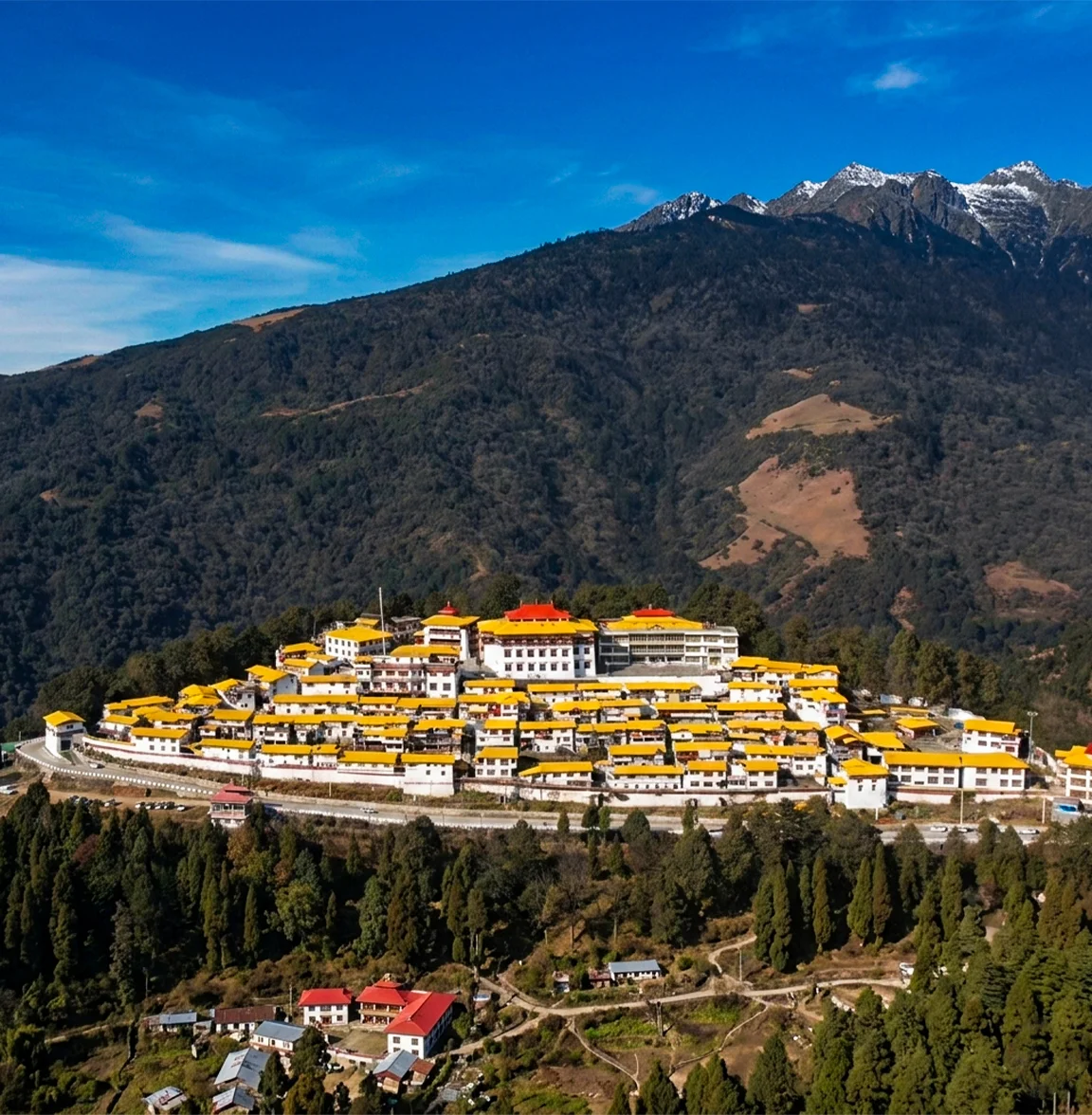
Img Src : India On Wheelz
The first thing visitors encounter is the colourful Kakaling, the monastery's distinctive entrance structure.
Shaped somewhat like a small hut, the gate has stone masonry walls and a roof decorated with mandalas. Inside, murals depict Buddhist divinities and saints.
Beyond it, the monastery opens into a large complex containing prayer spaces, residential quarters and other facilities that support monastic life.
The scale is striking, but so are the details. Traditional artwork, murals and Buddhist symbolism appear throughout the complex, creating the feeling that you are walking through a living piece of Himalayan history rather than a museum frozen in time.
The supplied reference article similarly records the Kakaling, mandalas, murals, residential areas and educational facilities within the complex.
At the heart of the monastery is the Dukhang, or main prayer hall.
The hall is filled with Buddhist imagery, colourful murals and religious artwork. A large gilded Buddha image dominates the prayer space, while traditional thangkas add to the visual richness.
One important artwork associated with the Dukhang is a thangka of Palden Lhamo, a Buddhist protector deity.
Several fascinating stories are associated with the artwork and monastery interiors. However, these accounts come from traditional beliefs and should not be presented as established historical facts. The supplied reference article records these traditions in detail.
Perhaps the most fascinating part of the monastery is not something you see from outside.
It is the knowledge preserved within its library.
The library houses important Buddhist scriptures, including Kangyur and Tengyur, along with several other texts. Incredible India also notes that the monastery has a printing press where religious books are produced using locally made paper and wooden printing blocks.
This traditional wooden block printing technique is more than an old-fashioned printing method. It represents a continuing link between Buddhist scholarship and the craftsmanship of the region.
The supplied reference material also describes the manuscript collection, printing process, locally made paper and wooden blocks, while noting concerns around the preservation of some texts.
For a place that is often photographed for its golden roofs and Himalayan views, its library may actually be one of its greatest treasures.
Tawang's modern history is inseparable from the journey of the 14th Dalai Lama.
In March 1959, the Dalai Lama escaped Tibet and entered India on 31 March 1959, according to the official chronology published by his office.
Tawang became an important part of that historic journey.
The Dalai Lama later returned to the region in 2009 and again visited Tawang in 2017, when he gave Buddhist teachings to a large gathering. His official website documents both visits.
This connection adds another layer to the monastery's importance. It isn't simply a monument from the past; it remains connected to the wider history of Tibetan Buddhism and the Himalayan region.
It is impossible to understand Tawang completely without acknowledging its geopolitical history.
The region became particularly significant during the colonial period and the boundary discussions surrounding the 1914 Simla Convention. Tawang later became a major theatre during the 1962 India-China War.
That history sits alongside the monastery's spiritual identity, making the region much more complex than a postcard-perfect Himalayan destination.
The supplied reference material covers the monastery's historical evolution, its relationship with wider political developments and the 1962 conflict.
One of the biggest mistakes a traveller can make is treating the monastery like an ancient monument.
It isn't.
Tawang continues to be a living religious and cultural centre. Monks study, pray and participate in religious ceremonies, while Buddhist traditions remain deeply connected to the Monpa community.
Festivals such as Torgya and Losar bring colour and movement to the region. Torgya, in particular, is known for its elaborate masked dances performed by monks.
The Tawang district administration identifies these traditions as an important part of the cultural identity of the region.
Reaching Tawang is an experience in itself.
The journey takes you through some of Arunachal Pradesh's most dramatic landscapes, including routes around Sela Pass, while attractions such as Nuranang Falls, Sangetsar Lake and Urgelling Monastery can be added to a wider Tawang itinerary. Incredible India lists these among the region's major attractions.
Incredible India currently lists the monastery's visiting hours as 7 AM to 7 PM. Because weather and local conditions can affect access in a high-altitude region, travellers should verify timings before setting out.
And once you arrive, remember one simple thing: this is an active place of worship. Dress respectfully, follow photography restrictions and avoid disturbing prayers or religious ceremonies.
The easiest way to describe Tawang is with a superlative: the largest monastery in India.
But that description barely scratches the surface.
There is the 300-year-old story of the missing horse. There are ancient scriptures and religious books. There is the quiet craft of wooden block printing, colourful Buddhist art, the Monpa cultural connection and the footsteps of one of the world's most recognisable Buddhist leaders.
And then there are the mountains.
Maybe that is why Tawang Monastery feels different from a monument you simply tick off a travel list.
You don't just come here to see an old monastery.
You come here to experience a place where faith, history, culture and the Himalayas exist under the same sky.
Everything you need to know
Tawang Monastery is famous for being the largest monastery in India, its centuries-old Buddhist heritage, Himalayan setting, scriptures and distinctive architecture.
Tawang Monastery is located in Tawang, Arunachal Pradesh, at an elevation of more than 10,000 feet in the eastern Himalayas.
Tawang Monastery was founded in 1680–81 by Merak Lama Lodre Gyatso at the behest of the 5th Dalai Lama.
According to the traditional origin story, the founder's horse disappeared while he was searching for a site. He later found it grazing at Tana Mandekhang and took this as an auspicious sign for building the monastery there.
Visitors can explore its prayer halls, Buddhist artwork, library, scriptures, traditional printing tradition and the distinctive Kakaling entrance, while respecting the monastery's active religious practices.

Oct 26, 2026
TUI Staff
Oct 26, 2026
TUI Staff
Oct 26, 2026
TUI Staff
Oct 21, 2026
TUI Staff
Oct 26, 2026
TUI Staff
Oct 26, 2026
TUI Staff
Oct 25, 2026
TUI Staff
Oct 23, 2026
TUI Staff

Stay informed with independent, fact-checked journalism on technology, environment, government, economy and more. India’s most trusted digital news platform.

Comments (0)
Be the first to comment!