
Netaji Subhash Chandra Bose International Airport: From 1924 to the Future of Indian Aviation
A century of aviation history, growth and transformation
 IN
Sat, Sep 19, 2026 | 07:33 PM IST
IN
Sat, Sep 19, 2026 | 07:33 PM IST


From a modest airfield in Dum Dum to one of eastern India’s most important aviation gateways, Kolkata’s airport has spent more than a century adapting to changing technology, rising passenger demand and new expectations around travel.
Established in 1924, the airport has witnessed the growth of commercial aviation, jet aircraft, air cargo and modern passenger travel. Today, Netaji Subhash Chandra Bose International Airport represents both Kolkata’s aviation heritage and its ambitions for the future.
The airport began operations in 1924 as Dum Dum Airport, when Indian aviation was still developing. Kolkata was already a major commercial and administrative centre, making the location strategically important for connectivity across eastern India.
In 1929, the Bengal Flying Club began operating from the airfield. Over the following decades, the airport became part of India’s expanding commercial aviation network. The commissioning of an air cargo complex in 1975 further strengthened its role in trade and logistics.
In January 1995, the airport was renamed in honour of Netaji Subhas Chandra Bose. By December 2024, it had completed 100 years of service, marking a century shaped by changing aircraft, technology and passenger volumes.
For many travellers, the older identity remains familiar, and searches for Dumdum Airport still point to the same historic aviation hub.
By the 2000s, India’s aviation market was expanding rapidly. Low-cost airlines brought flying within reach of more travellers, while business, tourism and migration increased demand for domestic and international routes.
Kolkata Airport faced growing pressure on its existing terminals. Congestion, limited space and the need for smoother passenger movement made a major upgrade necessary.
According to the Ministry of Civil Aviation, the integrated terminal project was sanctioned in 2008 at an estimated ₹1,942.51 crore. The revised project cost reached ₹2,325 crore in 2012.
The new integrated passenger terminal was inaugurated on January 20, 2013, and became operational on March 10. It brought domestic and international operations under one roof, replacing separate facilities.
With spacious interiors, modern baggage systems, improved check-in areas and better passenger amenities, the terminal marked a major shift in the traveller experience.
Behind every flight is a network of runways, taxiways, aircraft parking bays, navigation systems, baggage facilities, security infrastructure and ground services.
The airport has two parallel runways. Airports Economic Regulatory Authority documentation lists the main runway, 01R/19L, at about 3,627 metres and the secondary runway, 01L/19R, at around 2,839 metres. The main runway can support wide-body aircraft.
Limited separation between the runways prevents fully independent simultaneous operations. Expansion is also affected by land and surrounding infrastructure constraints, showing why airport development requires careful coordination between safety, engineering and urban planning.
The integrated terminal was originally designed with a built-up area of roughly 180,000 square metres and annual handling capacity of around 20 million passengers. Original specifications included 104 check-in counters, 18 aerobridges, immigration and customs facilities, baggage conveyor systems, escalators and travelators.
These figures describe the original design and should not automatically be treated as present operational capacity, which can change with upgrades and traffic patterns.
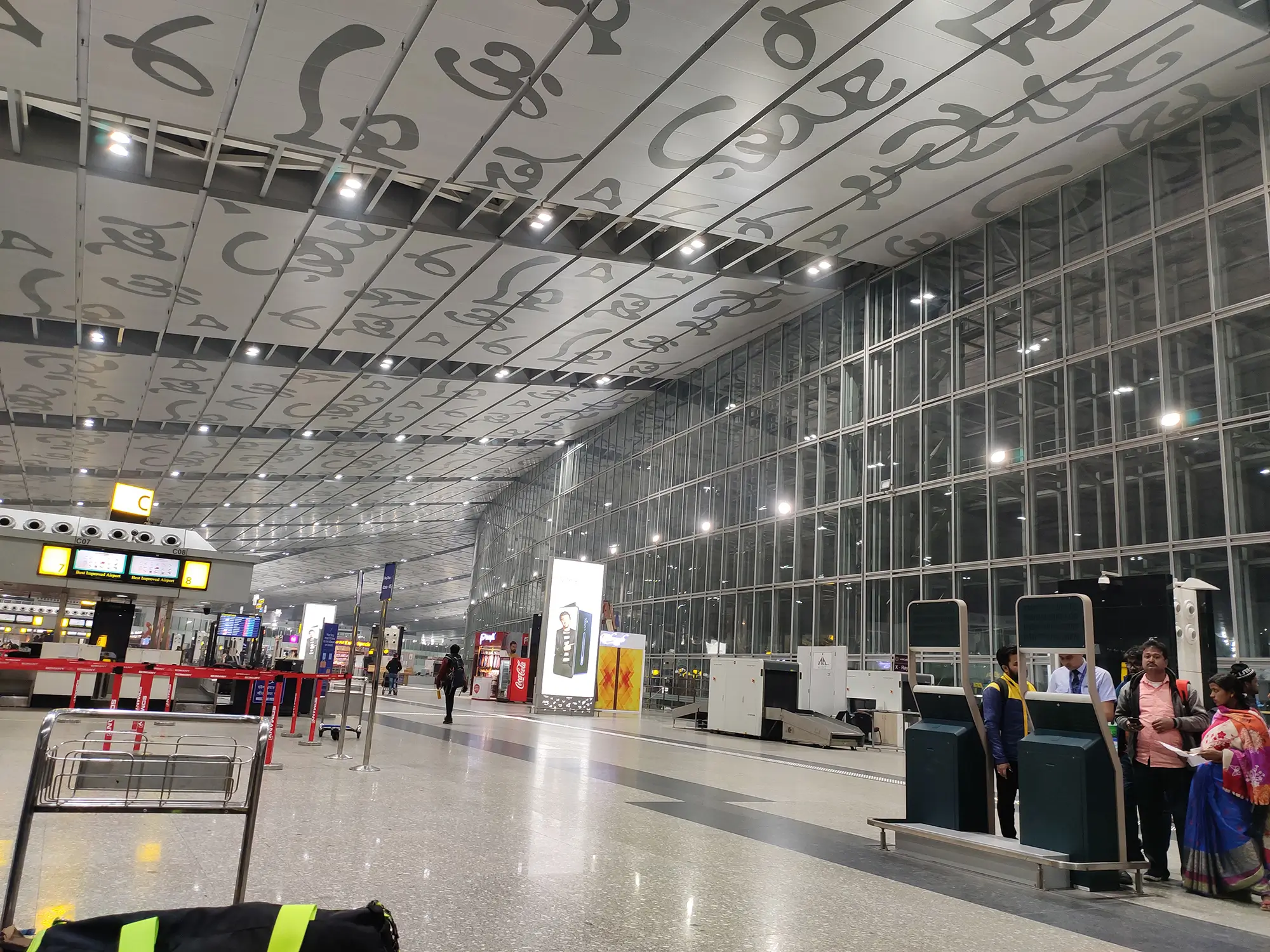
Img Src : Wikimedia Commons
Modern airports are judged not only by runways and buildings but also by how easy they are to use. Clear directions, responsive staff, accessible facilities, reliable information and efficient baggage handling can shape a traveller’s journey.
In September 2026, the airport became part of the 24-day Yatri Sewa Abhiyan, a passenger service scheduled from September 17 to October 10. The initiative focused on service quality and passenger comfort.
Such campaigns are particularly important for senior citizens, families with children, first-time flyers and passengers needing additional assistance. Their value depends on whether better service becomes part of everyday airport operations.
The airport has also received recognition for passenger experience. In 2014, it won an Airports Council International Airport Service Quality Award for Best Improved Airport in the Asia-Pacific region, reflecting improvements in passenger satisfaction between 2012 and 2013.
An airport journey begins before check-in. Road access, taxis, buses, suburban rail and metro connections influence how easily travellers can reach the terminal.
The opening of the Noapara–Jai Hind Airport section of Kolkata Metro’s Yellow Line in August 2025 strengthened public transport access. Better metro connectivity gives passengers another option beyond road travel and can reduce uncertainty during busy periods.
Improved city links are increasingly important as Kolkata expands. A major aviation hub works best when passengers can move efficiently between the airport, business districts, residential areas and surrounding regions.
Even today, many people use the search term Dumdum Airport when looking for directions or airport information, reflecting how strongly the older name remains associated with the location.
The future of Netaji Subhash Chandra Bose International Airport will depend on how effectively it responds to growing traffic, evolving airline networks and higher service expectations.
Priorities may include improving terminal efficiency, strengthening airside infrastructure, upgrading operational systems and expanding passenger facilities. Major development will also have to account for land availability, safety requirements, demand and financial viability.
West Bengal’s proposed Kalyani greenfield airport adds another dimension to the region’s aviation plans. It is separate from improvement work at the existing airport, but both developments reflect a wider push to strengthen air connectivity in eastern India.
After more than a century of operations, Netaji Subhash Chandra Bose International Airport is more than a historic airfield. It is a critical transport gateway connecting people, businesses and communities across India and the world.
Its story shows how aviation infrastructure must continually evolve. The challenge ahead is to preserve that legacy while building a more efficient and passenger-friendly airport for the next generation.
Everything you need to know
No FAQs available for this blog.






Sep 18, 2026
TUI Staff
Sep 17, 2026
TUI Staff
Sep 11, 2026
TUI Staff
Sep 19, 2026
TUI Staff
Sep 19, 2026
TUI Staff
Sep 17, 2026
TUI Staff
Sep 17, 2026
TUI Staff

Stay informed with independent, fact-checked journalism on technology, environment, government, economy and more. India’s most trusted digital news platform.




Comments (0)
Be the first to comment!