
Delhi Government Wants 30% Electric School Buses by 2030: But Can Schools Afford the ₹70 Lakh Switch?
Delhi’s green school-bus dream faces a costly reality.
 IN
Mon, Oct 19, 2026 | 01:44 PM IST
IN
Mon, Oct 19, 2026 | 01:44 PM IST


Sending your kids in an electric school bus!!
Well.. that could become increasingly common in Delhi in near future.
Under the Delhi EV Policy 2026, schools have been given a phased target to shift part of their bus fleets to electric vehicles. The requirement rises from 10% in the first two years to 20% in the third year and 30% by March 31, 2030. It applies to the entire school-bus fleet, including buses that are owned, leased or hired.
On paper, it sounds like a straightforward step towards cleaner air.
But there is a rather large number sitting behind this green transition.
Around ₹65–70 lakh.
That is the indicative price quoted by EV industry publication EVreporter for a 9-metre electric bus with a 150 kWh battery, compared with around ₹35–40 lakh for a comparable diesel school bus.
So the real question is not simply whether Delhi should electrify its school buses.
It is: who can afford to make the switch?
The government's timeline is gradual rather than an overnight replacement programme.
According to the notified policy:
10% of the school-bus fleet must be electric by the end of Year 2.
20% must be electric by the end of Year 3.
30% must be electric by March 31, 2030.
There is another important detail. The target applies whether buses are owned, leased or hired by schools. The Education Department is responsible for ensuring compliance and integrating the requirement into school recognition and affiliation processes.
That means a school cannot necessarily sidestep the transition simply because a private contractor operates its buses.
The shift will affect the wider school transport ecosystem.
The biggest reason is the battery.
A 9-metre diesel school bus is estimated by EVreporter at around ₹35–40 lakh, while a comparable electric model with a 150 kWh battery is around ₹65–70 lakh.
That creates an upfront difference of roughly ₹25–35 lakh per bus.
For a school operating several buses, the numbers can quickly become substantial.
And buying the vehicle is not necessarily the end of the spending. Depending on the operating model, schools or transport contractors may also need to account for charging equipment, electrical upgrades, parking arrangements and maintenance support.
This is where the economics of EV adoption become more complicated than simply comparing a diesel bill with an electricity bill.
An electric bus has a major advantage once it is on the road.
It can potentially cost less to operate because electricity is generally cheaper than diesel per kilometre, while electric drivetrains have fewer moving parts and can require less routine maintenance.
There is also a particularly useful feature of school transport: predictability.
Unlike taxis or delivery vehicles, a school bus normally follows a fixed route and schedule.
A recent Hindustan Times report quoting World Bank transport specialist Laghu Parashar said many school buses operate around 50–60 km a day, with long idle periods that can provide time for charging.
That makes the Electric school bus a technically attractive candidate for electrification.
But low utilisation creates another problem.
If a bus travels fewer kilometres each day, it also saves less on fuel. That can make it take longer to recover the higher purchase price.
For private operators, therefore, lifetime savings alone may not be enough. The monthly loan payment and cash flow from the first day matter too.
Here's another question parents may not have considered.
Where will these multiple electric school buses get charged?
A charging setup can require more than simply installing a wall-mounted charger. Schools may need adequate electricity capacity, suitable parking, cabling and other electrical infrastructure.
However, school buses have one big advantage: they spend several hours parked.
EVreporter says a 60 kW charger can replenish a school bus overnight, while a 120 kW charger can do so considerably faster. It also notes that one charger can potentially serve multiple buses if their schedules are staggered.
Delhi's policy itself recognises the infrastructure challenge. It assigns Delhi Transco Limited a central role in planning charging infrastructure and calls for demand aggregation, load assessment and grid-readiness planning.
So it is important to consider whether the right charging capacity is available or not.
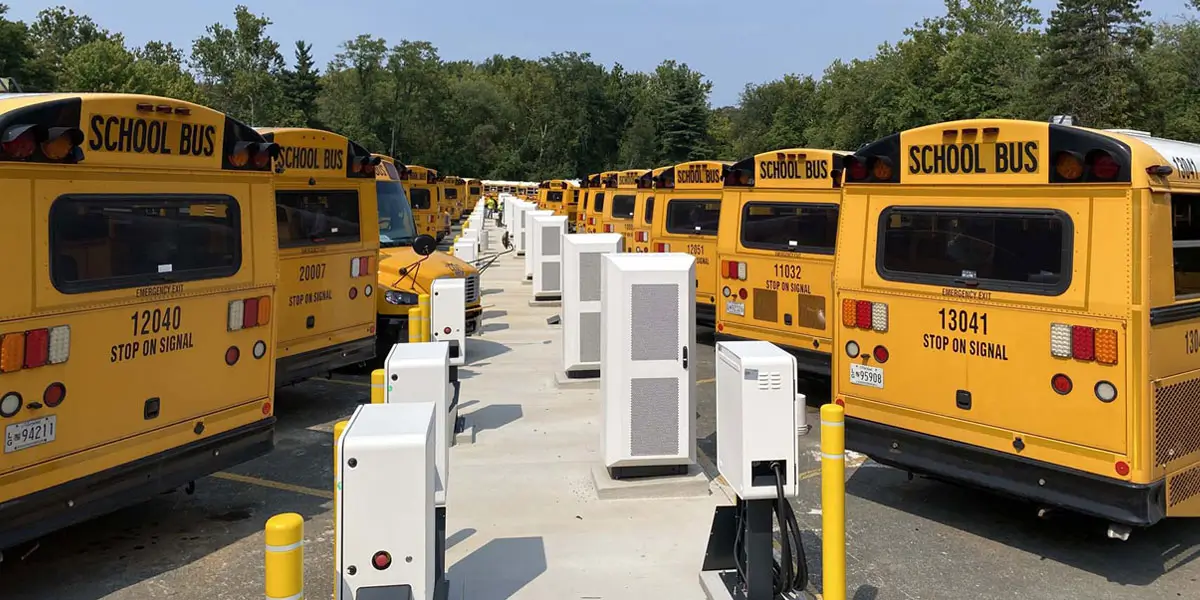
Img Src: Clean Mobility Shift
This may be one of the more practical & sustainable ways forward.
Not every school needs to build its own charging depot.
Several schools or transport operators in the same locality could potentially share charging facilities. That could spread infrastructure costs and improve charger utilisation.
A 2026 CSTEP study on school-bus electrification, involving nearly 100 schools in Thiruvananthapuram and Kochi, specifically recommends demand aggregation and shared charging infrastructure.
The same research examined models such as outright purchase, battery leasing, dry leasing, gross-cost contracts and retrofitting. It found that leasing-based models and gross-cost contracts can improve affordability for schools with limited capital.
That could be particularly relevant in Delhi.
Instead of asking a school to find ₹70 lakh upfront, a service or leasing model could convert a large capital expense into a more predictable operating payment.
This is perhaps the question families will care about most.
There is no basis to say that Delhi's EV policy automatically means higher school-bus fees.
But the possibility cannot simply be ignored.
If operators face substantially higher upfront costs, financing charges and infrastructure expenses, they will need to recover those costs somehow. Depending on the contract between schools and transport providers, some of that burden could eventually affect transport charges.
That is why the transition needs affordable financing and transparent contracts.
The CSTEP study recommends options such as green loans, concessional finance, CSR funding and other public-development funding mechanisms to reduce the capital barrier.
The goal should be simple: cleaner transport without making safe school transport unaffordable for families.
Probably not.
A bus travelling 50 km a day has very different requirements from one covering 100 km or more.
This is where purpose-built electric buses could make a difference.
Industry experts have argued that school transport needs vehicles with right-sized batteries and configurations designed around school routes, rather than simply adapting buses designed for intensive city operations.
CSTEP's research similarly suggests that schools should assess electrification based on actual route distances and operating conditions. Its assessment indicates that routes exceeding 80 km per day should actively evaluate electrification, while shorter routes need a closer look at the economics.
In other words, one EV strategy may not fit every school.
Replacing every existing bus with a brand-new vehicle isn't the only possibility.
Retrofitting suitable diesel buses with electric powertrains could offer another pathway, particularly for vehicles whose chassis still have useful life.
But it comes with its own questions around certification, safety, battery integration, vehicle eligibility and long-term reliability.
CSTEP identifies retrofitting as a potential option for ageing fleets, alongside leasing and other procurement models.
So Delhi's transition could eventually involve a combination of new electric buses, leased vehicles and carefully assessed retrofits.
The policy isn't focused only on buying EVs.
It also addresses the ecosystem needed to support them.
The Delhi electric vehicle policy provides for public and community charging infrastructure, assigns Delhi Transco Limited responsibility for system-level charging planning and requires assessment of future electricity-load requirements. It also provides for battery collection and recycling systems through authorised entities.
The policy further says EV manufacturers should work towards stabilising EV costs and ensuring adequate supply.
That matters because the success of EV buses in India will depend not just on how many vehicles are sold, but on whether the supporting ecosystem grows alongside them.
Before making the switch, schools and their transport partners should ask:
These questions may sound mundane, but they will determine whether electrification works beyond the headline announcement.
Yes, potentially - but the transition cannot depend on mandates alone.
Delhi has several things working in its favour: predictable school routes, long parking periods, falling technology costs and growing interest from manufacturers.
But the upfront price remains a serious hurdle.
The ₹65–70 lakh figure is an industry estimate, not a universal price tag. As more manufacturers enter the segment and develop school-specific models, costs could change. EVreporter notes that several major OEMs are already offering electric buses in the 9-metre category.
The bigger challenge will be making the entire equation work:
Bus + battery + financing + charging + electricity + maintenance + affordability.
Delhi has already set the destination for electric vehicles.
Now it needs to build a road that schools, operators and parents can realistically travel on.
Because cleaner school transport should not become a luxury. It should become a practical upgrade that more children can benefit from.
Everything you need to know
Under the Delhi EV Policy 2026, schools must progressively electrify their bus fleets, reaching 30% electric buses by March 31, 2030.
An indicative EVreporter estimate puts a 9-metre electric school bus with a 150 kWh battery at around ₹65–70 lakh, compared with approximately ₹35–40 lakh for a comparable diesel bus.
Not automatically. However, higher vehicle and infrastructure costs could put pressure on school transport fees depending on how schools and operators finance the transition.
Schools may install their own charging infrastructure, while shared charging facilities and government or public-transport depots could also help meet charging requirements.
School buses follow predictable routes and spend several hours parked between morning and afternoon trips. This gives them a useful window for charging while potentially reducing fuel and maintenance costs.



Oct 14, 2026
TUI Staff
Oct 08, 2026
TUI Staff
Oct 06, 2026
TUI Staff
Oct 19, 2026
TUI Staff
Oct 17, 2026
TUI Staff
Oct 17, 2026
TUI Staff
Oct 15, 2026
TUI Staff

Stay informed with independent, fact-checked journalism on technology, environment, government, economy and more. India’s most trusted digital news platform.




Comments (0)
Be the first to comment!