
Sealdah Railway Station: The 164-Year Journey of Kolkata’s Railway Lifeline
164 years of history powering Kolkata’s daily journeys
 IN
Tue, Oct 06, 2026 | 03:09 PM IST
IN
Tue, Oct 06, 2026 | 03:09 PM IST


Every day, Sealdah Railway Station sees the kind of rush that can make a million journeys look like one continuous movement. Trains arrive, platforms fill, commuters hurry towards exits and another crowd is already waiting to get in.
But Sealdah is much more than a busy railway station. For 164 years, it has been closely tied to Kolkata’s growth, Bengal’s changing geography, Partition-era migration and the evolution of public transport.
Today, as Sealdah crosses the million-passenger mark and undergoes a fresh wave of modernisation, its story is entering another chapter.
The story of Sealdah Railway Station began in 1862, when the Eastern Bengal Railway was expanding rail connectivity from Calcutta into eastern Bengal. The first section of the network reached Champahati in January that year, followed by Port Canning and Ranaghat. Sealdah was formally opened to the public on 2 December 1862, with a modest tin-roofed station room at the Calcutta end.
The Sealdah Railway Station got a proper building in 1869, designed by Walter Glanville. What started as an important railway point gradually became part of a much larger network connecting Calcutta with towns and regions across Bengal.
Electrification came in 1960, marking another major shift in Sealdah’s journey. Over time, suburban trains became central to its identity, turning the station into an indispensable gateway for people travelling into Kolkata every day.
There is another chapter of Sealdah’s history that many commuters may not know.
The station once had a tram terminus, and the first horse-drawn tram service in Kolkata began from Sealdah towards Armenian Ghat. Tram routes from the area eventually connected places including Rajabazar, Howrah, the High Court, Dalhousie Square, Park Circus and Dharmatala.
The tram terminus was demolished in 1981 as the Sealdah flyover was constructed. Tram services through the area continued in different forms for years before finally disappearing in 2019. Today, the rounded entrance of Sealdah Metro Station stands on the site of the former tram terminus.
It is a striking reminder of how Kolkata’s transport story has repeatedly reinvented itself - from horse trams to electric trains and now underground metro.
Perhaps the most painful chapter in Sealdah’s history came after the Partition of 1947.
The division of Bengal forced millions of people to leave their homes. For many refugees arriving from East Pakistan, Sealdah was not simply a railway station. It became a temporary home, transit point and place of uncertainty.
Historian Anwesha Sengupta’s research on Bengal’s Partition refugees documents how Sealdah’s platforms remained crowded with Bengali Hindu refugees from East Pakistan from the late 1940s into the following decades. Some stayed for days; others remained for months or even years.
That history is still relevant today.
In August 2026, the Union Culture Ministry announced plans for a memorial at Sealdah Railway Station dedicated to the victims of Partition. Indian Railways has allotted space within the station premises, and the proposed memorial is expected to take an abstract form representing the suffering of those displaced by Partition. It is specifically intended to remember people from West Bengal and what was then East Pakistan.
The choice of Sealdah is significant. A station that once received people forced to leave their homes will now have a permanent reminder of what that journey meant.
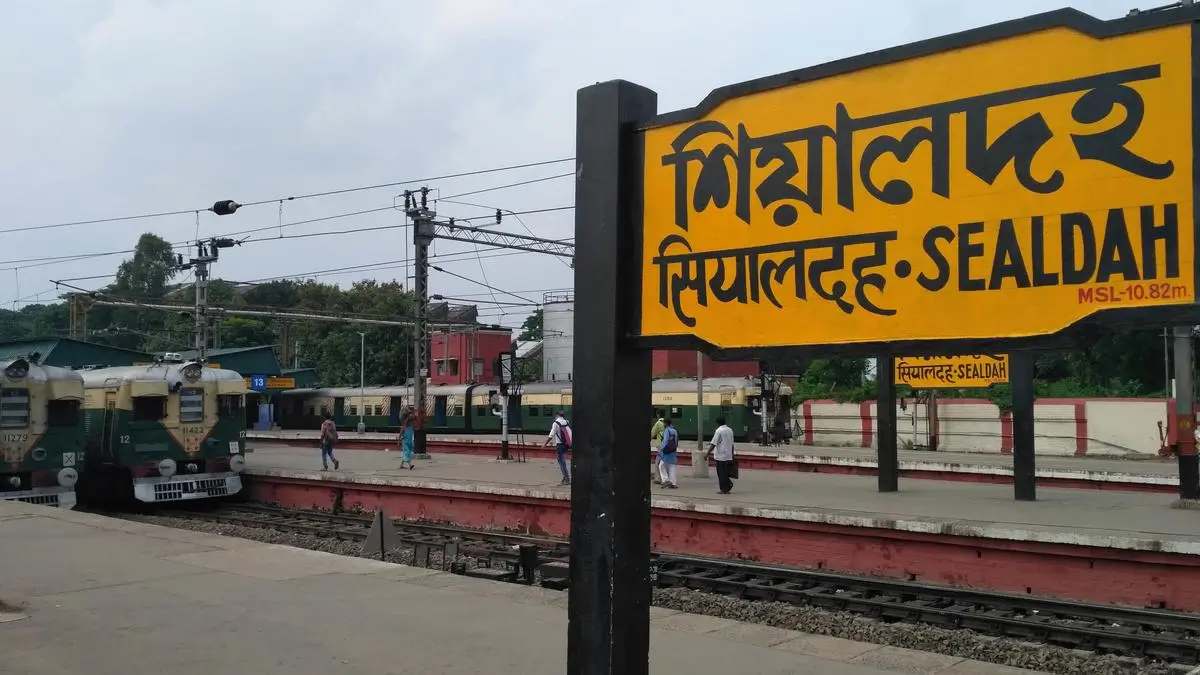
Img Src : Indian Rail Info
Today, Sealdah is effectively divided into three major terminal sections: Sealdah North, Sealdah Main and Sealdah South.
The North terminal covers platforms 1–5 and serves a wide suburban network stretching towards places such as Bongaon, Naihati, Ranaghat, Krishnanagar and Kalyani.
The Main terminal, platforms 6–14, handles both suburban and long-distance services. It connects Kolkata with destinations across eastern, northern and north-eastern India.
The South terminal, platforms 15–21, primarily handles suburban services towards places including Canning, Diamond Harbour, Budge Budge and Namkhana.
Together, these networks make Sealdah one of the most important transport lifelines for Kolkata and its surrounding regions.
Sealdah’s importance is perhaps easiest to understand through one number: more than one million daily passengers, according to a recent 2026 report on the Sealdah Division.
But the passenger growth has come alongside a significant expansion in Indian railway services.
The Sealdah Division has added:
For the average commuter, these numbers translate into something much simpler: more trains, more choices and greater capacity on a network that millions depend upon.
The suburban train is no longer being defined only by affordability and frequency. Comfort is becoming part of the conversation too.
Air-conditioned local trains have been introduced on busy suburban routes, with students, tourists and people travelling for healthcare among the passengers expected to benefit.
The latest expansion is particularly notable. From 20 August 2026, the Sealdah–Barasat AC local has been extended up to Bangaon, strengthening connectivity along one of the region’s major suburban corridors. The service operates six days a week, Monday to Saturday, and uses 12-coach AC trains.
For a city known for hot and humid summers, an air-conditioned local is more than a novelty. It signals a gradual shift towards making mass transit more comfortable without taking away its mass character.
Handling a million-plus passengers is not only about running more trains. It is also about moving people through the station without turning every rush hour into a bottleneck.
That is where recent passenger-focused upgrades come in.
The new Prafulla Dwar, described as Sealdah’s fourth gateway, is intended to spread passenger movement across the terminal. It includes booking counters, train indication boards and Automatic Ticket Vending Machines. Dedicated ramps have also been added to improve accessibility for passengers with disabilities.
A Platform Nomination System has also been introduced to make it easier for passengers to know where their trains will depart.
These may sound like small changes, but at a station of Sealdah’s scale, reducing confusion and unnecessary crowd movement can make a real difference.
Sealdah’s transformation is also about how different modes of transport meet.
The underground Sealdah Metro Station, part of Kolkata Metro’s Green Line, adjoins the railway station and occupies the site of the former tram terminus.
The result is a more connected transport ecosystem: suburban railway, Metro, road transport and last-mile services increasingly converge around the same location.
Sealdah is also among the stations identified under the Amrit Bharat Station Scheme, the national programme aimed at modernising railway stations with improved passenger amenities, accessibility and circulation.
Sealdah still sends long-distance trains across the country, from the Darjeeling Mail and Rajdhani to services connecting North Bengal, Delhi, Assam, Bihar and other regions.
Yet its greatest importance remains closer to home.
It carries workers to jobs, students to colleges, patients towards healthcare, families towards their destinations and thousands of people between Kolkata and the suburbs every single day.
That is what makes Sealdah Railway Station more than an infrastructure project.
It is a living record of Bengal’s journey.
It began with a modest railway room in 1862. It witnessed the expansion of colonial-era railways, the rise of trams, the electrification of suburban trains and the upheaval of Partition. It became a lifeline for generations of commuters and is now being reshaped with AC locals, smarter passenger systems, Metro connectivity and modern station infrastructure.
And soon, a memorial may stand within its premises to remember those who once arrived here not by choice, but because history had left them with nowhere else to go.
For 164 years, Sealdah has carried people forward. Its history reminds us that sometimes, a railway station carries much more than passengers - it carries the story of a city, a region and its people.
Everything you need to know
Sealdah railway station began operations in 1862, when the Eastern Bengal Railway expanded its network from Calcutta into eastern Bengal.
Sealdah railway station is one of Kolkata’s most important transport hubs, serving a vast suburban network alongside long-distance railway services and Metro connectivity.
Recent 2026 reporting states that daily passenger footfall at Sealdah railway station has crossed one million, following an expansion of train services by Sealdah Division.
Sealdah became an important arrival point for refugees displaced during the 1947 Partition of Bengal. A memorial for Partition victims is now planned within the station premises.
Yes. Sealdah railway station is connected to the underground Sealdah Metro station on the Green Line, creating an important interchange between suburban rail and Metro services.




Sep 23, 2026
TUI Staff
Sep 23, 2026
TUI Staff
Sep 19, 2026
TUI Staff
Sep 18, 2026
TUI Staff
Oct 05, 2026
TUI Staff
Oct 05, 2026
TUI Staff
Oct 05, 2026
TUI Staff
Oct 03, 2026
TUI Staff

Stay informed with independent, fact-checked journalism on technology, environment, government, economy and more. India’s most trusted digital news platform.



Comments (0)
Be the first to comment!