
Godzilla El Niño 2026: NOAA Warns of 83% Historic Risk; What It Means for India
India faces fresh rainfall and temperature concerns after its driest monsoon in years.
 IN
Thu, Oct 15, 2026 | 01:44 PM IST
IN
Thu, Oct 15, 2026 | 01:44 PM IST


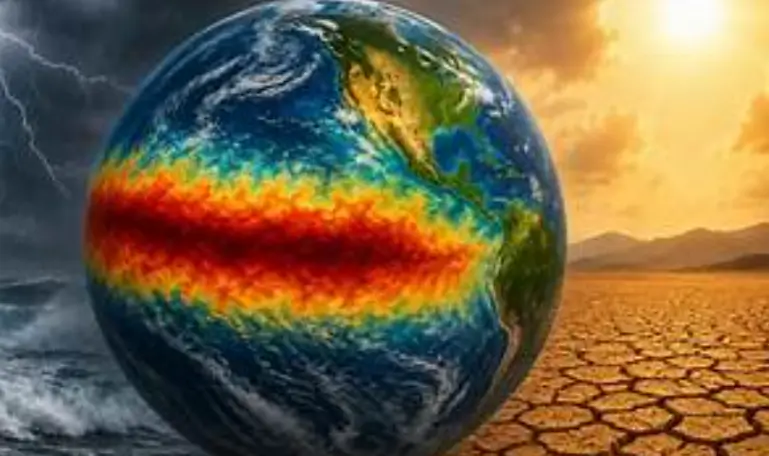
A strengthening Godzilla El Niño, the informal name being used for an unusually powerful El Niño event, could peak around November and December 2026. The US National Oceanic and Atmospheric Administration (NOAA) now estimates an 83% chance of historically strong conditions during October–December, potentially exceeding previous events recorded since 1950.
For India, the warning comes at a difficult time. The country ended its 2026 southwest monsoon with a 12.6% rainfall deficit, the sharpest shortfall since 2015, according to Business Standard, citing the India Meteorological Department (IMD). The growing El Niño impact on India raises concerns about water availability, agriculture and India summer weather projections for 2027.
NOAA's October 8, 2026 ENSO bulletin estimated an 83% probability of a historically strong event during October–December. The agency also expects strong-to-very-strong El Niño conditions to remain likely through January–March 2027.
The World Meteorological Organization (WMO) expects the event to continue into early 2027, with a possible peak around December 2026. Such conditions could influence India's winter temperatures, rainfall distribution and subsequent summer heat.
However, these predictions do not guarantee an extreme summer. The El Niño impact on India depends on several atmospheric and oceanic factors, including the Indian Ocean Dipole and regional weather systems.
The IMD has also warned of below-normal rainfall across much of India during October–December, increasing concerns about agriculture, groundwater and rural livelihoods.
India's 2026 southwest monsoon recorded approximately 759.4 mm of rainfall against the normal 868.6 mm, leaving a 12.6% deficit. The shortfall was particularly severe across southern and eastern regions, where agricultural communities depend heavily on seasonal rainfall.
The IMD expects most of India to receive below-normal rainfall through December, although parts of northwest India and the southern peninsula could receive normal to above-normal rainfall.
The agency expects El Niño to peak around November before weakening gradually from March 2027. These conditions have placed the Indian monsoon forecast 2027 under closer scrutiny, although a reliable seasonal rainfall prediction remains premature.
Reduced rainfall also highlights broader climate change effects in India, particularly the challenges of water management, agricultural planning and growing exposure to extreme weather.
Following the southwest monsoon deficit, attention has shifted to the northeast monsoon, which supplies important seasonal rainfall across southern India.
On October 12, the IMD said conditions were favourable for its onset within two to three days. Isolated heavy rainfall was forecast across Kerala, Karnataka, Tamil Nadu, Puducherry and coastal Andhra Pradesh between October 15 and 18, The New Indian Express reported.
The strengthening El Niño has raised concerns about rainfall variability, although heavy spells remain possible even during a strong event.
If seasonal rainfall remains insufficient, reservoirs supplying drinking water and irrigation could face additional pressure before summer.
This is why the Indian monsoon forecast 2027 will depend partly on reservoir recovery, winter rainfall and how Pacific Ocean temperatures evolve over the coming months.
Historically, El Niño has been associated with weaker southwest monsoon rainfall in India, although the relationship is not consistent every year. Its influence can also emerge several weeks after Pacific conditions strengthen, The Indian Express explained.
Current India summer weather projections suggest increased concern about unusually high temperatures, but the intensity and duration of any India heatwave in 2027 cannot yet be predicted confidently. A warmer winter followed by severe pre-monsoon heat could affect crops, electricity demand and outdoor workers. Climate change and extreme heat in India already present serious public-health challenges, particularly for people working in construction, agriculture and delivery services.
Concerns about 2026 heat-related deaths in India also underline the importance of reliable mortality reporting, heat-action plans and early warnings. However, no verified national death toll is established by the sources cited here. The possible godzilla el nino india impact should therefore be understood as an elevated climate risk rather than a certainty of drought or record-breaking temperatures. For now, three indicators deserve close attention: northeast monsoon rainfall, reservoir storage levels and the IMD's updated seasonal forecasts. Together, they will offer a clearer picture of potential water shortages and India heatwave risks.
As climate change and extreme heat in India continue to challenge public infrastructure, early planning will matter more than dramatic weather labels. The coming months will help determine whether the feared conditions develop into a serious challenge for 2027.
Everything you need to know
It refers to a strengthening El Niño event that NOAA says has a 90% chance of being strong this winter and a 69% chance of exceeding every El Niño since 1950. The WMO expects it to peak around December 2026 and continue through February 2027, while the IMD expects it to peak in November 2026 and weaken from March 2027.
India's 2026 southwest monsoon ended with a rainfall deficit of nearly 13%, the country's worst shortfall since 2015, according to an IMD assessment reported by Business Standard.
The IMD said on October 12, 2026 that the northeast monsoon was likely to begin over southern peninsular India within two to three days, bringing isolated heavy rain to Kerala, Karnataka, Tamil Nadu, Puducherry and Andhra Pradesh between October 15 and 18. However, reports have flagged concern that the strengthening El Niño could make this monsoon weaker than usual too.




Oct 14, 2026
TUI Staff
Oct 14, 2026
TUI Staff
Sep 28, 2026
TUI Staff
Sep 22, 2026
TUI Staff
Oct 14, 2026
TUI Staff
Oct 14, 2026
TUI Staff
Oct 13, 2026
TUI Staff
Oct 13, 2026
TUI Staff

Stay informed with independent, fact-checked journalism on technology, environment, government, economy and more. India’s most trusted digital news platform.




Comments (0)
Be the first to comment!