
Brahma Kamal Flower Plant : Can This Rare Bloom Really Bring Good Luck to Your Home?
A mysterious bloom where faith meets fascinating science!
 IN
Mon, Oct 05, 2026 | 06:46 PM IST
IN
Mon, Oct 05, 2026 | 06:46 PM IST


Imagine stepping onto your balcony late at night and finding a large, fragrant white flower slowly opening in the darkness. By morning, it may already be closing.
For generations, this unusual bloom has been linked with blessings, prosperity and good fortune. But there is a fascinating twist: the flower popularly called Brahma Kamal in many Indian homes is often not the same species as the rare Himalayan flower that officially carries the name.
So, can this mysterious bloom really bring good luck? And what exactly is growing in your pot?
Let's separate faith, folklore and science.
The true Brahma Kamal is scientifically known as Saussurea obvallata. It belongs to the Asteraceae family and is a perennial herb native to high-altitude Himalayan environments.
According to India Flora Online, maintained by the Centre for Ecological Sciences at the Indian Institute of Science, the species grows in Himalayan grasslands, rocky mountain slopes, scree slopes and areas near streams. It is recorded at elevations of around 3,200 to 5,200 metres, with flowering generally occurring between July and October.
The plant is also recognised as the state flower of Uttarakhand. A Botanical Survey of India publication describes it as a small perennial herb of the alpine meadows of the Himalayas.
Its remote habitat is part of what makes this flower so intriguing. It is not simply an exotic garden plant. It has evolved to survive in some of the Himalayas' most demanding environments.
Here is where the story gets interesting.
The large white, fragrant flower that many people grow at home and call a brahma kamal plant is generally Epiphyllum oxypetalum, commonly known as Queen of the Night or a night-blooming cactus.
North Carolina State University's Extension Gardener describes Epiphyllum oxypetalum as an epiphytic cactus with large, fragrant white flowers that bloom at night.
So, despite sharing a popular name, these are two different plants.
| Feature | True Brahma Kamal | Common home-grown “Brahma Kamal” |
| Scientific name | Saussurea obvallata | Epiphyllum oxypetalum |
| Plant family | Asteraceae | Cactaceae |
| Natural habitat | High-altitude Himalayas | Tropical/subtropical environments |
| Commonly grown at home | Uncommon | Yes |
| Flowering reputation | Himalayan alpine flower | Famous for night-blooming flowers |
| Uttarakhand state flower | Yes | No |
This distinction matters because many online claims about night flowering actually describe Epiphyllum oxypetalum, rather than the true Himalayan species.
The dramatic night-blooming behaviour is particularly associated with Epiphyllum oxypetalum.
Its large, pale flowers open after dark and are strongly fragrant. NC State Extension notes that the flowers are nocturnal and associated with pollination by night-active animals, including moths and bats.
There is a scientific reason for this unusual timing.
Pale flowers can be easier for nocturnal pollinators to locate in low light, while fragrance can help guide them towards the bloom. In nature, flowering at night can therefore be an effective reproductive strategy.
That may also explain why watching a brahma kamal flower open after sunset feels almost theatrical. What looks mysterious is also an example of how plants adapt to their environment.
And because the flower's display is brief, you can easily miss it. A tightly closed bud at bedtime can become a spectacular bloom later in the evening- and begin fading by morning.
This is where science and tradition take different paths.
In popular Indian belief, the blooming of Brahma Kamal is associated with auspiciousness, prosperity, positivity and good fortune. Some traditions also connect its rare bloom with blessings or the fulfilment of wishes.
However, there is no scientific evidence that the flower itself causes wealth, luck or prosperity.
That distinction is worth making clearly.
A belief can have cultural or personal meaning without being a scientific fact. For someone who has grown the plant for years and finally sees it flower, the moment may genuinely feel lucky. It can represent patience, hope or simply the joy of witnessing something unusual.
So, does Brahma Kamal guarantee good fortune?
No scientific evidence says it does. But for many people, its rare bloom remains a deeply auspicious experience.
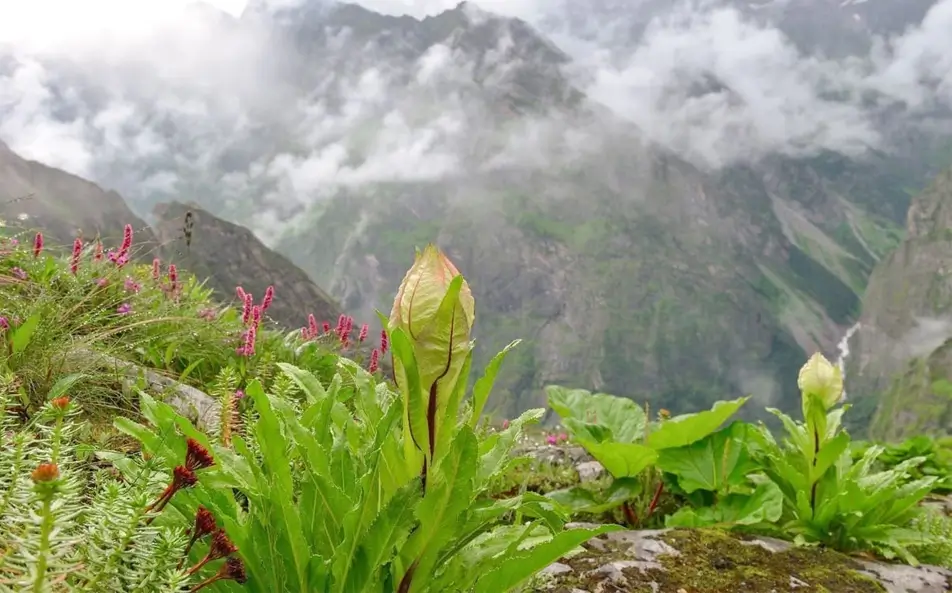
Img Src : Magic Bricks
The true Himalayan species has a strong cultural connection with Uttarakhand.
The Botanical Survey of India's profile describes Saussurea obvallata as a sacred plant and records its flowers and inflorescences being offered to local deities, Goddess Ganga and Lord Shiva. It also notes their use in decorating temples during festivals.
The name itself adds to its spiritual aura. “Brahma Kamal” evokes the lotus associated with Lord Brahma, although botanically, the Himalayan Brahma Kamal is not a lotus.
Its unusual appearance, difficult habitat and cultural associations have helped give the flower a special place in Himalayan traditions.
If you are referring to Epiphyllum oxypetalum, yes.
This commonly cultivated brahma kamal plant prefers bright, indirect light and a well-draining growing medium. NC State Extension recommends allowing the growing medium to dry somewhat between waterings and reducing watering during cooler periods. Stem cuttings can also be used for propagation.
A few basic care principles can help:
The true Saussurea obvallata is a different matter. Its natural home is the high Himalayas, so ordinary houseplant care advice for Epiphyllum should not be applied to it.
If your Epiphyllum oxypetalum is healthy but refusing to flower, possible factors include:
Flowering can also take patience. A plant may need time to mature before it produces those dramatic blooms.
Myth: A Brahma Kamal bloom guarantees good luck.
Fact: Good fortune is a cultural belief, not a scientifically established effect.
Myth: Every plant sold as Brahma Kamal is the same species.
Fact: The true Himalayan species is Saussurea obvallata, while the popular night-blooming plant is generally Epiphyllum oxypetalum.
Myth: It always blooms at exactly midnight.
Fact: Night flowering is strongly associated with Epiphyllum oxypetalum, but the precise timing can vary.
Myth: The true Brahma Kamal is rare simply because its flower doesn't last long.
Fact: Its rarity is also linked to its specialised high-altitude Himalayan habitat.
The true Saussurea obvallata is a specialised alpine plant, so protecting its natural habitat is important.
India Flora Online records the species from areas including Uttarakhand's Valley of Flowers and Sikkim.
Research and conservation literature have also documented local pressures on Himalayan populations. A Wildlife Institute of India publication identifies grazing and collection of inflorescences for religious offerings among pressures affecting the species in parts of North Sikkim.
That does not mean the species should simply be labelled “endangered” without qualification. Current global extinction-risk predictions available through Kew's Plants of the World Online do not classify Saussurea obvallata as threatened.
The more accurate takeaway is simple: local pressures still matter, and protecting the Himalayan habitats where the species grows remains important.
The word “Brahmakamal” also appeared in an unexpected context in 2026.
During the 135th episode of Mann Ki Baat on June 28, Prime Minister Narendra Modi spoke about Brahmakamal Dominicana, a group of Spanish-speaking residents in the Dominican Republic who study Indian spiritual traditions.
According to the official transcript, the group members study Vedic literature and have taught themselves to chant mantras using audio recordings, without formal training. Modi specifically mentioned their chanting of the Purusha Suktam, Sri Suktam, Sri Rudram, Durga Suktam and Devi Mahatmyam.
Modi praised the group as an example of Indian culture and spirituality reaching people far beyond India's borders.
However, the official account does not establish that the group was named after the flower. That connection should therefore not be presented as fact.
So, Does Brahma Kamal Bring Good Luck?
Science cannot promise that a bloom will bring money, prosperity or a sudden change in fortune.
Tradition gives the flower a different kind of meaning. For many people, its rare appearance represents hope, blessings, patience and something auspicious unfolding at home.
And perhaps that explains its enduring charm.
A bud appears quietly. Darkness falls. A white flower slowly opens. For a few precious hours, it becomes impossible to ignore.
Maybe the real good fortune is simply being there to see it.
Everything you need to know
Brahma Kamal is traditionally associated with auspiciousness, prosperity and good fortune. However, there is no scientific evidence that the flower itself causes luck.
The true Himalayan Brahma Kamal is scientifically known as Saussurea obvallata. The plant commonly grown in Indian homes under the same name is usually Epiphyllum oxypetalum.
The dramatic night-blooming behaviour commonly associated with Brahma Kamal is primarily seen in Epiphyllum oxypetalum, also known as Queen of the Night.
No. The true Brahma Kamal is Saussurea obvallata, while Queen of the Night is Epiphyllum oxypetalum. They are botanically different plants.
The commonly cultivated Epiphyllum oxypetalum can be grown at home with suitable light, well-draining soil and careful watering.




Sep 28, 2026
TUI Staff
Sep 22, 2026
TUI Staff
Sep 16, 2026
TUI Staff
Sep 15, 2026
TUI Staff
Oct 05, 2026
TUI Staff
Oct 05, 2026
TUI Staff
Oct 05, 2026
TUI Staff
Oct 03, 2026
TUI Staff

Stay informed with independent, fact-checked journalism on technology, environment, government, economy and more. India’s most trusted digital news platform.






Comments (0)
Be the first to comment!