
From Being Rejected by 100+ Investors, To Building a $4 Billion AI Startup : The Victor Riparbelli Story
Sometimes the world's biggest innovations begin with the words, "That will never work."
 IN
Sun, Sep 20, 2026 | 05:47 PM IST
IN
Sun, Sep 20, 2026 | 05:47 PM IST


"It's a crazy sci-fi idea."
That was the verdict from more than 100 investors when Victor Riparbelli pitched his startup in 2017. At a time when ChatGPT didn't exist, generative AI wasn't a buzzword, and most people associated artificial intelligence with futuristic movies rather than business software, convincing investors to back AI-generated video felt almost impossible.
Most said no.
One said yes.
Today, that same AI startup is valued at $4 billion, serves more than 60,000 enterprise customers, and is used by 90% of Fortune 100 companies, according to the company and CNBC's reporting on its latest funding round.
So, what changed?
Was it better technology, changing market conditions, or simply a founder who refused to give up?
The answer lies somewhere in between-and it offers valuable lessons for entrepreneurs, investors, and anyone trying to build the next big innovation.
Founded: Synthesia (2017)
Initial investor rejections: 100+
Breakthrough investor: Mark Cuban
Original focus: AI dubbing for Hollywood
Successful pivot: Enterprise training and business communication
Beta success: Over $300,000 in revenue within four months from around 1,000 customers
Current valuation: $4 billion
Enterprise customers: 60,000+
Fortune 100 adoption: 90%
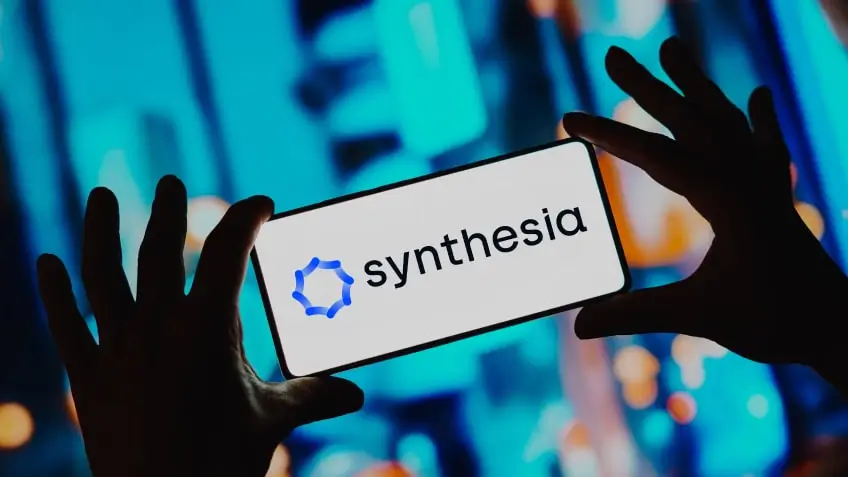
Victor Riparbelli co-founded his AI startupSynthesia in London in 2017 with an ambitious goal: making video production as simple as typing text.
Today, AI-generated videos are becoming increasingly common.
Back then, however, the idea sounded almost unbelievable.
There was no ChatGPT. AI image generators hadn't entered the mainstream, and businesses weren't actively exploring AI video creation as part of their everyday workflows.
Riparbelli believed that creating videos using artificial intelligence would eventually become as simple as creating a presentation.
Investors didn't share that optimism.
According to CNBC Make It, many dismissed the idea as "a crazy sci-fi idea," believing both the technology and the market were years away from becoming commercially viable.
Looking back, their skepticism wasn't irrational. It reflected how difficult it is to imagine a market that doesn't yet exist.
Img Src : Simplilearn
More than 100 investors turned him down, according to CNBC. The most fascinating part of Victor Riparbelli's story isn't that investors rejected him.
It's why they rejected him.
Most venture capitalists weren't questioning his commitment. They were questioning whether businesses would ever trust AI to create professional videos.
In 2017, there were very few real-world examples of generative AI products succeeding at scale.
Without public familiarity, the idea felt speculative.
This highlights an important truth about innovation.
Investors don't just evaluate technology-they evaluate timing.
Many groundbreaking companies appear unrealistic until the market catches up.
That's exactly what happened here.
Every startup story has a turning point; For Synthesia, it came through a simple cold email.
According to CNBC, co-founder and Chief Operating Officer Steffen Tjerrild sent billionaire entrepreneur Mark Cuban a short email with a product demonstration.
The response came within five minutes.
After exchanging emails for several hours, Mark Cuban invested $1 million in the company.
Later, Cuban explained that he already believed AI would become one of the defining technologies of the future and that video would play a central role in that transformation.
His investment didn't magically solve every challenge.
It did something equally important; It gave the founders confidence and credibility when very few people believed in their vision.
In January 2026, Synthesia announced a $200 million Series E round that pushed its valuation to $4 billion, according to CNBC's coverage of the round. GV led the raise, with participation from Nvidia's venture arm, Accel, NEA and Air Street Capital, per the same report.
GV's relationship with the company goes back further than that headline number suggests. The firm said it first backed Synthesia in its Series B round in 2021, years before AI video was a mainstream investment category, and returned to lead the Series E in 2026.
Riparbelli framed the raise as validation of a long bet rather than a sudden discovery. "We're very excited to announce our Series E raising $200 million at a $4 billion valuation and doubling down on what's been a fantastic couple of years and a huge opportunity in AI video," he said, according to a transcript from the Wave podcast.
Interestingly, funding wasn't the biggest reason behind Synthesia's success.
Finding the right customer was.
Initially, the company built technology for Hollywood studios, allowing filmmakers to dub dialogue using AI.
Studios found the technology impressive.
But they didn't urgently need it.
Businesses, on the other hand, asked very different questions.
Could this technology simplify employee training?
Could it improve onboarding?
Could multinational organisations create multilingual communication more efficiently?
Those questions revealed a much larger opportunity.
Instead of pursuing the entertainment industry, Synthesia focused on enterprise communication and AI video creation for businesses.
It wasn't the glamorous path.
It was the practical one.
The strategic pivot quickly produced measurable results.
According to CNBC, the beta version of Synthesia's enterprise platform generated more than $300,000 in revenue within just four months, attracting approximately 1,000 business customers.
For startups, this milestone matters more than funding announcements.
Investors can validate an idea.
Customers validate a business.
Over the following years, the application expanded its platform with AI avatars, templates, multilingual support and editing tools.
According to GV, Alphabet's venture capital arm, the company now works with more than 60,000 organisations worldwide, including 90% of Fortune 100 companies.
The biggest takeaway?
People admired the technology.
Businesses paid for the solution.
Victor Riparbelli's journey offers lessons that go well beyond AI.
1. Being early often feels exactly like being wrong.
Many transformative ideas seem unrealistic before markets mature. Vision alone isn't enough-you also need patience.
2. Rejection doesn't define the quality of an idea.
More than 100 investors declined to support.
The market eventually proved there was demand.
3. Product-market fit is more valuable than investor validation.
Hollywood appreciated the technology.
Businesses needed it.
That difference transformed the company.
4. Billion-dollar companies often solve ordinary problems.
Employee onboarding, compliance training and internal communication rarely grab headlines.
Yet they became the foundation of a multi-billion-dollar business.
5. Conviction must be balanced with adaptability.
Riparbelli never abandoned his belief in AI-generated video.
He simply found the customers who benefited from it most.
India's AI ecosystem is growing rapidly, with startups building solutions across healthcare, education, manufacturing, finance and enterprise software.
As excitement around AI continues to rise, Victor Riparbelli's journey offers an important reminder.
Building a successful startup isn't about adding AI to every product.
It's about solving problems people already have.
The next breakthrough may not come from the flashiest consumer app.
It may come from making an everyday business process dramatically simpler, faster and more affordable.
That's exactly how Synthesia built a billion-dollar business.
It's easy to look at Victor Riparbelli's journey and focus on the headline: 100 investor rejections. A $4 billion valuation.
But the real story is much deeper.
He didn't succeed because he predicted the future perfectly.
He succeeded because he understood that innovation is rarely a straight line. It requires conviction, constant learning, customer feedback and the willingness to adapt without losing sight of the bigger vision.
Reflecting on his journey, Riparbelli once observed that if you're early to a trend and survive long enough for it to take off, you'll understand it better than almost anyone else.
Perhaps that's the most important lesson for every founder building today.
The world's next billion-dollar company may already exist.
The only question is whether enough people believe in it yet.
Everything you need to know
Synthesia was co-founded in 2017 by Victor Riparbelli, Professor Matthias Niessner, UCL scientist Dr. Oran G. Agapito and COO Steffen Tjerrild, according to GV and UCL.
Riparbelli has said more than 100 investors turned down his AI video idea in the early years, with some calling it a 'crazy sci-fi idea,' according to CNBC.
Synthesia raised $200 million in a Series E round in January 2026 that valued the company at $4 billion. The round was led by GV, with participation from Nvidia's venture arm, Accel, NEA and Air Street Capital, per CNBC.



Sep 16, 2026
TUI Staff
Sep 16, 2026
TUI Staff
Sep 15, 2026
TUI Staff
Sep 05, 2026
TUI Staff
Sep 19, 2026
TUI Staff
Sep 19, 2026
TUI Staff
Sep 17, 2026
TUI Staff
Sep 17, 2026
TUI Staff

Stay informed with independent, fact-checked journalism on technology, environment, government, economy and more. India’s most trusted digital news platform.


Comments (0)
Be the first to comment!