
Tesla Cybercab Launched : The Driverless Robotaxi Takes Over Austin
Tesla's driverless, pedal-free Cybercab is now taking rides in Austin, and the design choices hint at where robotaxis are headed next.
 IN
Tue, Oct 20, 2026 | 11:39 PM IST
IN
Tue, Oct 20, 2026 | 11:39 PM IST


Imagine getting into a car with no steering wheel, no accelerator and no brake pedal. You choose your destination, sit back and let the vehicle handle the road.
That is no longer just a futuristic concept.
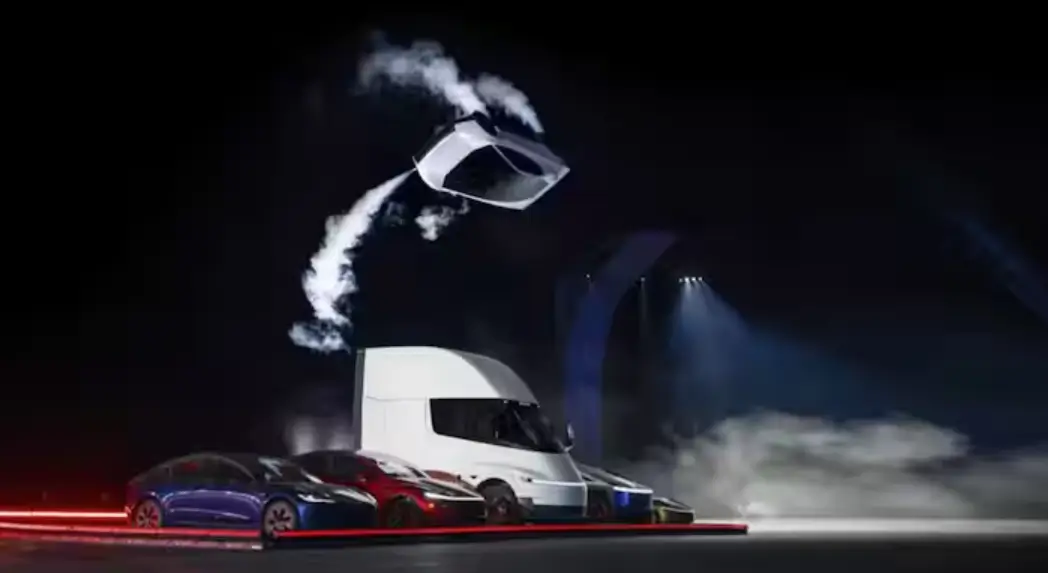
Tesla has officially launched the Tesla Cybercab as a driverless two-seater in Austin, Texas. The company began offering rides in limited areas of the city after an invite-only launch event on September 3, 2026. Tesla says Cybercab rides are currently available only in selected parts of Austin through its Robotaxi service.
But the bigger story is not just about a new car hitting Austin's streets. The launch puts a bold question in front of regulators, automakers and passengers: Are cities ready for vehicles that are designed without human driving controls at all?
For India, that question could become increasingly relevant as electric mobility, ride-hailing and autonomous-driving technology evolve.
There is no traditional driver's cockpit inside the Cybercab. Instead, the two-seat cabin is designed around passengers, with a central touchscreen and space for luggage. Tesla's official rider guide also outlines controls for seating, climate and entertainment through the vehicle and Robotaxi app.
The vehicle has a distinctive exterior as well. The gold-coloured Cybercab features butterfly-style doors and a compact, futuristic design. Its two-seat layout leaves more room for passengers because there is no need to accommodate a conventional driver.
Tesla says the vehicle is designed for full autonomy without a steering wheel or pedals. Its Robotaxi page describes bench-style seating for up to two passengers, a centre touchscreen and trunk space for items such as luggage, golf clubs and scooters.
The cabin also includes an emergency stop function and other passenger-focused features. Tesla's rider guide provides specific instructions covering doors, seats, seat belts, emergencies and other aspects of using the vehicle.
One interesting accessibility detail highlighted around the launch was the available floor and seating space, which could accommodate passengers travelling with service animals.
Tesla is not putting thousands of Cybercabs on every American road overnight.
The current rollout is limited to Austin, Texas, while Tesla's wider autonomous service also operates Model Y vehicles in Austin, Dallas, Houston, Miami and Tampa, with other markets planned. Tesla's own support page specifically states that Cybercab rides are currently available only in limited areas of Austin.
This distinction matters.
The existing Tesla autonomous fleet and the new Cybercab are not the same thing. Model Y vehicles have been used to build Tesla's Robotaxi network, while the Tesla Cybercab is a purpose-built vehicle designed from the beginning for fully autonomous operation.
Tesla has said the Cybercab is expected to become the highest-volume vehicle in its autonomous fleet over time. In an April 2026 filing, the company said it expected the Cybercab to begin replacing the existing Model Y fleet once production was underway.
The Austin launch therefore looks more like the beginning of a wider rollout than the finished product.
The journey to Austin began months earlier.
On April 24, 2026, Tesla CEO Elon Musk announced that Cybercab production had started and shared footage showing the vehicle moving from the factory floor onto public roads. Bloomberg also reported that Tesla had begun manufacturing the vehicle that month.
Tesla's initial plan was to move towards volume production during 2026. The April company update said the business was laying the groundwork to expand its autonomous service into additional US metropolitan areas.
The September launch marks the next major step: moving the purpose-built vehicle from production and testing into passenger service.
That makes the Cybercab more than another electric car. It is a test of whether Tesla can turn its long-running autonomy ambitions into a scalable transportation business.
The launch was followed almost immediately by a regulatory challenge.
On September 4, the US National Highway Traffic Safety Administration (NHTSA) opened an Audit Query into Tesla's self-certification of the Cybercab.
The agency said it is examining the technical data and processes Tesla used to certify that the vehicle complies with applicable Federal Motor Vehicle Safety Standards. The review is particularly relevant because the Cybercab lacks traditional human controls.
Tesla's approach is significant because the company has self-certified the vehicle rather than waiting for a special exemption for its unconventional design.
NHTSA has made clear that it supports the development of automated vehicles but still expects manufacturers to comply with existing federal requirements while those rules remain in force.
So, while the Cybercab is already carrying passengers, its regulatory journey is far from over.
For India, the Cybercab is less about when a Tesla will arrive on Indian roads and more about what happens when autonomous transport becomes difficult for regulators to ignore.
India currently does not have a commercially deployed steering-wheel-free robotaxi service. Any future move towards such vehicles would involve questions around vehicle certification, road safety, liability, insurance, passenger protection and the role of state transport authorities.
Infrastructure would be another major hurdle.
A fully autonomous driverless vehicle needs to interpret constantly changing road conditions, traffic behaviour, lane markings and obstacles. Indian cities present a particularly complex environment, with mixed traffic, pedestrians, two-wheelers, unpredictable road behaviour and varying road quality.
That does not make autonomous mobility impossible. But it does mean technology alone will not determine when such services become practical in India.
India's growing EV ecosystem could eventually provide a foundation for autonomous mobility. Yet an electric car becoming autonomous is only one part of the equation. The country would also need regulations, infrastructure, safety standards and a clear framework for responsibility when something goes wrong.
The Austin launch gives Tesla a major real-world test.
The company now needs to prove that its autonomous technology can operate reliably, scale beyond a limited service area and win public confidence. It also needs to expand production while navigating regulatory scrutiny.
Competition will make that challenge tougher.
Waymo already operates a large commercial autonomous ride-hailing network in the United States, giving it a significant operational head start. Tesla's advantage is its manufacturing scale and its ambition to build a purpose-designed autonomous fleet.
The company's longer-term vision is even bigger: a transportation network where autonomous vehicles can operate as a fleet rather than simply being privately owned cars.
Whether that vision becomes mainstream will depend on three things - safety, scale and regulation.
The September 2026 launch is an important milestone, but it is not the end of the story.
Tesla has moved its steering-wheel-free robotaxi from a futuristic presentation to real passenger service. For now, that service remains limited to parts of Austin.
The next test will be whether Tesla can expand the fleet, increase geographic coverage and satisfy regulators while maintaining passenger safety.
For India, the lesson is equally important. The arrival of autonomous vehicles may still be some distance away, but the regulatory questions are already taking shape.
The Cybercab is therefore not simply a new electric car. It is a glimpse of a transportation model in which the passenger is no longer the driver - and the biggest challenge may be making laws, roads and public trust ready for that change.
Everything you need to know
Tesla launched the Cybercab at an invite-only event in Austin, Texas on 3 September 2026, with public rides in limited areas of the city starting shortly after, according to Hindustan Times.
No. The Cybercab is a two-seater built without a steering wheel or pedals, designed to operate fully autonomously as a robotaxi, per reports from Hindustan Times and Motor1.
No. Initial Cybercab rides are limited to certain areas of Austin, while Tesla's separate Model Y robotaxi service already runs in Austin, Dallas, Houston, Miami, Orlando and Tampa, per Hindustan Times, pointing to a phased rollout.




Oct 17, 2026
TUI Staff
Oct 17, 2026
TUI Staff
Oct 17, 2026
TUI Staff
Oct 12, 2026
TUI Staff
Oct 19, 2026
TUI Staff
Oct 19, 2026
TUI Staff
Oct 17, 2026
TUI Staff
Oct 17, 2026
TUI Staff

Stay informed with independent, fact-checked journalism on technology, environment, government, economy and more. India’s most trusted digital news platform.

Comments (0)
Be the first to comment!