
Tesla's Flying Roadster: The Rocket Science Behind Its Air Thrusters
Tesla's new Roadster launched off a ramp and flipped in midair at a SpaceX site, powered by stored-gas thrusters and a suction-fan system, not an actual rocket engine.
 IN
Sat, Oct 17, 2026 | 02:57 PM IST
IN
Sat, Oct 17, 2026 | 02:57 PM IST


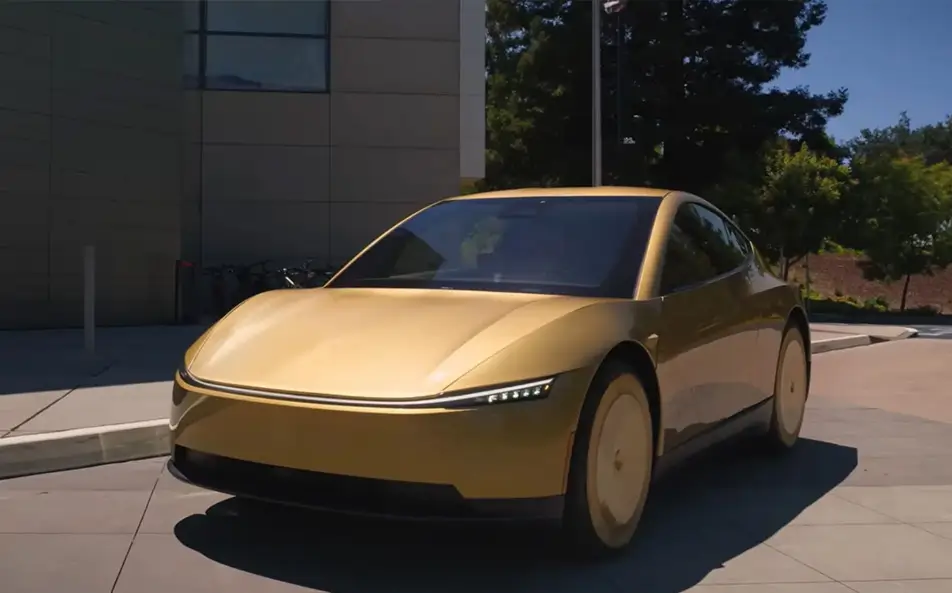
Tesla unveiled its next-generation Flying Roadster at a SpaceX testing facility in McGregor, Texas, on October 15, 2026. The electric sports car raced along an inverted ramp, flipped through the air and landed on its wheels using cold-gas thrusters and an advanced suction-fan system, according to Reuters.
The demonstration brought Rocket science into the world of electric vehicles, but it also raised a crucial question. Can a car performing spectacular aerial stunts become a practical road vehicle? For customers who reserved the long-delayed Roadster, the difference between a working prototype and a production-ready car matters.
The unveiling came nearly nine years after the next-generation Roadster was first introduced in 2017. Instead of a conventional showroom reveal, Elon Musk chose a rocket-testing facility to demonstrate the vehicle's capabilities. The company showcased extraordinary acceleration, including a claimed 0–60 mph sprint in approximately 0.81 seconds during its demonstration.
However, this figure came from Tesla's own presentation and has not been independently certified through standard production-car performance testing. Musk also indicated that the new Roadster could exceed 230 mph, placing it among the world's fastest proposed electric sports cars. The reveal demonstrated how aerospace engineering is increasingly influencing high-performance Tesla cars, even as questions remain about commercial availability.
Unlike conventional rocket engines, the vehicle's propulsion system for airborne manoeuvres uses high-pressure gas released through strategically positioned nozzles. Elon Musk previously described approximately ten small thrusters developed with SpaceX engineering expertise. The system reportedly uses reinforced pressure vessels containing compressed gas. When released through controlled outlets, the gas generates thrust that can assist acceleration, braking and directional movement.
This approach differs from combustion-powered rockets because the system does not burn propellant to produce thrust. During the demonstration, the thrusters helped the prototype rotate in midair before returning to the ground. The technology illustrates how Rocket science concepts can support unusual vehicle manoeuvres, although practical safety, weight and regulatory challenges remain significant.
Separate from the thrusters, the Roadster features an underbody suction system designed to generate additional downforce. According to Autocar India, the manufacturer claims the system can provide up to 2G of grip. This suction mechanism allowed the prototype to remain attached to a curved ramp even while travelling upside down.
The design draws on principles used in motorsport, where aerodynamic downforce helps vehicles maintain traction at high speeds. However, generating suction through powerful fans introduces engineering challenges involving energy consumption, road clearance and mechanical reliability. For ordinary Tesla cars, such extreme capabilities are unlikely to become standard features without extensive safety validation.
Despite the spectacular reveal, the Roadster is not yet a certified Flying car capable of regular airborne travel. The company has outlined Performance, Thrust and Rocket configurations, with the most extreme version reportedly reserved for selected customers. The Rocket configuration demonstrated in Texas is not currently road-legal, and its ability to perform brief jumps should not be confused with sustained, controlled flight.
The company has announced plans to begin production in 2028, more than a decade after first revealing the next-generation vehicle. For Indian buyers, there is no confirmed regulatory approval for the rocket-assisted variant to operate on public roads. The demonstration therefore remains a showcase of advanced engineering rather than proof that flying vehicles are ready for everyday transportation.
The company now faces the challenge of turning its dramatic prototype into a commercially viable product. Safety testing, manufacturing costs, regulatory approvals and clear specifications will determine which features eventually reach customers.
While Elon Musk has promoted the Roadster as an extraordinary performance vehicle, the company has yet to demonstrate that its most ambitious capabilities can meet ordinary road-use requirements. The broader significance lies in the potential crossover between automotive engineering and Rocket science, especially as manufacturers continue exploring unconventional performance technologies. For now, the Roadster's Texas demonstration has shown what experimental hardware can achieve under controlled conditions. Whether that technology reaches customers by 2028, and whether a Flying car becomes a practical reality, remains an open question.
Everything you need to know
Tesla unveiled its next-generation Roadster at a SpaceX test site in McGregor, Texas, on October 15, 2026, according to CNBC.
The Roadster uses roughly ten small thrusters built with carbon-overlay pressure vessels and diffusers that release stored high-pressure gas through directional nozzles, aiding acceleration, braking and limited controlled flight, per CNBC's reporting on the event.
No. The vehicle shown was a prototype demonstration. Tesla has said production of the next-generation Roadster will begin in 2028, and there is no indication the flying or thruster capability is approved for ordinary public roads, per CNBC.



Oct 17, 2026
TUI Staff
Oct 12, 2026
TUI Staff
Sep 30, 2026
TUI Staff
Sep 30, 2026
TUI Staff
Oct 15, 2026
TUI Staff
Oct 15, 2026
TUI Staff
Oct 15, 2026
TUI Staff
Oct 14, 2026
TUI Staff

Stay informed with independent, fact-checked journalism on technology, environment, government, economy and more. India’s most trusted digital news platform.






Comments (0)
Be the first to comment!