
Bitcoin Price Falls, But Which Rate Is Real? Everything Indians Need to Know Before Investing
One Coin, Many Prices
 IN
Wed, Oct 28, 2026 | 01:19 AM IST
IN
Wed, Oct 28, 2026 | 01:19 AM IST

Bitcoin price falls on one tracker, rises on another, and looks almost flat on a third. That confusion is not unusual in crypto. It is part of how the market works.
At the time of this check, Coinbase showed Bitcoin at about $64,420, while CoinMarketCap’s live page showed Bitcoin around the $63,500–$63,800 range. Coindesk listed Bitcoin at $63,824.55 as of July 28, 2026, 11:07 pm EDT. The live finance snapshot checked for this article showed Bitcoin around $64,396.
That gap matters for Indian investors. It shows why no one should treat a single bitcoin price screenshot as the final truth. Crypto prices move constantly, and different platforms use different exchange feeds, timestamps, liquidity pools and calculation methods.
The bitcoin market is not like the Indian stock market, where investors can look at one official exchange price. Bitcoin trades globally across many exchanges, 24 hours a day.
That means a price tracker may pull data from Coinbase, Binance, Kraken, OKX, Bitstamp or several exchanges at once. Some platforms show a weighted average. Some show their own exchange price. Some update faster than others.
This is why Bitcoin price falls in one headline can sit beside another tracker showing only a small move. The direction may be right, but the exact number depends on source and timing.
For readers, the safe rule is simple: always check the platform name, currency and timestamp before believing the number.
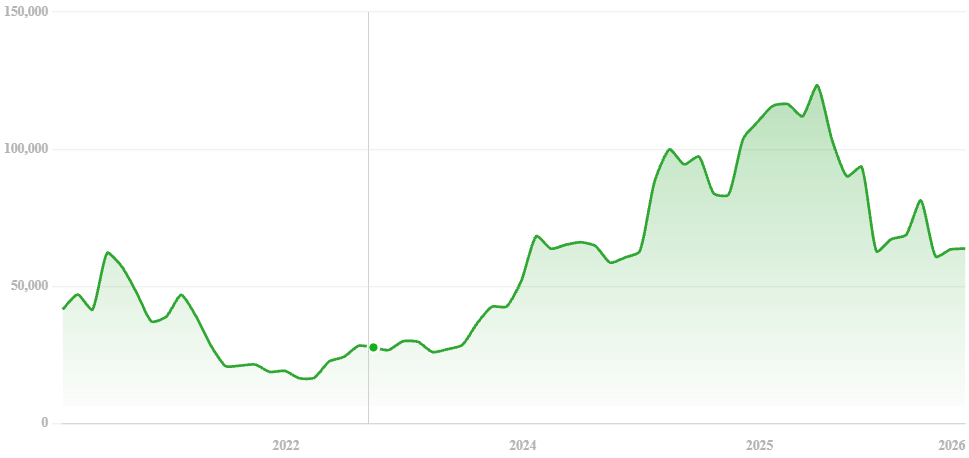
Recent bitcoin news has focused on weakness around the $63,000–$64,000 zone. Economic Times reported that Bitcoin slipped near $63,000 amid chip-stock selling, ETF outflows, large crypto liquidations and uncertainty around the US Federal Reserve.
Another Economic Times report said Bitcoin had been holding near $63,000 as investors waited for the Fed meeting, despite easing geopolitical tensions.
That means the current move is not only about crypto sentiment. It is also tied to wider risk appetite, interest-rate expectations, ETF flows and global market mood.
Bitcoin is not legal tender in India. That means it cannot be treated like the rupee for official payments.
The RBI’s own digital rupee FAQ makes the distinction clear: the e₹ is legal tender and a liability of the Reserve Bank of India. Private cryptocurrencies such as Bitcoin do not have that status.
But that does not mean India ignores crypto. The government taxes and monitors virtual digital assets through a separate framework.
India taxes income from the transfer of virtual digital assets under Section 115BBH. The Income Tax Department lists income from transfer of any virtual digital asset at a 30% tax rate.
The law also restricts loss adjustment. The Income Tax Department’s Section 115BBH note says losses from transfer of virtual digital assets cannot be set off against other income and cannot be carried forward.
That is why Indian crypto holders cannot treat the market as invisible. Even if Bitcoin is not legal tender, profits from crypto transfers can still fall under India’s tax net.
The bigger shift is anti-money laundering compliance.
The Financial Intelligence Unit-India has said virtual digital asset service providers operating in India, whether offshore or onshore, must register as reporting entities and comply with obligations under the Prevention of Money Laundering Act.
FIU-IND has also issued notices to offshore virtual digital asset service providers for non-compliance. In 2025, it issued notices to 25 offshore VDA service providers under Section 13 of the PMLA.
This shows that India’s crypto market is not completely unregulated. It is taxed, watched and increasingly pulled into compliance reporting.
The answer is somewhere in the middle.
India does not yet have one full crypto law that works like SEBI’s framework for stocks. Bitcoin is not legal tender. Crypto exchanges are not licensed by the RBI in the way banks are.
But calling the market a free-for-all is also wrong. A 30% tax, loss restrictions, transaction reporting and PMLA-linked compliance already create a serious regulatory scaffold.
So when Bitcoin price falls, Indian investors should not look only at the chart. They should also understand the rules around taxation, reporting and risk.
The first lesson is that Bitcoin prices differ across websites. Always compare more than one source.
The second lesson is that price volatility is normal in crypto. A move from $64,400 to $63,800 may look dramatic in a headline, but the market can shift again within minutes.
The third lesson is regulatory. India may not recognise Bitcoin as currency, but it does track and tax crypto transactions.
For now, Bitcoin price falls is not just a market headline. It is a reminder that Indian investors are dealing with an asset that is volatile, globally priced and locally taxed.
The safest takeaway is this: check the price carefully, record the source, understand the tax rules, and never mistake a crypto screenshot for a complete investment picture.
Everything you need to know
Bitcoin trades globally across many exchanges. Different platforms use different exchange feeds, timestamps, liquidity pools and weighted averages..
At the time of this update, Bitcoin was trading around $64,249, with an intraday range of about $62,772 to $64,485. Since Bitcoin trades 24/7, the price can change within minutes.
No. Bitcoin is not legal tender in India. The RBI’s digital rupee is legal tender, while private cryptocurrencies do not have that status.
Yes. Income from transfer of virtual digital assets is taxed under India’s crypto tax framework, according to the draft.




Oct 19, 2026
TUI Staff
Oct 19, 2026
TUI Staff
Oct 19, 2026
TUI Staff
Oct 19, 2026
TUI Staff
Oct 27, 2026
TUI Staff
Oct 26, 2026
TUI Staff
Oct 26, 2026
TUI Staff
Oct 25, 2026
TUI Staff

Stay informed with independent, fact-checked journalism on technology, environment, government, economy and more. India’s most trusted digital news platform.







Comments (0)
Be the first to comment!