
Gold Rate Today in India: 24 Carat Gold Price, 22K and Silver Rate
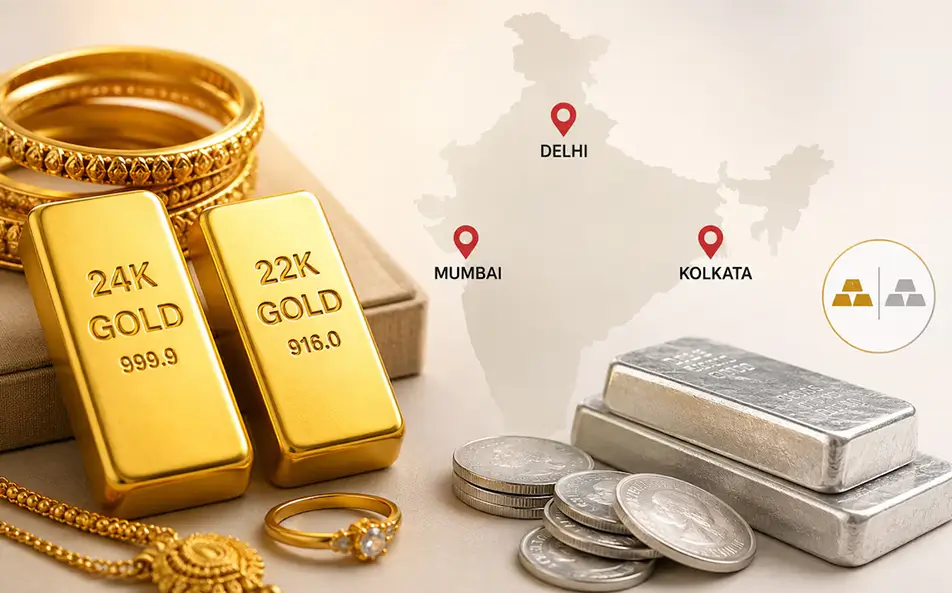
Gold rate today in India hovers near record highs on 31 August 2026, with 24 carat gold above ₹1.58 lakh per 10 grams and silver split by city.
 IN
Thu, Oct 15, 2026 | 06:57 PM IST
IN
Thu, Oct 15, 2026 | 06:57 PM IST


Gold rate today in India remains historically elevated on Monday, August 31, 2026, even as bullion prices retreat from the sharp highs reached earlier this month. Bajaj Broking's India-wide tracker showed 24-carat gold at ₹1,58,230 per 10 grams as of 8 am, while Delhi-specific data from India Today placed 24K gold at ₹1,58,380 per 10 grams. The small but noticeable difference highlights an important point for buyers: there is no single retail gold price that applies uniformly across India.
Jewellery-brand rates can differ again. Economic Times reported that, as of 11:48 am, Tanishq was quoting 22K gold at ₹14,415 per gram in Delhi, Mumbai, Chennai, Hyderabad and Bengaluru, while Malabar Gold & Diamonds and Joyalukkas were quoting ₹14,370 per gram.
Silver shows an even wider spread between trackers. Bajaj Broking lists 999 silver at ₹2,54,900 per kilogram, while India Today's Delhi tracker shows ₹2,71,900 per kilogram.
For buyers, that means today's headline number is only a starting point. The actual amount paid will depend on the city, jeweller, purity, taxes, making charges and the benchmark used by the seller.
Bajaj Broking's nationwide tracker, updated at 8 am on August 31, showed the following indicative rates:
| Gold purity | Indicative rate |
|---|---|
| 24K gold | ₹15,823 per gram |
| 22K gold | ₹14,504 per gram |
| 18K gold | ₹11,867 per gram |
The same tracker places 24K gold at ₹1,58,230 per 10 grams.
Delhi-specific figures are slightly different. India Today's Delhi commodity tracker shows 24-carat gold at ₹1,58,380 per 10 grams, compared with ₹1,58,390 a day earlier. Its 22K rate stands at ₹1,45,190 per 10 grams, while 18K gold is listed at ₹1,18,785. That means today's physical gold market is relatively stable on some retail trackers even as futures prices are seeing much sharper movement.
A buyer checking three gold-price websites can easily find three different numbers. That does not necessarily mean one of them is wrong. Some trackers publish nationwide indicative rates gathered from jewellers. Others show city-specific prices. Jewellery chains may use their own daily reference prices, while bullion associations publish separate benchmark rates.
Timing matters too.
A price collected at 8 am can differ from a jeweller's rate at noon, particularly during a volatile trading session. Economic Times, for example, found Tanishq quoting 22K jewellery gold at ₹14,415 per gram on August 31, while Malabar Gold & Diamonds and Joyalukkas were quoting ₹14,370 per gram. Those rates also do not represent the final jewellery bill. Making charges, applicable GST and other costs can increase the amount paid by the consumer. So someone searching for gold price India today should treat online rates as benchmarks and confirm the final per-gram rate with the jeweller before making a purchase.
For most jewellery buyers, 22 carat gold rate today is more relevant than the 24K bullion price. Bajaj Broking lists 22K gold at ₹14,504 per gram in its nationwide morning snapshot.
Delhi's India Today tracker puts the corresponding 22K rate at ₹1,45,190 per 10 grams. Jewellery-company quotes are slightly lower in some cases.
Tanishq listed 22K gold at ₹14,415 per gram on Monday morning, while Malabar Gold & Diamonds and Joyalukkas showed ₹14,370 per gram across several major cities. For consumers, the correct comparison is therefore not just between two websites. It is between the final rates offered by the jewellers they actually intend to buy from.
Consumers buying lightweight or diamond-studded jewellery often encounter 18K gold. Bajaj Broking's August 31 morning rate puts 18 carat gold at ₹11,867 per gram.
India Today's Delhi figure is ₹1,18,785 per 10 grams. The same tracker lists 14K gold at ₹92,388 per 10 grams. The lower gold content makes 18K and 14K jewellery cheaper than equivalent pieces made with 22K gold, although the final price still depends heavily on design, gemstones and making charges.
The silver rate today is particularly difficult to summarise with one number. Bajaj Broking lists silver at ₹254.90 per gram, or ₹2,54,900 per kilogram, as of 8 am on August 31. It notes that Indian silver prices are influenced by international rates, the rupee-dollar exchange rate, duties, domestic demand and local market conditions.
India Today's Delhi tracker, however, places silver at ₹272 per gram, or ₹2,71,900 per kilogram. The tracker shows the rate down ₹100 per kilogram from August 30. The gap is too large to casually describe as a normal local dealer premium without knowing exactly how each platform calculates its rate. For consumers, the safer approach is to treat the figures as separate reference benchmarks and check the quote available from a local bullion dealer or jeweller.
The biggest change from the earlier August narrative is happening in the futures market. Gold had enjoyed an extraordinary rally earlier this month. The MCX October 5 gold contract rose from ₹1,43,376 per 10 grams on July 31 to a record ₹1,62,438 on August 21 — an increase of ₹19,062, or 13.3%, in just three weeks. But that rally has now reversed sharply.
On the morning of August 31, MCX October gold futures dropped ₹2,700 to around ₹1,53,640 per 10 grams, according to Economic Times. September silver futures were down ₹3,635 at ₹2,38,809 per kilogram.
Gold had fallen for four consecutive sessions, with Economic Times reporting a decline of roughly ₹9,500 per 10 grams over the recent four-day period. So while retail gold remains extremely expensive compared with historical levels, describing August 31 simply as another day of rising prices would be misleading. The market is experiencing a sizeable pullback.
The immediate trigger is a change in expectations around US interest rates. Federal Reserve Chair Kevin Warsh struck a hawkish tone at Jackson Hole, warning that policymakers could still have work to do if inflation failed to move convincingly towards the Fed's 2% target. Reuters reported that traders increased the probability of a September US interest-rate hike to around 60%, compared with roughly 36% before his comments.
Higher interest rates generally hurt gold because the metal pays no interest. When yields rise, interest-bearing assets become relatively more attractive. Spot gold consequently fell 0.4% to about $4,436 an ounce during Monday's global session after suffering its biggest one-day decline since June on Friday. Yet the wider August picture remains remarkably strong.
Despite the late-month sell-off, Reuters said international gold was still up more than 10% for August, while silver had gained more than 16% for the month.
Before the latest correction, several forces pushed bullion sharply higher.
A weaker US dollar helped international buyers. Falling Treasury yields also supported gold, particularly after the US Treasury announced an expansion of longer-dated bond buybacks.
Geopolitical concerns around Iran and the Strait of Hormuz strengthened safe-haven demand, while central-bank purchases provided longer-term support.
NDTV Profit reported that central banks bought 289 tonnes of gold during the second quarter of 2026, citing World Gold Council figures.
Domestic festive and wedding-season demand has also begun to enter the equation as Indian jewellers prepare inventories for the coming months.
But the final week of August demonstrates how quickly those supportive factors can be overwhelmed when interest-rate expectations shift.
Consumers buying jewellery on August 31 should distinguish between three different prices: the online indicative gold rate, the jeweller's own selling rate and the final invoice after taxes and making charges. For 24K gold, commonly cited retail benchmarks are currently around ₹1.58 lakh per 10 grams. For 22K jewellery, rates vary by tracker and jewellery chain.
Silver is even more fragmented, with major trackers showing significantly different Delhi and nationwide figures.
Investors watching MCX face a different market altogether. After touching ₹1,62,438 earlier in August, October gold futures were trading around ₹1,53,640 on Monday morning as expectations of higher US interest rates triggered profit-taking. The next major clues will come from US labour-market data, including the ADP employment report and nonfarm payrolls. Those numbers could influence whether markets continue pricing in a Federal Reserve rate hike. So the key takeaway from gold rate today is not simply that gold remains expensive.
It is that bullion has entered a highly volatile phase: retail prices remain near historically elevated levels, while futures have already fallen sharply from the record levels reached only days ago.
Everything you need to know
On 31 August 2026, 24 carat gold in India is priced between about ₹1,58,230 and ₹1,58,960 per 10 grams depending on the tracker, per Bajaj Broking and Gulf News' India gold tracker.
The Times of India's national baseline shows silver near ₹2,549 per 10 grams, but India Today's Central Delhi data shows a premium rate of ₹2,720 per 10 grams, reflecting local dealer markups and purity certification differences.
MCX gold futures for the October 5 expiry rose from ₹1,43,376 to ₹1,62,438 per 10 grams between 31 July and 21 August 2026, a 13.3 percent gain per NDTV Profit, while silver futures gained ₹10,673 to settle at ₹2,48,124 per kilogram, per Mint.




Oct 15, 2026
TUI Staff
Oct 15, 2026
TUI Staff
Oct 15, 2026
TUI Staff
Oct 15, 2026
TUI Staff
Oct 15, 2026
TUI Staff
Oct 15, 2026
TUI Staff
Oct 15, 2026
TUI Staff
Oct 14, 2026
TUI Staff

Stay informed with independent, fact-checked journalism on technology, environment, government, economy and more. India’s most trusted digital news platform.





Comments (0)
Be the first to comment!