
Navratri 2026 : 9 Nights, 9 Colours, Ghatasthapana Muhurat & Everything You Need to Know
One festival, nine nights, and a thousand traditions.
 IN
Tue, Sep 15, 2026 | 05:42 PM IST
IN
Tue, Sep 15, 2026 | 05:42 PM IST


Nine nights. Nine forms of Maa Durga. Nine colours. And an entire country celebrating the same festival in remarkably different ways.
Navratri 2026 begins on Sunday, October 11, and culminates with Vijayadashami on Tuesday, October 20. For some, it means waking up early for puja and observing a vrat. For others, it means stepping onto a Garba ground after sunset, visiting a Durga Puja pandal or watching Ramlila with family.
This year, the festival once again brings together faith, food, music, dance and India's extraordinary regional diversity. Here is everything you need to know - from the Navratri dates 2026 to Ghatasthapana Muhurat, the nine colours, Navadurga, fasting, Garba and Dandiya, Kanya Pujan and Dussehra.
The main Sharad Navratri 2026 period runs from October 11 to October 19, 2026, followed by Vijayadashami on October 20. The exact observance of Ashtami and Navami can vary by location because Hindu festivals are determined by tithi and local Panchang calculations.
| Date | Day | Main Observance | Goddess |
| October 11 | Sunday | Ghatasthapana | Maa Shailputri |
| October 12 | Monday | Day 2 | Maa Brahmacharini |
| October 13 | Tuesday | Day 3 | Maa Chandraghanta |
| October 14 | Wednesday | Day 4 | Maa Kushmanda |
| October 15 | Thursday | Day 5 | Maa Skandamata |
| October 16 | Friday | Day 6 | Maa Katyayani |
| October 17 | Saturday | Day 7 | Maa Kalaratri |
| October 18 | Sunday | Day 8 | Maa Mahagauri |
| October 19 | Monday | Ashtami/Navami observances* | Maa Mahagauri/Maa Siddhidatri |
| October 20 | Tuesday | Vijayadashami/Dussehra | — |
*The exact Ashtami/Navami observance depends on the local Panchang. In Delhi, Mahashtami and Maha Navami observances fall on October 19.
Ghatasthapana falls on Sunday, October 11, 2026.
For Delhi, the listed Ghatasthapana Muhurat is 6:19 AM to 10:12 AM, while the Abhijit Muhurat is 11:44 AM to 12:31 PM. These timings are location-specific, so readers in other cities should check their local Panchang before performing the ritual.
Ghatasthapana, also called Kalash Sthapana, marks the beginning of the Navratri observance. A sacred kalash is installed and Shakti is invoked. In many households, barley seeds are also sown as part of the ritual.
The important thing to remember is that puja procedures and timings can differ between regions and traditions. A timing calculated for Delhi should not automatically be treated as valid across India.
Each night of Navratri is traditionally associated with one form of the Navadurga.
Together, these forms offer more than nine names to remember. They represent different dimensions of Shakti - from nurturing and devotion to courage and transformation.
The popular colour tradition assigns a different colour to each day, with the first colour determined by the weekday on which Navratri begins. Since Navratri 2026 begins on a Sunday, the sequence starts with orange. This tradition is particularly popular in Maharashtra and Gujarat.
| Day | Date | Colour |
| 1 | October 11 | Orange |
| 2 | October 12 | White |
| 3 | October 13 | Red |
| 4 | October 14 | Royal Blue |
| 5 | October 15 | Yellow |
| 6 | October 16 | Green |
| 7 | October 17 | Grey |
| 8 | October 18 | Purple |
| 9 | October 19 | Peacock Green |
These colours are a popular cultural custom, not a compulsory religious rule. That distinction matters, especially when Navratri traditions vary so widely across India.
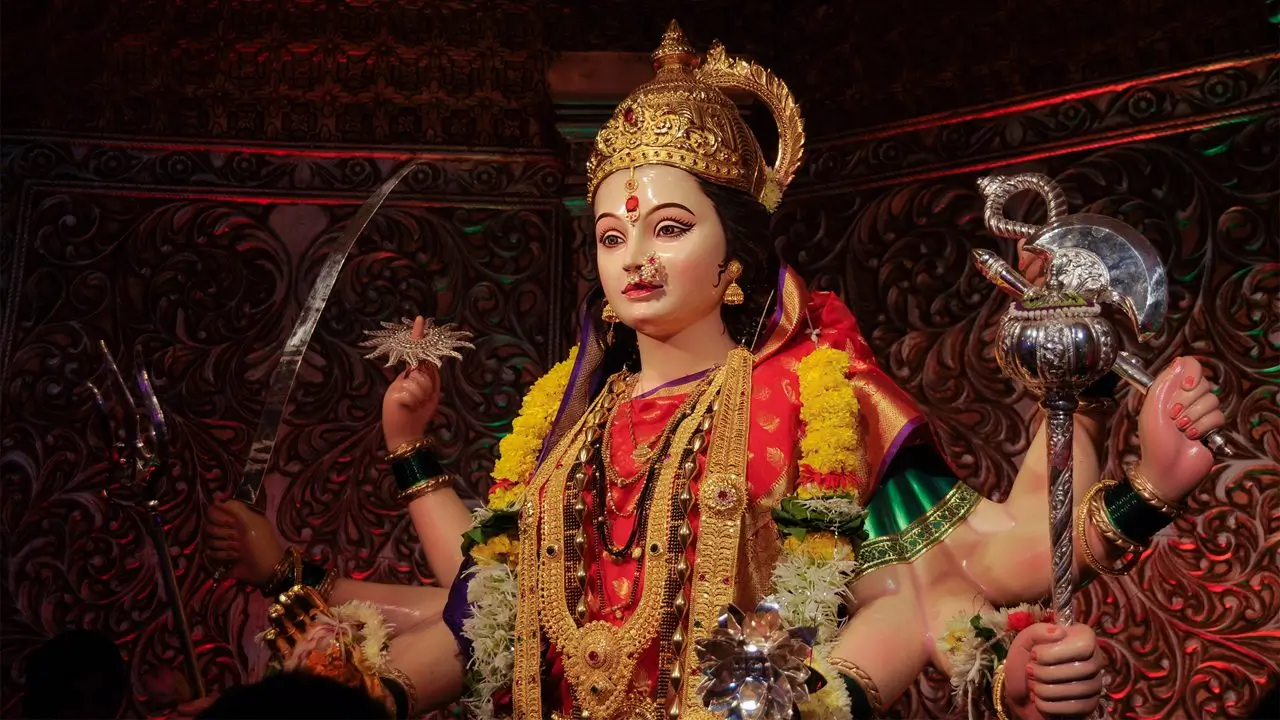
At its heart, Navratri celebrates Shakti - the divine feminine power.
One of the most widely known stories is the battle between Goddess Durga and Mahishasura. According to the traditional narrative, the gods' combined energies manifested as Durga, who fought the powerful demon and ultimately defeated him. Vijayadashami therefore becomes a celebration of the triumph of good over evil.
Another important tradition connects the festival season with Lord Rama's battle against Ravana. In North India, this connection comes alive through Ramlila performances and the burning of Ravana's effigy on Dussehra.
The result is a festival with more than one layer of meaning: divine feminine power, courage, renewal and the victory of dharma over adharma.
Img Src : Gujrat Tourism
For many devotees, fasting is an important part of the festival. But there is no single fasting rule followed by every Indian household.
Common vrat foods include fruits, milk, curd, makhana, sabudana, samak rice, kuttu, singhara and rajgira. Potatoes and certain vegetables are also eaten according to individual and regional traditions.
Foods commonly avoided include wheat, regular rice, pulses, onion, garlic, meat, eggs and alcohol. Sendha namak is widely used instead of regular salt.
The sensible approach is to fast according to your own tradition and circumstances. Stay hydrated, avoid relying entirely on fried vrat foods and remember that a late-night dance event and an empty stomach are not always the best combination.
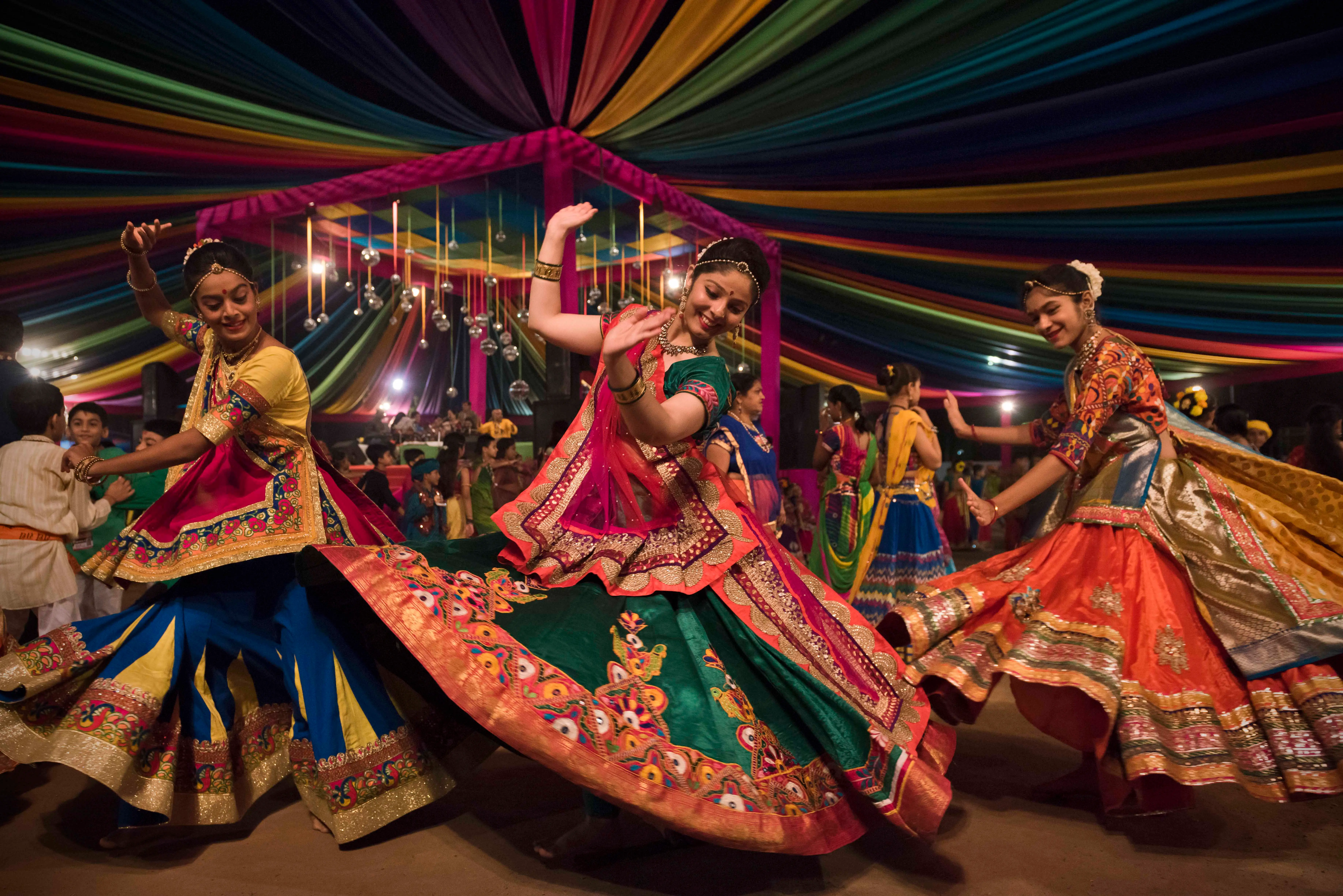
Few sights capture the public energy of Navratri quite like a crowded Garba circle.
In Gujarat, Garba is deeply associated with the worship of Shakti and is performed around a central representation of the divine feminine. Gujarat Tourism describes the festival as a nine-night celebration in which communities gather to celebrate feminine divinity.
Dandiya uses decorated wooden sticks and has developed into another defining part of the festivities. Interestingly, Gujarat Tourism notes that Ras Garba has historical connections with Krishna traditions as well, reminding us that even seemingly familiar festival customs can have layered histories.
A modern Garba night may look very different from a traditional village celebration, but the community spirit remains at its centre.
Kanya Pujan, also known as Kanjak or Kumari Puja in different regions, is traditionally observed around Ashtami or Navami in several North Indian households.
Young girls are welcomed as symbolic manifestations of the Goddess and offered food, respect and gifts. Puri, kala chana and halwa are commonly associated with the ritual in North India.
The exact number of girls, accompanying rituals and the day of observance can vary by family and region. What remains central is the recognition of the divine feminine in its youngest form.
Img Src : Incredible India
The beauty of India's Navratri celebration lies in its diversity.
In Gujarat, the nights revolve around Garba and Dandiya.
In West Bengal, the same festive season takes the spectacular form of Durga Puja, with idols, pandals, Sandhi Puja and immersion ceremonies.
In North India, fasting, Kanya Pujan and Ramlila are prominent.
In parts of South India, traditions such as Golu or Kolu bring families together around displays of dolls and deities.
Karnataka's Mysuru Dasara offers yet another expression of the festive season.
India's official tourism portal highlights this regional diversity as one of the defining characteristics of the festival.
They are closely connected, but they aren't interchangeable.
The 2026 calendar is a useful reminder that regional calendars matter. The IMD's Rashtriya Panchanga lists Bengal's Mahashtami on October 19 and Mahanavami/Vijaya Dashami on October 20.
Dussehra, or Vijayadashami, falls on Tuesday, October 20, 2026.
For many Indians, it is the day when the story of good overcoming evil reaches its symbolic conclusion - whether through Durga's victory over Mahishasura, Rama's victory over Ravana, or the many regional traditions that have developed around the festival.
The most exciting part of Navratri 2026 is probably a Garba night. It may look very different from a quiet puja at home. A Durga Puja pandal in Kolkata may feel worlds apart from a Ramlila ground in Delhi.
And yet, they belong to the same festive season.
That is perhaps what makes the festival so enduring. It gives India a shared cultural moment without demanding that everyone celebrate it in exactly the same way.
Nine nights, nine forms and countless traditions - Navratri is ultimately a celebration of Shakti, community and the enduring idea that light can overcome darkness.
Everything you need to know
Navratri 2026 begins on Sunday, October 11, and the nine-night observance continues through October 19. Vijayadashami or Dussehra falls on October 20, 2026.
The commonly followed nine colours are Orange, White, Red, Royal Blue, Yellow, Green, Grey, Purple and Peacock Green, beginning with Orange on October 11.
Ghatasthapana is on October 11, 2026. For Delhi, the main Muhurat is 6:19 AM to 10:12 AM. Timings vary by location, so devotees should check their local Panchang.
The nine days are traditionally dedicated to Maa Shailputri, Maa Brahmacharini, Maa Chandraghanta, Maa Kushmanda, Maa Skandamata, Maa Katyayani, Maa Kalaratri, Maa Mahagauri and Maa Siddhidatri.
Dussehra, also known as Vijayadashami, falls on Tuesday, October 20, 2026. It marks the culmination of the Navratri festive period and celebrates the victory of good over evil.




Sep 14, 2026
TUI Staff
Sep 14, 2026
TUI Staff
Sep 14, 2026
TUI Staff
Sep 14, 2026
TUI Staff
Sep 14, 2026
TUI Staff
Sep 14, 2026
TUI Staff
Sep 14, 2026
TUI Staff
Sep 14, 2026
TUI Staff

Stay informed with independent, fact-checked journalism on technology, environment, government, economy and more. India’s most trusted digital news platform.



Comments (0)
Be the first to comment!