
Who Is Gitanjali Angmo? Wangchuk’s Wife Leads Protest Amid Barricades and Lathi-Charge Claims
A Protest Finds Its New Face
 IN
Mon, Oct 19, 2026 | 05:42 PM IST
IN
Mon, Oct 19, 2026 | 05:42 PM IST

Gitanjali J Angmo stepped into the centre of the Cockroach Janta Party’s Chalo Sansad march on July 20, 2026, after her husband, Ladakhi reformer Sonam Wangchuk, remained at Safdarjung Hospital during his indefinite hunger strike.
Wangchuk’s fast had entered Day 23, according to Hindustan Times. He has been demanding Union Education Minister Dharmendra Pradhan’s resignation over alleged irregularities in the exam system and student suicides. With Wangchuk unable to lead the march himself, Angmo had said a day earlier that she would represent him if he could not reach Parliament.
The stakes now go beyond one family. The protest has become a flashpoint over NEET-UG grievances, youth anger and the limits of police handling during a march towards Parliament on the opening day of the Monsoon Session.
Gitanjali J Angmo is not new to public work, but this is a different kind of role. Hindustan Times describes her as a social entrepreneur and educationist who has been the founding CEO and dean of the Himalayan Institute of Alternatives, Ladakh since 2017. She co-founded HIAL with Wangchuk to build an alternative education model rooted in sustainability, mountain communities and local problem-solving.
Her education background is also wide. According to HT, she holds an MBA from Xavier Institute of Management, Bhubaneswar, and a bachelor’s degree from Fakir Mohan University, Balasore. Her LinkedIn profile, cited by HT, also says she completed a doctorate in education from Sri Sathya Sai University for Human Excellence in 2025.
Before HIAL, Angmo worked across business consulting, education, healthcare and technology. HT also reported that she received the Women Transforming India National Award from the Government of India.
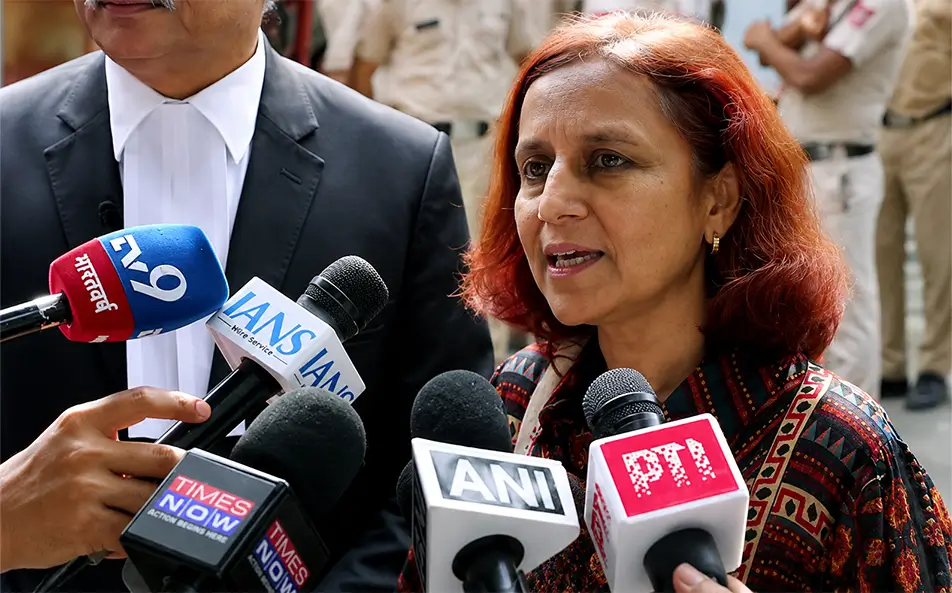
Gitanjali J Angmo had already made her position clear before the march. “He is still on hunger strike. If Sonam cannot march to Parliament, I will lead the march. The march will definitely happen,” she told reporters outside Safdarjung Hospital, according to Hindustan Times.
That line became the turning point. Wangchuk had been taken from Jantar Mantar to Safdarjung Hospital on July 18 after Delhi Police cited health concerns and a High Court order. Angmo disputed the way he was moved, saying neither she nor Wangchuk had been properly informed.
She also challenged his continued stay at Safdarjung Hospital. On July 19, the Delhi High Court refused to order his immediate transfer to a private hospital. The court said Wangchuk was not under detention, his family had access to him and doctors were monitoring his health. It sought a status report in three days and posted the matter for July 24.
Angmo has not stopped at the single-judge order. HT reported that she again moved the Delhi High Court against the refusal to shift Wangchuk to a private hospital. Her appeal argues that the order affects Wangchuk’s rights, including his right to choose treatment and continue his protest.
This makes the legal battle just as important as the street protest. Angmo’s argument is that Wangchuk should have access to doctors trusted by him and his family. The government’s position, as accepted for now by the court, is that the hospitalisation was based on health concerns and medical monitoring.
That disagreement is now at the heart of the case: whether Wangchuk is simply under medical care, or whether the hospital setting is limiting his protest.
The Chalo Sansad march brought thousands of supporters to Jantar Mantar amid heavy security. Police had imposed prohibitory orders under Section 163 of the BNSS in New Delhi district and said no permission had been granted for a march towards Parliament.
The situation escalated when protesters tried to move beyond barricades. TOI reported that police used tear gas and mild force after demonstrators allegedly attempted to march towards Parliament. Several protesters were detained, while Delhi Police said some personnel were injured after stones were allegedly thrown.
The march did not stay peaceful for long. CJP spokesperson Saurav Das alleged that Angmo was assaulted by Delhi Police, her hair pulled during the confrontation, while a 12-year-old girl and dozens of other protesters were hurt in a lathi-charge and tear gas, according to DT Next. Angmo herself had pushed for the protest to stay peaceful, telling ThePrint, "A graceful govt would have allowed this protest, because then they would have heard the voices of the people," per ThePrint. . Delhi Police denied reports of violence and detentions, saying the protest was being handled professionally and asking people not to believe rumours.
The protest is now moving on two tracks. On the ground, CJP leaders have pressed three demands: Wangchuk’s release from hospital restrictions, Dharmendra Pradhan’s resignation, and compensation for families of NEET aspirants who died by suicide, according to TOI. CJP representatives were also set to meet Union minister J.P. Nadda after the government reached out for talks.
In court, Angmo’s fight over Wangchuk’s hospital transfer and access to his doctors continues. The next medical status report and the July 24 hearing will decide how much room the court gives the family to challenge the current arrangement.
For now, Angmo has moved from being Wangchuk’s legal and personal voice to becoming the public face of the march. The question is whether that shift helps open negotiations, or whether the protest hardens further after the clash at Jantar Mantar.
Everything you need to know
Gitanjali Angmo is a social entrepreneur and educationist, wife of Ladakhi reformer Sonam Wangchuk, and co-founder with him of the Himalayan Institute of Alternatives, Ladakh (HIAL), which she helped set up in 2017. She received the Women Transforming India Award from NITI Aayog in 2022.
Wangchuk was shifted from his hunger strike site at Jantar Mantar to Safdarjung Hospital on 18-19 July 2026, on the 21st day of his fast. Angmo said she would represent him at the 20 July 'Chalo Sansad' march if he could not attend, and she led the march alongside CJP founder Abhijeet Dipke.
CJP spokesperson Saurav Das alleged that Delhi Police assaulted Angmo during the march, pulling her hair, while a 12-year-old girl and other protesters were injured in a lathi-charge and tear gas use amid Section 163 restrictions.




Oct 19, 2026
TUI Staff
Oct 19, 2026
TUI Staff
Oct 19, 2026
TUI Staff
Oct 19, 2026
TUI Staff
Oct 19, 2026
TUI Staff
Oct 17, 2026
TUI Staff
Oct 17, 2026
TUI Staff

Stay informed with independent, fact-checked journalism on technology, environment, government, economy and more. India’s most trusted digital news platform.





Comments (0)
Be the first to comment!