
Chikka Tirupathi : The Lesser-Known Tirupati Temple Near Bengaluru With a Fascinating Legend
A Sacred Corner Of Karnataka Hiding Fascinating Stories
 IN
Thu, Oct 01, 2026 | 11:12 PM IST
IN
Thu, Oct 01, 2026 | 11:12 PM IST


At first glance, Chikka Tirupati may seem like Bengaluru's smaller answer to Tirupati. Spend a little time with its story, though, and the comparison starts to feel far too simple.
Located in Karnataka's Kolar district, this Venkateshwara temple brings together Mahabharata mythology, local legends, Dravidian architecture and centuries-old worship traditions. And then there is the detail that makes the temple especially intriguing: the Venkateshwara idol here is described as having an Abhayahastha, or a raised hand in a blessing gesture, unlike the hand position traditionally associated with the deity at Tirumala.
For Bengaluru travellers looking for a spiritual day trip with a story behind it, this lesser-known temple offers plenty to discover.
Chikka Tirupati is located in Lakkur Hobli, Malur Taluk, Kolar district, Karnataka. The temple's official website lists it at Chikka Tirupathi and places it around 15 km from Malur, 26 km from ITPL and about 30 km from Koramangala.
Its location makes it accessible from Bengaluru's eastern side and nearby towns. That makes the temple particularly suited to travellers who want to step away from the city for a few hours without planning an elaborate pilgrimage.
The answer lies in its name. “Chikka” means “small” in Kannada, while Tirupati refers to the famous Venkateshwara pilgrimage centre in Andhra Pradesh.
The connection isn't difficult to understand. The temple is dedicated to Lord Venkateshwara, a form of Vishnu, with Alamelumangamma, a form of Lakshmi, worshipped as his consort. Like several prominent South Indian temples, it also follows the Dravidian architectural tradition.
Yet calling it simply a smaller Tirupati doesn't tell the whole story. Chikka Tirupati has its own legends, rituals, festivals and architectural character, and devotees from Karnataka and neighbouring states have long visited the shrine.
According to temple tradition, the sacred site is connected with the Khandava Dahana episode of the Mahabharata.
The story says that Takshaka escaped when the Khandava forest was burned. He then cursed Agni, the fire god, who lost his divine status. Following Shiva's advice, Agni is believed to have worshipped Vishnu in this region and regained his divinity. The temple's official account preserves this story as part of the site's sacred history.
This is important to frame as religious tradition, not independently established history. Still, it gives Chikka Tirupati a fascinating place in the storytelling tradition surrounding South Indian pilgrimage sites.
And the temple has another legend that is even more local.
According to local tradition, a village head once dreamt that the image of the presiding deity was buried in a nearby pond. The idol was reportedly recovered and placed on a bullock cart so it could be taken to the intended temple site.
The cart, the story goes, broke at a particular spot.
That spot eventually became the site of the temple. This legend is recorded in reference material about Chikka Tirupati and remains part of the traditional story associated with the shrine.
Whether one approaches the story as faith, folklore or oral history, it adds an interesting layer to the visit. The temple isn't simply associated with a deity; tradition also tells a story about how that deity came to rest there.
This is where the story needs a little fact-checking.
The temple's official website describes its sacred history as 4,000 years old. However, that should not automatically be read as the archaeological age of the present structure.
Available historical references state that the exact history of the temple is not known, while Mysore records are cited as indicating that the Chikka Tirupathi Temple is several centuries old. The wider region has also been associated with the Ganga, Chola and Hoysala dynasties.
So the safest way to understand the history is this: the temple's sacred traditions are considered extremely ancient, while the documented history of the surviving temple is considerably more recent and spans several centuries.
That distinction matters. It lets the mythology remain fascinating without turning a traditional claim into an archaeological fact.
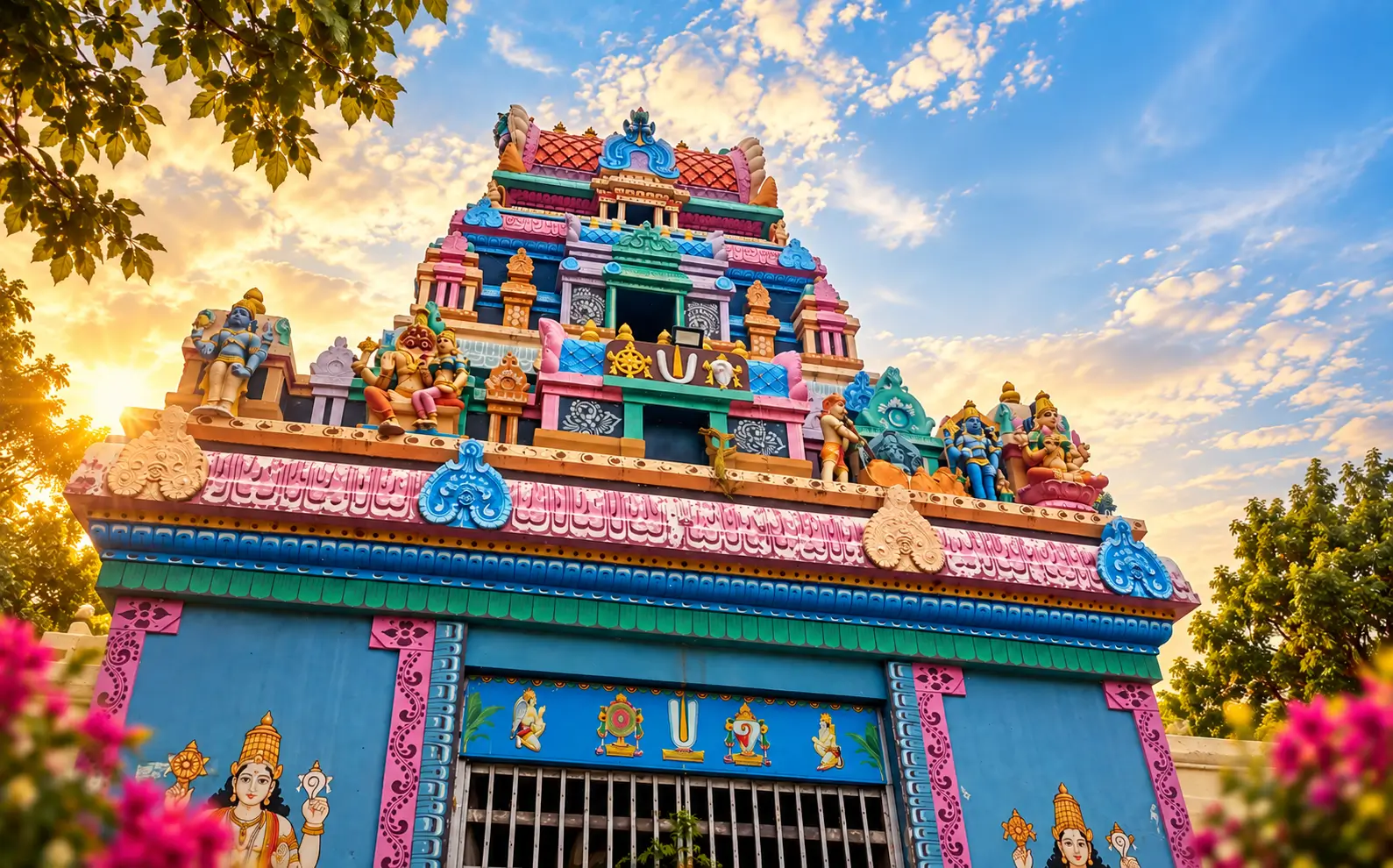
The Chikka Tirupathi Temple follows the Dravidian style of architecture and has a five-tiered gopura. The complex contains two precincts, while a temple tank lies to the north. The central shrine houses Venkateshwara in a standing posture.
From the entrance, the temple's main axis leads towards the Dwajasthamba, offering pillar and Garuda Mantapa. Garuda, the traditional mount of Vishnu, faces the presiding deity in the shrine.
For visitors, these details make the temple worth slowing down for. Look beyond the main shrine and you begin to notice how the architecture guides movement, worship and attention through the complex.
Here's one detail that sets the temple apart.
The Venkateshwara idol at Chikka Tirupati is described as having an Abhayahastha, with the hand raised in a blessing gesture. Reference material about the temple contrasts this with the downward hand position associated with the presiding deity at Tirumala.
It is a small visual detail, but one with considerable storytelling value. Two temples associated with Venkateshwara can share a devotional connection while still retaining their own traditions and iconographic details.
Daily Rituals at the Temple
The temple follows four principal daily rituals:
| Ritual | Time |
| Ushathkalam | 8:00 AM |
| Kalasanthi | 10:00 AM |
| Sayarakshai | 5:00 PM |
| Ardha Jamam | 7:00 PM |
Traditional worship includes alankara, or decoration; neivedhya, the offering of food; and deepa aradane, the waving of lamps. Vedic recitations are also part of the worship, alongside weekly, fortnightly and monthly observances.
The official temple website currently lists general visiting hours of approximately 6:30 AM to 7:30 PM.
If you are planning your visit around a particular ritual, however, check the latest schedule before leaving. Festival days and special occasions can follow different timings.
The annual Brahmotsava is described in available references as the temple's major festival. During the celebrations, festival images of the presiding deities are taken through the temple streets in a chariot procession. The celebration has historically drawn devotees from surrounding areas.
The Karaga festival, associated with the Mother Goddess, offers another glimpse into the temple's living traditions. Traditional accounts describe devotees walking around 15–20 km from surrounding villages as part of their pilgrimage, while neighbouring villages provide food for the pilgrims.
These celebrations show why a temple visit here can feel different during festival season. The experience extends beyond the shrine itself and into the surrounding community.
Travellers from Bengaluru can reach the temple by road, with the shrine accessible from Malur, Hoskote and Bengaluru's eastern suburbs.
There is also a more organised way to explore the region. In February 2026, KSRTC launched a Bengaluru–Chikka Tirupati package route covering several destinations in the Kolar region, including Kotilingeshwara, Bangaru Tirupati, Avani, Mulbagal, Kurudumale and Kolar, according to Deccan Herald.
The Tirupati connection may be what gets you curious, but it is the stories around this temple that make it memorable.
There is the Mahabharata-linked tradition of Agni, the tale of the deity discovered in a pond, the historical association of the region with the Ganga, Chola and Hoysala dynasties, the five-tiered gopura and the distinctive Abhayahastha of Venkateshwara.
Then there are the festivals, rituals and pilgrims who continue to keep these traditions alive.
For travellers from Bengaluru, Chikka Tirupati, Karnataka, offers an easy way to experience a place where mythology, architecture and living worship meet. You don't need to travel hundreds of kilometres to find a temple with a story worth telling.
Sometimes, the most interesting travel discoveries are hiding just beyond the familiar city map.
Everything you need to know
Chikka Tirupati is known for its Venkateshwara temple, Dravidian architecture, traditional worship, Mahabharata-linked legend and association with the wider Tirupati pilgrimage tradition.
Chikka Tirupati is located in Lakkur Hobli, Malur Taluk, Kolar district, Karnataka, near Bengaluru. The temple's official website provides the temple's current address and location details.
“Chikka” means “small” in Kannada. The name refers to the temple's association with Venkateshwara worship and the famous Tirupati pilgrimage centre.
According to temple tradition, the site is associated with the Khandava Dahana episode. The legend says Agni worshipped Vishnu in this region after losing his divine status and regained it through that worship.
The official temple website currently lists general visiting hours of approximately 6:30 AM to 7:30 PM. Ritual and festival timings may vary, so visitors should confirm the schedule before travelling.



Sep 30, 2026
TUI Staff
Sep 30, 2026
TUI Staff
Sep 29, 2026
TUI Staff
Oct 01, 2026
TUI Staff
Oct 01, 2026
TUI Staff
Oct 01, 2026
TUI Staff
Oct 01, 2026
TUI Staff

Stay informed with independent, fact-checked journalism on technology, environment, government, economy and more. India’s most trusted digital news platform.





Comments (0)
Be the first to comment!