
FSSAI Warning Labels: Chips, Biscuits and Sugary Drinks May Soon Get Red Health Alerts
Red Labels, Clearer Choices
 IN
Tue, Oct 13, 2026 | 05:11 PM IST
IN
Tue, Oct 13, 2026 | 05:11 PM IST

Packets of chips, biscuits, instant noodles and sugary drinks sold in India could soon carry prominent red health warnings on the front. India's food regulator, FSSAI, has proposed a red hexagonal label for packaged foods high in specified levels of fat, sugar or salt, according to a compliance filing placed before the Supreme Court and reported on August 28.
The proposed labels would use direct declarations such as “HIGH FAT”, “HIGH SUGAR” and “HIGH SALT”, allowing shoppers to identify products with high levels of nutrients of concern without searching through the nutrition table on the back of the packet.
The proposal is significant for another reason. Only weeks earlier, the regulator had moved away from prominent colour-coded warnings and favoured a less conspicuous black-and-white nutrition table. Now, after sustained public-health pressure and a sharp Supreme Court intervention, that position has changed.
Under the system proposed by the Food Safety and Standards Authority of India, products crossing prescribed thresholds for two or more nutrients would be covered first. Phase I would apply to foods high in at least two of these three categories:
Specified sweetened beverages would also come under the first phase. A product high in fat and salt, for example, could carry a red hexagonal declaration showing “HIGH FAT HIGH SALT” on the front of its packaging. Similarly, qualifying beverages could display a “HIGHLY SWEETENED BEVERAGE” declaration.
The proposed warning labels would also have to be prominent. Hindustan Times reported that the text would need to appear in a font one point larger than that used for the nutritional information table on the back of the packet. The idea is straightforward: shoppers should be able to recognise potentially concerning nutritional characteristics before making a purchase rather than having to interpret a detailed nutrition panel.
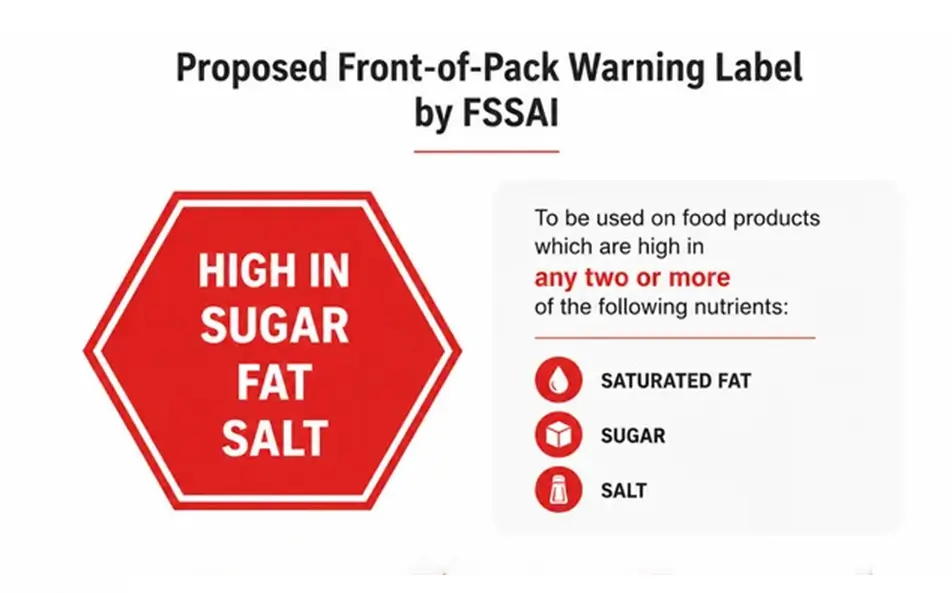
The first stage would not cover every product that exceeds the threshold for sugar, fat or salt. That would change under Phase II. Once the system expands, packaged foods exceeding the prescribed level for even one of the specified nutrients could be required to carry the relevant red declaration.
This phased approach gives food manufacturers more time to adjust packaging and, potentially, reformulate products before the wider rules take effect. It also means consumers should not assume that the absence of a red symbol during Phase I automatically means a product is low in sugar, salt or fat. A product exceeding only one threshold may initially fall outside the first phase.
Not every food sold in a packet would automatically require a red symbol. FSSAI has proposed exempting single-ingredient products and foods that are naturally or inherently rich in fat, sugar or salt. The affidavit specifically cites products including:
These exemptions would remain subject to other existing food safety and labelling requirements. That distinction matters because the proposed system is intended primarily to flag formulated or processed products rather than place warnings indiscriminately on basic ingredients.
The proposal follows unusually strong criticism from the Supreme Court. On August 13, a bench of Justices J B Pardiwala and K Vinod Chandran gave the Centre and FSSAI two weeks to put its final position on front-of-pack labelling before the court. The judges questioned why the authorities had taken so long to adopt clearer nutritional warnings and repeatedly framed the issue as one of public health, particularly children's health.
“This is your last chance,” the bench told the government, warning that the court could issue its own directions if regulators failed to act. The court also rejected arguments that international standards could not easily apply to India simply because Indian food and dietary habits were different. Its central point was that consumers should have clear information about what they are buying. The court was not seeking to ban chips, namkeen, biscuits or other products. It wanted shoppers to know when such products contained particularly high levels of nutrients linked with health concerns.
India has debated front-of-pack labelling for years. Reuters reported that large food and beverage companies and industry associations representing businesses including Coca-Cola, Nestlé and PepsiCo had opposed warning-label systems, arguing that they could confuse consumers and might not significantly change dietary behaviour. For manufacturers, the stakes are substantial.
A visible red warning label could influence how shoppers perceive products even when those foods remain completely legal to manufacture and sell. Companies could therefore face a choice: carry the warning or reformulate products to reduce sugar, salt or fat below the relevant threshold. That possibility is one reason front-of-pack rules can function as more than consumer information. They can also create pressure on manufacturers to change recipes.
The front-of-pack debate is not new. FSSAI circulated an early draft related to front-of-pack labelling in 2018. Almost eight years later, the regulator still had not finalised the framework.
Economic Times Health reported in March 2026 that the regulator had conducted repeated industry and stakeholder consultations over the years. More than 14,000 comments and suggestions had also been received on an earlier draft regulatory framework. A parliamentary panel again called for the regulations to be finalised in a time-bound manner in July 2026, citing growing consumption of packaged and ultra-processed foods and the need for clearer consumer information. That long history explains why the Supreme Court became increasingly impatient with further delays.
India's existing system largely requires nutritional information and ingredient details to appear on packaging, but consumers usually need to turn over the packet and interpret several numbers. The proposed red symbol changes that. For a shopper standing in a supermarket, food safety information would become much harder to overlook. That is particularly important in the context of rising obesity and non-communicable diseases. Reuters cited research projecting that around 450 million Indians could be overweight or obese by 2050.
Supporters of stronger labelling argue that the purpose is not to tell consumers what they can or cannot eat. It is to make nutritional characteristics immediately visible so buyers can make an informed decision.
Not yet. This is perhaps the most important point for consumers following FSSAI Latest News. The affidavit represents the regulator's proposed framework before the Supreme Court. It does not mean companies must immediately start printing red hexagons on packets. FSSAI has told the court that amendments to the relevant regulations will have to follow the prescribed regulatory procedure before implementation. The exact rollout schedule has also not been announced publicly. The proposed nutritional thresholds are linked to the Dietary Guidelines for Indians 2024, issued by the ICMR-National Institute of Nutrition. However, the reporting on the affidavit does not yet provide a complete product-by-product table of numerical limits that consumers can use to predict exactly which brands will receive a warning.
For now, the direction is much clearer than it was even a few weeks ago. After years of consultations, industry opposition and regulatory hesitation, India is closer than before to putting unmistakable nutritional warnings directly on the front of packaged foods. Whether the red hexagon reaches supermarket shelves in its current form will now depend on the regulatory process, the Supreme Court's next directions and how firmly the government holds to the proposal it has placed before the court.
Everything you need to know
FSSAI has proposed a red hexagonal front-of-pack warning label for packaged foods and drinks high in any two or more of added fat, added sugar or salt, filed in a Supreme Court compliance affidavit dated 28 August 2026, per Reuters and Hindustan Times.
Earlier in August 2026, FSSAI had told the Supreme Court it favoured a black-and-white nutrient table over colour-coded warnings. After the Court, on 13 August 2026, warned it was FSSAI's 'last chance' to act, the regulator reversed course and proposed the red hexagon label instead, according to The Times of India and The Week.
Implementation is planned in phases: products high in two or more nutrients of concern would be labelled first, with coverage later extended to products high in even one nutrient. Single-ingredient foods would be exempt, per Hindustan Times' reporting on FSSAI's filing.






Oct 08, 2026
TUI Staff
Oct 06, 2026
TUI Staff
Oct 01, 2026
TUI Staff
Sep 30, 2026
TUI Staff
Oct 13, 2026
TUI Staff
Oct 13, 2026
TUI Staff
Oct 13, 2026
TUI Staff
Oct 13, 2026
TUI Staff

Stay informed with independent, fact-checked journalism on technology, environment, government, economy and more. India’s most trusted digital news platform.








Comments (0)
Be the first to comment!