
Career, Marriage or Motherhood? What’s Driving the Rise of Egg Freezing in India?
Preserving fertility today, keeping tomorrow’s choices open!
 IN
Sat, Oct 24, 2026 | 05:10 PM IST
IN
Sat, Oct 24, 2026 | 05:10 PM IST


What if you want children someday, but not yet?
Maybe your career is taking off. Maybe you haven't found the right partner. Maybe you want financial stability first. Or perhaps you simply aren't ready to make one of life's biggest decisions.
For a growing number of women, egg freezing in India is emerging as a way to keep that decision open for a little longer.
But this isn't simply a story about ambitious women choosing careers over motherhood. It is about something more complicated: what happens when the timelines of career, marriage, relationships and biology don't line up?
The reasons are changing as Indian women's lives change.
A recent Indian study published in the International Journal of Reproduction, Contraception, Obstetrics and Gynecology analysed 62 women who underwent planned oocyte cryopreservation between 2013 and January 2026. It found that 85.5% of cases were for elective or social reasons, while the most common age group was 30–34. The study also reported an approximately four-fold increase in the annual rate of patients undergoing the procedure after the COVID period.
The study is based on a single fertility centre, so it cannot represent all Indian women. But it does offer a useful window into a changing conversation.
Women are spending longer in education, building careers and seeking financial independence before starting families.
For some, motherhood remains firmly in their plans. It simply doesn't fit into their immediate plans.
That distinction matters.
Egg freezing is not necessarily about choosing career over children. For some women, it is about creating more flexibility between the two.
There is another reason that often gets less attention: partner uncertainty.
A woman may want children but may not have found a partner with whom she wants to start a family. Freezing eggs can potentially separate two questions:
“Do I want children?”
and
“Am I ready to have them now?”
That can be particularly relevant in India, where marriage and parenthood have traditionally been closely connected.
Personal and financial readiness
Some women also want to first achieve a degree of financial or emotional stability.
That could mean building savings, establishing a career, finding a partner or simply feeling ready for parenthood.
In this sense, the rise of egg freezing reflects a much larger change: Indian women are increasingly planning major life decisions on their own timelines.
Egg freezing, medically known as oocyte cryopreservation, involves retrieving mature eggs from the ovaries and preserving them for possible future use.
So, how is egg freezing done?
The egg freezing procedure usually involves hormonal stimulation for around 10–14 days, monitoring of the ovaries, and then egg retrieval. The mature eggs are rapidly frozen using vitrification and stored in specialised cryogenic tanks.
If a woman later chooses to use them, the eggs are thawed, fertilised in a laboratory and the resulting embryo may be transferred to the uterus.
The biggest technological change has been the move from slow freezing to vitrification. According to the American Society for Reproductive Medicine (ASRM), rapid cooling reduces intracellular ice-crystal formation and has improved the survival of eggs after thawing.
In simple terms, how is egg freezing done? It is a process of stimulating, retrieving, rapidly freezing and storing eggs - not freezing an embryo or guaranteeing a future pregnancy.
The available evidence points towards growing interest, although India does not yet have comprehensive nationwide data tracking planned egg-freezing cycles.
The Indian market for egg freezing and embryo banking was estimated by Grand View Research at $206 million in 2023 and is projected to reach $632.5 million by 2030, representing a projected CAGR of 17.4%. The under-35 segment was the largest revenue-generating age group in 2023.
The recent Indian study adds another interesting finding: only 9.7% of women in its cohort had used their frozen eggs by the time of analysis.
That number needs context.
Low utilisation does not necessarily mean women regret freezing their eggs or that the procedure failed. Some may conceive naturally, change their plans or simply not have reached the stage at which they need the stored eggs.
Sometimes the value is knowing that another option exists.
Egg freezing is not only for women postponing motherhood for career or relationship reasons.
It can also be considered for medical fertility preservation.
This may include women who are facing treatments such as chemotherapy or radiotherapy that can affect ovarian function, as well as some women with medical conditions or procedures that may threaten future fertility.
The American Society for Reproductive Medicine's 2026 guidance recognises mature oocyte cryopreservation as an established fertility-preservation technique for appropriate patients facing medical risks to fertility.
For planned egg freezing, however, the decision needs individual counselling. Age, ovarian reserve, medical history and reproductive goals all need to be considered.
This is where online conversations often become misleading.
You may hear that every woman should freeze her eggs before 35. There is no universal magic age.
What the evidence does show is that age at freezing matters. ASRM says live-birth rates per embryo transfer are improved when planned egg freezing is performed in younger women compared with older women, but there is insufficient evidence to prescribe one optimal age for everyone.
The 2026 Indian study also found that the number of mature eggs retrieved declined significantly with increasing age.
Tests such as AMH and antral follicle count may help doctors assess ovarian reserve and plan treatment. But these tests cannot promise that frozen eggs will eventually result in a baby.
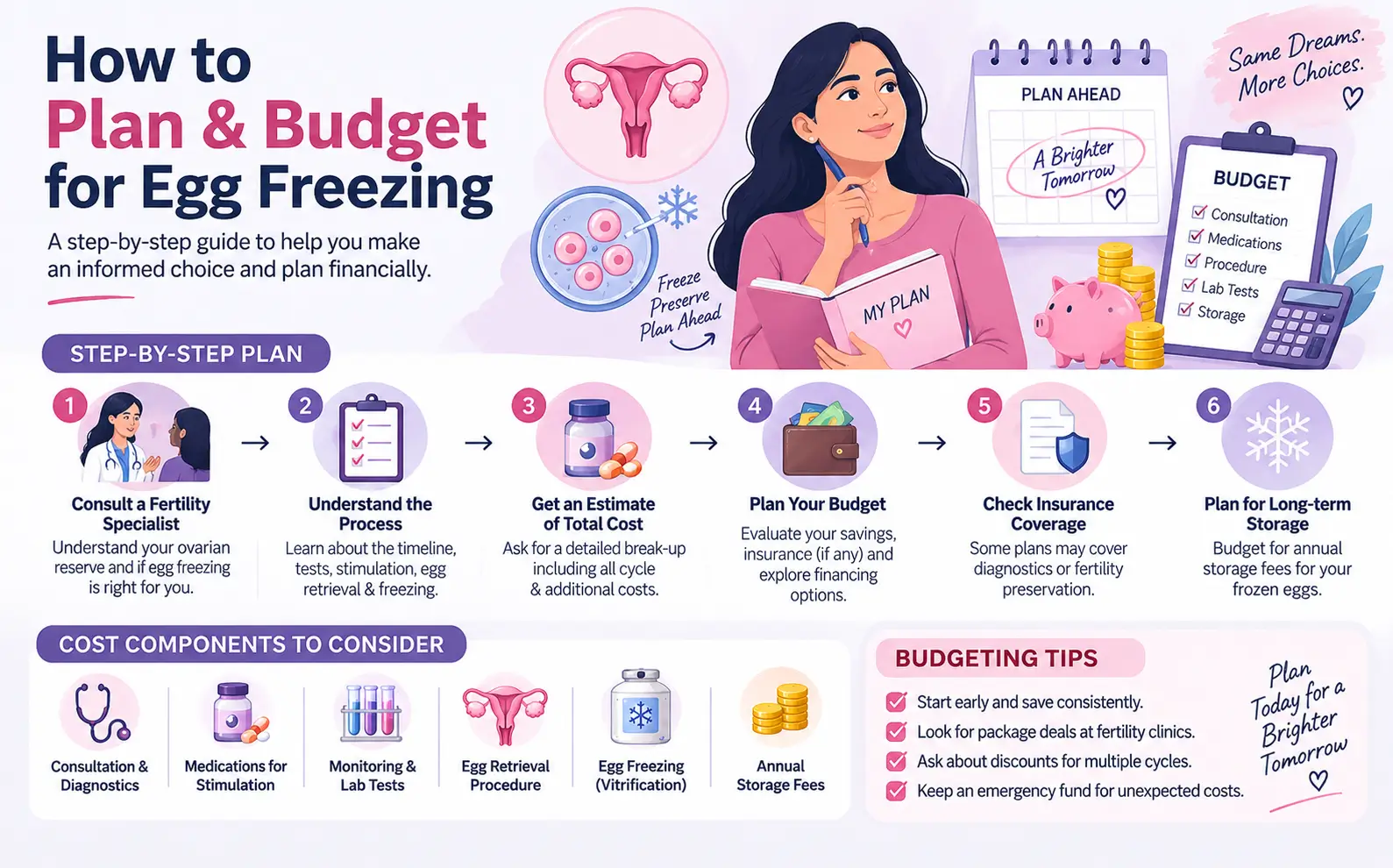
The egg freezing cost in India varies considerably depending on the fertility clinic, medicines, laboratory services and what the quoted package includes.
The three Indian articles reviewed for this story cite an approximate range of ₹1.5 lakh to ₹3 lakh per cycle, with additional storage charges. The actual amount can be higher if more than one cycle is required or if the eggs are eventually used through IVF.
That makes affordability an important part of the conversation.
The egg freezing cost in India isn't simply the price of one retrieval procedure. Women should ask about:
This is why egg freezing may offer reproductive flexibility, but it is not equally accessible to everyone.
The first step should not be booking a egg freezing procedure. It should be having an informed conversation with a qualified fertility specialist.
When comparing egg freezing India doctors and clinics, ask about the clinic's experience, its own thaw-survival and treatment outcomes, the expected number of mature eggs that may be retrieved, and the complete cost.
ASRM recommends that people considering planned egg freezing be informed about its benefits, costs, risks and uncertainties, and that clinics disclose their own statistics where available.
Also remember that egg freezing does not guarantee future pregnancy.
Success can depend on:
Perhaps this is the bigger question behind the trend.
For some women, freezing eggs can feel empowering. It may provide more reproductive autonomy and reduce the pressure to make decisions before they feel ready.
But there is another side.
If workplaces make motherhood difficult, relationships happen later, and social expectations continue to push women towards a narrow timeline, is egg freezing giving women freedom — or helping them adapt to a system that hasn't become flexible enough?
There may be no single answer.
A case reported by THIP illustrates the more personal side of the decision. Mumbai-based PR professional Gayatri Sethi froze her eggs in her early 30s after discussing future family planning with her husband. She described the decision as a way of keeping another possibility open and gaining peace of mind. She later conceived at 32.
Her story also highlights something easy to miss: frozen eggs may never be used.
The rise of egg freezing in India is ultimately about more than fertility technology.
It reflects changing ideas about work, marriage, relationships, financial independence and motherhood.
For some women, it may offer precious breathing room. For others, medical fertility preservation may make it an important part of protecting future reproductive possibilities.
But eggs can be frozen. Time cannot.
The procedure cannot stop reproductive ageing, and it cannot guarantee a future baby.
What it can do is preserve one more possibility - allowing some women to say:
“I may not be ready today. But I don't want to close the door on tomorrow.”
Everything you need to know
Egg freezing is a fertility-preservation procedure in which a woman’s mature eggs are collected, rapidly frozen and stored for possible future use.
Delayed parenthood, career and financial priorities, personal readiness, changing marriage patterns and greater awareness of fertility preservation are among the factors driving interest.
The process generally involves ovarian stimulation with medicines, monitoring through scans and blood tests, egg retrieval under sedation, and rapid freezing of mature eggs using vitrification.
Costs vary by clinic and city. A cycle may commonly range from around ₹1.5 lakh to ₹3 lakh, with storage and future IVF expenses potentially adding to the overall cost.
No. Egg freezing preserves an option for future fertility treatment, but it does not guarantee pregnancy or a live birth. Outcomes depend on factors including age when eggs are frozen and the number and quality of eggs stored.






Oct 21, 2026
TUI Staff
Oct 19, 2026
TUI Staff
Oct 19, 2026
TUI Staff
Oct 19, 2026
TUI Staff
Oct 23, 2026
TUI Staff
Oct 23, 2026
TUI Staff
Oct 22, 2026
TUI Staff
Oct 22, 2026
TUI Staff

Stay informed with independent, fact-checked journalism on technology, environment, government, economy and more. India’s most trusted digital news platform.






Comments (0)
Be the first to comment!