
Satya Niketan PG Collapse Update: Rekha Gupta Orders Delhi-Wide Bulldozer Crackdown, PG Operator Arrested
Seven deaths trigger inspections, demolitions and a proposed new PG law.
 IN
Sat, Oct 24, 2026 | 08:13 PM IST


Delhi Chief Minister Rekha Gupta has ordered a citywide crackdown on illegal construction, including intensive inspections of paying-guest accommodations, after the Satya Niketan PG building collapse killed seven people. On September 9, Gupta directed the Municipal Corporation of Delhi to deploy demolition teams against unauthorised structures in different parts of the capital and asked senior MCD officers to remain on the ground during enforcement operations. She also ordered officials to inspect PG hostels across Delhi and act wherever building violations are found.
The action marks a major escalation from the initial response to the September 6 tragedy. What began as an investigation into one collapsed student hostel has now expanded into questions about unauthorised floors, structural safety, MCD oversight and whether hundreds of private PGs operating around Delhi's university hubs are legally fit to house students.
The Delhi Chief Minister has asked the civic body to identify unauthorised structures and begin enforcement instead of limiting action to Satya Niketan. According to the latest Hindustan Times reporting, Gupta specifically directed officials to:
Her instruction on building records is particularly important. Gupta wants officials to establish not only who constructed illegally, but also how such buildings were allowed to remain standing and commercially occupied for years. As of the morning of September 9, the MCD had already sealed nine properties during its wider crackdown, while additional enforcement activity was reported in different civic zones.
The building that collapsed on September 6 was being used as student accommodation in South Delhi's Satya Niketan, close to Delhi University's South Campus. The death toll ultimately rose to seven, while several others were injured. An early MCD assessment found serious regulatory issues. According to a senior civic official cited by Hindustan Times, the property at P-14 stood on a plot of roughly 55 square yards, had a basement and four floors, and did not have a sanctioned building plan. Unauthorised construction in the basement was also identified during the preliminary assessment.
Investigators are examining additional floors, repair work and basement construction as possible factors behind the collapse. Police have also alleged that the owner knew the base of the decades-old building was weak but additional floors were constructed nevertheless. Those allegations remain part of the ongoing criminal investigation and have not yet been established in court. That distinction matters. It is safer to say structural alterations and illegal construction are under investigation than to state that one specific activity has already been proven as the definitive cause.
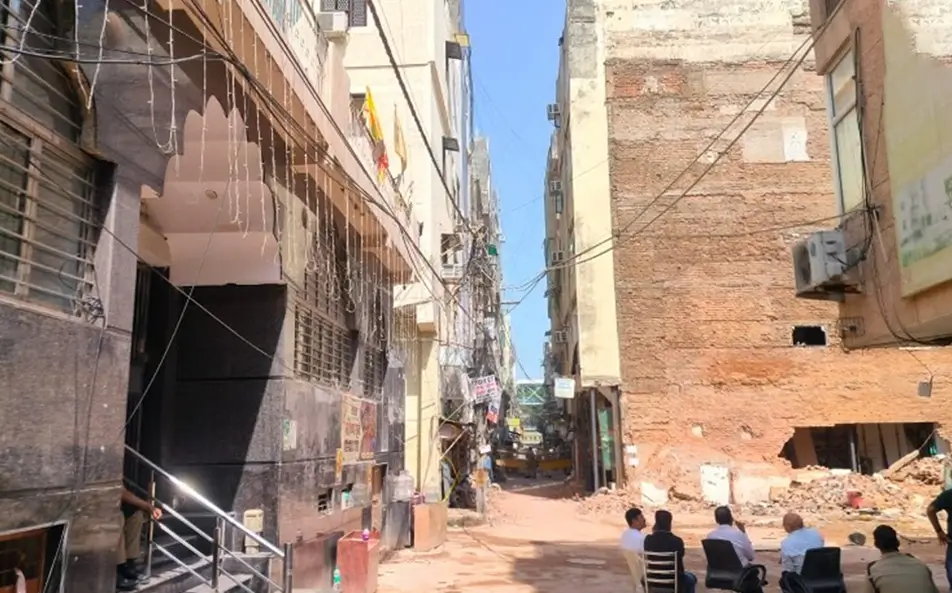
Early reports on the day of the disaster initially put the death toll at three and later five as rescue teams continued searching through the debris. It eventually climbed to seven. The Indian Express reported that five of those who died were Delhi University students. The tragedy immediately raised questions about the conditions in privately operated hostels around South Campus, where students arriving from outside Delhi often depend on small PG accommodations because university hostel capacity is limited. TUI has previously examined the wider safety problem in its report on the Satya Niketan PG collapse and the risks facing Delhi students. The latest crackdown is the government's attempt to answer some of those concerns.
Responsibility is not being examined only at the property-owner level. The MCD suspended five senior and junior officials from its South Zone on September 7 while investigations continue.
Those suspended include:
The suspensions were ordered with immediate effect pending disciplinary proceedings. MCD Commissioner Sanjiv Khirwar subsequently said the corporation had “zero tolerance” for unauthorised construction and that building-department officials would be held accountable where lapses were found. That makes Gupta's instruction to trace old building records more significant. The investigation could establish whether violations occurred under the watch of current officials or previous officers responsible for the area.
The criminal investigation has also widened. Police first arrested Hariram Gupta, who investigators identified as the property's owner, after tracing him to Bhiwadi in Rajasthan. His wife Urmila and son Mahesh were subsequently arrested as investigators examined ownership and management of the property. Police have also arrested the labour contractor connected with the construction work. On September 9, police arrested Sudhanshu, who allegedly operated the hostel through the Hostel Daze chain.
The Indian Express reported that the operator had leased the property for approximately ₹1 lakh per month and that the chain ran several other student facilities in the surrounding area. The FIR includes allegations involving culpable homicide not amounting to murder, negligent conduct connected with construction or repair, and acts endangering life or personal safety. All accused remain entitled to due process, and the allegations will need to be proven through the investigation and subsequent court proceedings.
The crackdown is already visible on the ground. Municipal teams have begun preparing unsafe buildings in the neighbourhood for demolition, while residents and students have been asked to vacate some properties. The Indian Express reported that MCD teams had begun dismantling parts of building number 13 and that three additional buildings in Satya Niketan had received orders to vacate.
For students, this creates another problem. Removing dangerous accommodation may be necessary for safety, but large-scale closures could also leave students scrambling for housing near their colleges. That is why enforcement cannot be separated from the broader shortage of affordable student accommodation in Delhi.
The most significant longer-term development may be happening away from the bulldozers. The Delhi government has now drafted proposed legislation specifically to regulate private hostels and paying-guest accommodation. Under the proposal, PG operators would need:
The draft also proposes a central online platform called GovPG, where registered accommodations could be listed and complaints handled. Existing PG hostels would reportedly receive around 90 days to obtain the required approvals if the proposed framework becomes law. Larger accommodations could also face requirements involving CCTV coverage, security personnel and designated wardens. The legislation is still a draft proposal, not an enacted law, and is expected to undergo further work before finalisation. That distinction is important because Delhi currently lacks a dedicated, comprehensive licensing structure designed specifically around the modern PG industry.
Delhi's PG market has changed substantially. What once often meant a homeowner renting one or two spare rooms has evolved in many student neighbourhoods into multi-storey commercial accommodation businesses. A senior MCD official told Hindustan Times that PG accommodation currently does not operate under a dedicated licensing regime because it has not historically been treated as a separately regulated commercial activity. That gap becomes particularly significant in neighbourhoods where old residential houses have been vertically expanded, partitioned and converted into accommodation for dozens of students.
The Satya Niketan PG tragedy has forced authorities to confront that mismatch. A building may look like a residence on old municipal records while functioning in practice like a private hostel. For residents of a Satya Niketan PG or any similar student hostel, the question after September 6 is no longer simply how much the room costs or how close it is to college.
It is whether the building itself was legally and safely built in the first place.
Everything you need to know
After a PG building collapse in Satya Niketan killed at least five people on September 6, 2026, Delhi CM Rekha Gupta ordered the MCD to use bulldozers against illegal construction across the city and to inspect all PG hostels for violations, according to Rediff.
Gupta said the PG building was undergoing renovation when basement excavation caused a pillar to shift, bringing the structure down, per Moneycontrol. An official told The Hindu the building had only permission for a ground floor plus one floor but far more had been constructed.
The MCD ordered immediate sealing of illegal buildings above four floors, per India Today and LiveMint. An FIR has been filed against the building owner, and Gupta ordered a magisterial probe and a records check to trace when the illegal construction occurred.






Oct 23, 2026
TUI Staff
Oct 23, 2026
TUI Staff
Oct 22, 2026
TUI Staff
Oct 22, 2026
TUI Staff
Oct 23, 2026
TUI Staff
Oct 23, 2026
TUI Staff
Oct 22, 2026
TUI Staff
Oct 22, 2026
TUI Staff

Stay informed with independent, fact-checked journalism on technology, environment, government, economy and more. India’s most trusted digital news platform.






Comments (0)
Be the first to comment!