
Malegaon Fort : The 1818 Siege That Changed Its History Forever
Where layered walls turned a small fort formidable
 IN
Sun, Oct 25, 2026 | 03:08 PM IST
IN
Sun, Oct 25, 2026 | 03:08 PM IST


A small fort. A large British force. And a defence that refused to collapse.
In 1818, British troops surrounded Malegaon Fort, a Maratha stronghold in present-day Maharashtra. They expected a quick victory. Instead, they faced layered walls, a water-filled trench, determined Arab defenders and repeated artillery attacks. The fort capitulated on 13 June 1818, after an explosion in its magazine opened a breach.
Why does it matter today? Malegaon Fort shows how Maratha military planners adapted to flat terrain without the natural advantage of a hill. Its story also connects warfare with migration, craftsmanship and the growth of a town.
The fort stands in Malegaon, Nashik, Maharashtra, on the north bank of the Mausam River, a tributary of the Girna. It is about 104 km from Nashik and sits within the modern city rather than in a remote hill landscape.
Its location shaped its defence. The Mausam River formed a natural barrier, while trenches and multiple walls strengthened the landward approaches.
Local tradition links the fort’s construction around 1740 to Naro Shankar Raje Bahadur, a Sardar associated with the Peshwa administration. Historical accounts say craftsmen came from Surat and northern India and that construction took about 25 years. Some reportedly settled in Malegaon.
There is an important caveat. A Deshdoot report citing archaeological findings says there is no inscription or conclusive evidence at the site proving Naroshankar as the builder. The attribution should therefore be presented as a historical tradition, not an absolute archaeological fact.
A hill fort can use height as its first defence. This one had to create its own advantages.
The Mausam River helped protect the fort, while trenches were built around it. A local archaeological account describes them as about 25 feet deep and 16 feet wide and says they could be filled with river water. A collapsible bridge reportedly allowed controlled access.
The fort also used multiple defensive walls, bastions and cannon positions. Local documentation describes burnt-brick walls, internal passages and stairways built into the defensive structure.
It was a defence system built in layers.
The Third Anglo-Maratha War was nearing its end when British forces moved against the fort.
On 16 May 1818, Lieutenant-Colonel MacDowell surrounded the fort. A detailed local account says the British initially underestimated it because of its size.
That mistake became clear when they breached part of the outer wall.
Behind it stood another wall.
A British engineer then tried to climb the second barrier using ladders. The attempt failed, and the engineer was killed, according to the local account.
The layered design forced attackers to overcome each defensive line separately.
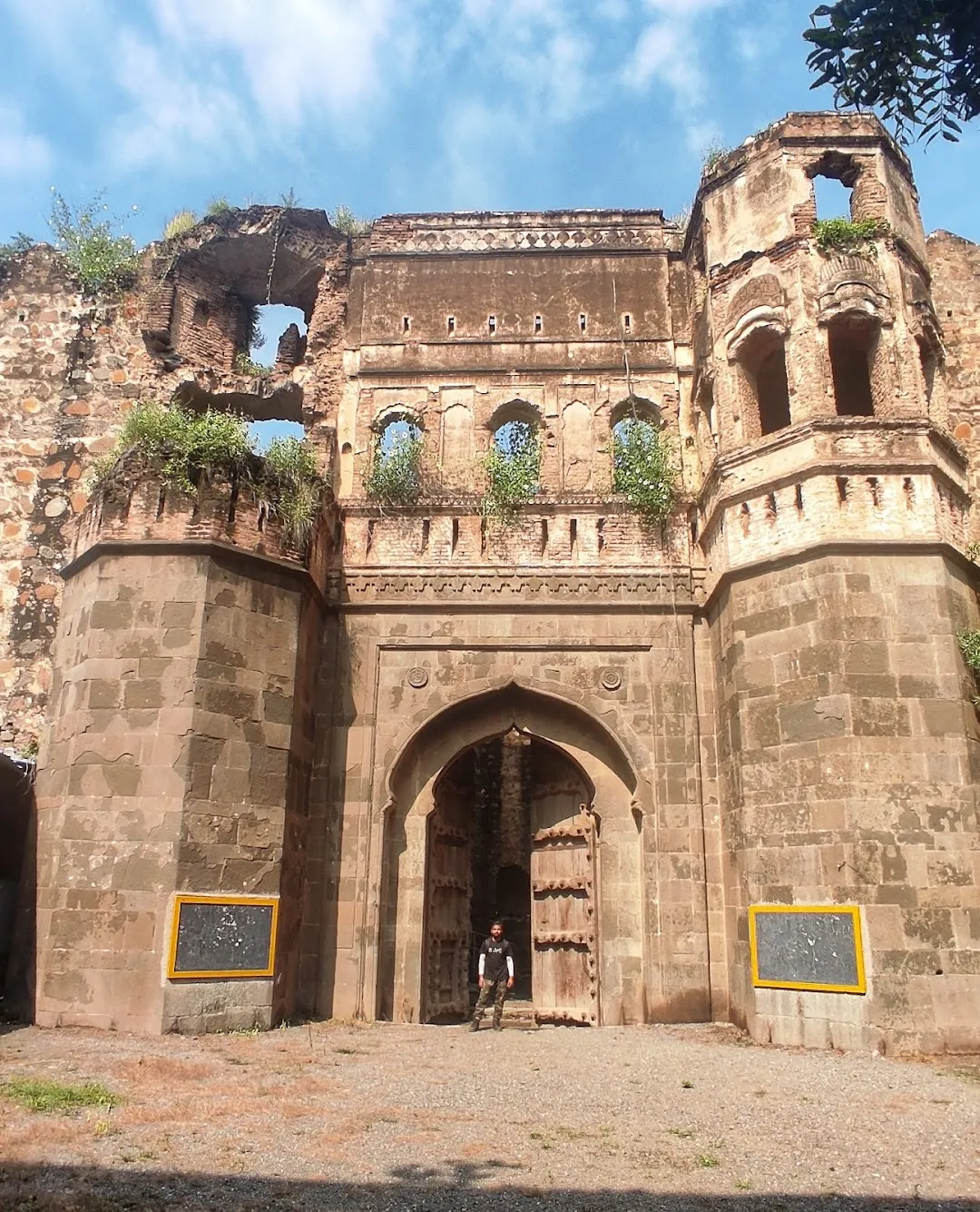
Img Src : Yappe
The Bombay Gazetteer records a garrison of about 300 men and describes repeated sorties by the Arab defenders. It says Lieutenant Davies, the chief engineer, was killed during one of these actions and Major Andrews was seriously wounded.
British reinforcements followed. The Gazetteer records 500 Hindustani Horse arriving on 22 May and another 450 infantry the next day.
The British also faced the challenges of the river and the approaching rains. Their camps shifted during the siege, while artillery positions were strengthened. The defenders continued to hold out.
By June, the British had shifted towards heavier artillery.
A howitzer attack on 5 June failed, according to the local account. Additional guns were then brought from Ahmednagar.
The turning point came when the fort’s magazine exploded. The Bombay Gazetteer says the blast created a clear breach about 30 feet wide in the inner wall. The garrison capitulated on 13 June, and the British flag was raised on one of the inner bastions.
The next day, the garrison marched out and laid down its arms. The Gazetteer records that the Arab soldiers were later sent to Surat and then Arabia.
Visitors can still find features that reveal its military design.
A Marathi high school now operates within the premises, creating an unusual contrast between an 18th-century military structure and everyday city life.
For travellers coming from Nashik, Maharashtra, Malegaon is connected by the Mumbai–Agra highway corridor. The fort lies within the city and is near the Ramsetu Bridge, according to local travel references.
It is an urban heritage site rather than a demanding hill trek. Local references place it around 15 minutes from the Malegaon ST bus stand. Older listings mention visiting hours of 10 AM to 5 PM; confirm access locally before travelling because the premises include an active school.
The fort’s importance goes beyond the battle of 1818.
Its design shows how a flat-land fort could turn a river, trenches, walls and bastions into a layered defensive system. Its siege offers a close look at the final phase of Maratha resistance against British expansion. Its construction story also points to the movement of skilled craftsmen who helped shape the town around it.
Most importantly, the fort remains part of the living city. The 1818 story of Malegaon Fort is more than a battle account. It shows how architecture, geography and human resistance can shape history.
You do not have to climb a remote mountain to encounter Maharashtra’s military past. In Malegaon, history survives beside roads, schools and everyday life.
Everything you need to know
Malegaon Fort is traditionally attributed to Naro Shankar Raje Bahadur around 1740, although archaeological evidence does not conclusively establish his authorship.
British forces besieged Malegaon Fort and faced prolonged resistance before capturing it on 13 June 1818 after artillery fire damaged its defences.
It is called a Bhuikot because it is a land fort built on relatively flat terrain rather than on a hill or mountain.
Visitors can see surviving fort walls, bastions, cannons, entrance structures, a hexagonal well and internal structures including Rangmahal.
Malegaon Fort is approximately 104 km from Nashik, according to commonly cited historical and travel references.




Oct 21, 2026
TUI Staff
Oct 19, 2026
TUI Staff
Oct 19, 2026
TUI Staff
Oct 19, 2026
TUI Staff
Oct 25, 2026
TUI Staff
Oct 23, 2026
TUI Staff
Oct 23, 2026
TUI Staff
Oct 22, 2026
TUI Staff

Stay informed with independent, fact-checked journalism on technology, environment, government, economy and more. India’s most trusted digital news platform.





Comments (0)
Be the first to comment!