
India vs Japan T20I Highlights: India Survive Huge Scare to Win 5-Over Thriller by 2 Runs
A rain-hit five-over shootout turned Japan’s historic India clash into an unexpected last-ball thriller.
 IN
Tue, Sep 22, 2026 | 04:50 PM IST
IN
Tue, Sep 22, 2026 | 04:50 PM IST


The historic T20I between India and Japan survived days of weather uncertainty, but the rain left its mark as the landmark contest at Sano was reduced to a five-over shootout.
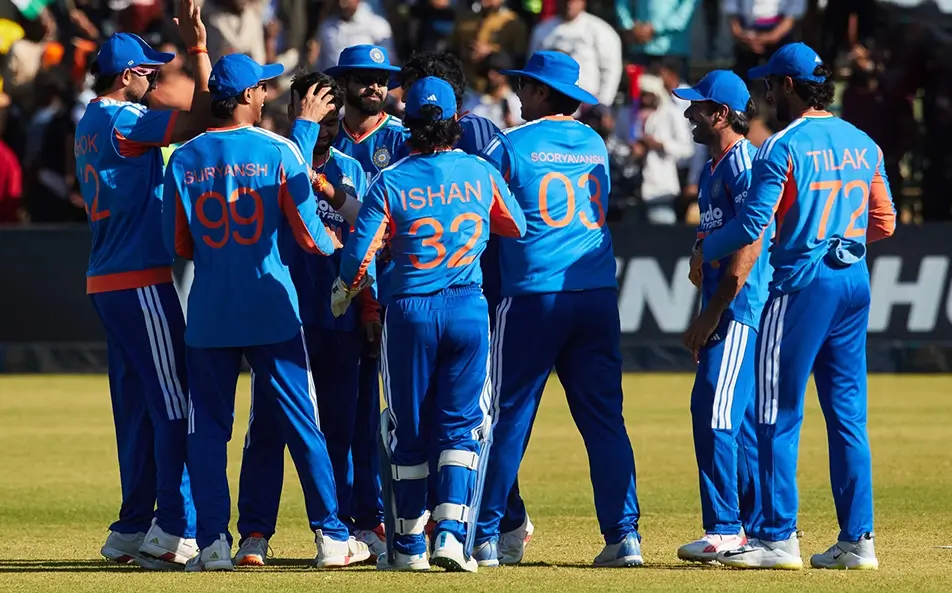
India eventually escaped with a two-run victory after scoring only 32/4 at the Sano International Cricket Ground on September 22. Japan came within touching distance of one of international cricket’s biggest upsets, finishing on 30/3 after taking the contest to the final delivery.
The match had been under serious threat after Typhoon Dujuan brought heavy rainfall to parts of eastern Japan, disrupting India’s preparation and saturating the venue. India’s scheduled training session on the eve of the game was abandoned, while another international at the same ground had already been washed out two days earlier. For the Japan Cricket Team, however, the shortened contest became an opportunity. Instead of simply sharing the field with the reigning world champions, the hosts pushed India to the final ball in their first men’s international meeting.
The T20I had originally been scheduled as a standard 20-over match beginning at 1 PM local time, but the saturated outfield forced a lengthy delay. Officials repeatedly inspected the playing conditions before eventually deciding that enough of the ground had recovered for a five-over contest. That was already an achievement considering the state of the venue less than 24 hours earlier.
Persistent rain associated with Typhoon Dujuan had disrupted India’s training on Monday and left the outfield soaked. The same Sano International Cricket Ground had been unable to host Japan’s second T20I against Hong Kong on September 20, with that fixture abandoned without a toss. The weather therefore shaped the match even after the rain itself eased. A damp, slow surface made aggressive batting difficult and transformed what was expected to be a showcase for India’s power hitters into a low-scoring contest.
India captain Shreyas Iyer won the toss and chose to bat, but the innings immediately went off script. Abhishek Sharma was dismissed for a golden duck, while Sanju Samson and Ishan Kishan also struggled to generate momentum on the sluggish surface. India lost four wickets while managing only 32 runs from five overs. Iyer top-scored with 16. For a side containing some of the most accomplished T20 players in the world, the total was remarkably modest.
But conditions helped explain the struggle.
The india vs japan cricket match was played on a surface that had absorbed substantial rain over several days. The ball did not come onto the bat cleanly, and Japan’s bowlers adapted quickly. Charlie Hara-Hinze was particularly effective, taking two wickets and putting India under pressure. What had been promoted as a historic celebration suddenly looked like a genuine contest.
A target of 33 in five overs appeared achievable, and the Japan Cricket Team refused to be overwhelmed by the occasion. Japan kept themselves in the chase deep into the innings and entered the final over needing eight runs for victory. India turned to Axar Patel for the decisive six deliveries. The hosts continued fighting, but India defended the small total and restricted Japan to 30/3, completing a two-run victory.
The result might appear straightforward in the record books—India beat Japan—but the scorecard tells a very different story. Japan had pushed one of world cricket’s strongest sides to the last ball in its first men’s international against India. For a national programme trying to increase cricket’s profile in a country dominated by baseball and football, that competitiveness could prove almost as valuable as the result itself.
India’s difficulties did not begin at the toss. Typhoon Dujuan had already affected their preparation by forcing the cancellation of Monday’s training session. That left the Indian players with limited opportunity to understand a venue where they had never previously played an international. Captain Shreyas Iyer acknowledged before the game that India had relatively little information about Japan or how the Sano surface would behave.
The lost practice session became more significant once the match began. The pitch and outfield were slower than India’s batters might typically encounter, and the five-over format left virtually no time to adjust. In a full 20-over game, a batting side can absorb an early wicket or two and rebuild. In five overs, every dot ball and every dismissal dramatically changes the contest.
The india vs japan cricket match represented far more than an unusual bilateral fixture. It was the first men’s T20 international between the two countries and was staged as the Suzuki Cup to launch celebrations connected with 75 years of India-Japan diplomatic relations. The Japan Cricket Association had described it as the largest international fixture in the history of Japanese cricket.
India arrived as one of the most powerful teams in the sport. Japan, by contrast, remain an Associate cricket nation still building participation, facilities and public recognition. That gap made the eventual two-run margin particularly striking. The weather shortened the contest dramatically, but Japan still had to bowl accurately, field effectively and handle the pressure of chasing against international-quality opposition. They did all three.
The Sano International Cricket Ground has become the centre of Japan’s attempt to build a stronger cricket culture. Located in Tochigi Prefecture, the venue regularly hosts Japan’s domestic and international fixtures. Temporary infrastructure and expanded spectator arrangements were also organised for India’s visit. The event attracted support from organisations including Suzuki Motor Corporation, Tata Consultancy Services Japan, MUFG Bank, Mizuno and State Bank of India.
That commercial interest matters for Japanese cricket. High-profile international matches can help bring investment into facilities, coaching and player development while attracting audiences who may have had little previous exposure to the sport. Tuesday’s weather could easily have turned the occasion into a complete washout. Instead, supporters eventually received an unexpectedly dramatic five-over contest.
The Japan Cricket Team now turns immediately towards a much bigger competitive challenge. Japan’s involvement in the Asian Games provides another opportunity to test its progress against stronger cricket nations. The India match was not itself part of the Games. It was a separate international staged before the tournament as both a commemorative fixture and preparation opportunity. The experience of pushing India so close could nevertheless give Japan significant confidence.
Shortened matches can create unusual results, and nobody should interpret one five-over contest as proof that the competitive gap between the two sides has disappeared. But Japan demonstrated that it could remain composed in front of a larger audience and apply pressure when conditions offered an opportunity. That is useful experience for any developing national side.
The victory also produced an important statistical milestone. Reports following the game said the win became India’s 200th men's T20I victory, making them the first country to reach that mark. That achievement creates an extraordinary contrast with the match itself. A team celebrating its 200th win in the format was pushed to the final delivery by a country playing India for the first time. That is precisely why the fixture has generated unusual India Cricket News attention despite being only a one-off match before a multi-sport tournament. India achieved another landmark. Japan nearly created one of its own.
Before the first ball, the biggest question was whether the match would happen at all. Heavy rain had cancelled India’s training, another international had already been abandoned at Sano, and the outfield remained the biggest concern even as forecasts improved. In the end, the weather did not completely erase the occasion. It transformed it. The T20I became a five-over sprint in which every delivery mattered. India scored 32, Japan chased bravely, and the result remained uncertain until the final ball.
For India, it was a narrow victory and an unusual test before the Asian Games. For Japan, it was evidence that the country’s cricketing ambitions are beginning to produce moments capable of attracting attention well beyond its existing cricket community. And for anyone following India Cricket News, the historic india vs japan cricket match will now be remembered for more than its diplomatic symbolism: Japan came within two runs of defeating one of the strongest teams in world cricket.
Everything you need to know
India defeated Japan by two runs in the historic one-off T20I. India scored 32/4 from five overs before restricting Japan to 30/3.
Wet conditions following heavy rain delayed play at the Sano International Cricket Ground, and officials eventually reduced the match to five overs per side.
Japan required eight runs from the final six balls. Axar Patel conceded only five, allowing India to escape with a two-run victory.
Yes. The September 22 fixture was the first-ever men’s international cricket meeting between India and Japan.



Sep 21, 2026
TUI Staff
Sep 21, 2026
TUI Staff
Sep 21, 2026
TUI Staff
Sep 19, 2026
TUI Staff
Sep 21, 2026
TUI Staff
Sep 21, 2026
TUI Staff
Sep 21, 2026
TUI Staff
Sep 21, 2026
TUI Staff

Stay informed with independent, fact-checked journalism on technology, environment, government, economy and more. India’s most trusted digital news platform.


Comments (0)
Be the first to comment!