
India Couture Week 2026 : How Sobhita Dhulipala Became Rahul Mishra’s Eternal ‘Devi’?
India Couture Week 2026 turned couture into live art as Sobhita Dhulipala embodied Rahul Mishra’s eternal muse.
 IN
Wed, Sep 16, 2026 | 04:15 PM IST
IN
Wed, Sep 16, 2026 | 04:15 PM IST


The runway did not end with a quick celebrity wave. It slowed into a ritual.
At the centre stood Sobhita Dhulipala, dressed in ivory and champagne. As classical music filled the venue, attendants surrounded her, added an embroidered skirt and placed each ornament with deliberate care. Within minutes, a couture look became a live transformation.
That sequence closed the India Couture Week 2026 finale and gave Devi: The Eternal Muse its defining image. The actor was not used only as a conventional showstopper. She became part of the collection’s story and a bridge between modern couture and India’s sculptural traditions.
The India Couture Week 2026 presentation showed how Indian fashion can bring heritage, artisan craft and live performance together without reducing the moment to celebrity spectacle.
The 19th edition ran from July 23 to 29, 2026. It opened with Anamika Khanna at Taj Falaknuma Palace in Hyderabad before moving to Taj Palace, New Delhi, according to Hyundai Motor India’s official announcement.
The closing showcase brought Devi: The Eternal Muse to India after its Paris Haute Couture Week outing. Femina described the Delhi presentation as the collection’s Indian debut and a homecoming shaped through fashion, music and storytelling.
The outfit was completed on stage through a shringara-inspired sequence. The transformation became part of the design rather than a separate celebrity moment.
She first appeared in a fitted, sculptural base in ivory and champagne tones. Femina reported that the mesh corset-inspired silhouette carried detailed embroidery linked to India’s architectural heritage, including references to the Ajanta Caves.
The presentation then changed pace.
Attendants gathered around her and added an elaborate outer skirt. Jewellery and decorative elements followed, each placed with choreographed precision. Classical music strengthened the ceremonial mood.
The Times of India reported that the final look included crystals, sequins, beads and floral embroidery. It also described the performance as a live transformation rather than a standard runway close.
The outfit was not revealed at once. Viewers watched it take shape layer by layer. That choice turned the act of dressing into the story itself.
A showstopper usually appears in the final and most dramatic look. Here, the role carried more purpose.
According to Femina, Rahul Mishra viewed “Devi” as an enduring idea that has inspired generations of sculptors, artisans and storytellers. He chose the actor to embody that continuing source of inspiration, not simply to create a celebrity-led finale.
Her stillness, movement and participation in the adornment sequence helped make that concept visible. She represented the shift from sculpture to fabric and from inherited memory to present-day fashion.
Calling her a showstopper explains where she appeared. Calling her a muse explains why she was there.
The Rahul Mishra Devi collection drew from feminine figures found across Indian sculpture and sacred architecture. The label’s official collection page describes devis, dancers and celestial attendants carved into sandstone, granite and basalt.
The garments did not simply copy historic sculptures. The atelier translated their posture, jewellery, carved folds and volume into wearable surfaces.
Stone appears permanent and heavy. Couture must move with the body. The collection addressed that contrast through dense handwork, structured bodices, fluid drapes and jewellery-like embellishment.
The official collection note explains that the atelier built form through accumulation. Hand embroidery, weaving and artisanal craft added texture until the fabric began to carry the depth of a carved surface.
The collection used zardozi, dabka, crystals and bugle beads, according to the designer’s official page. Reports on the Delhi show also highlighted detailed threadwork that created gradual shifts in shadow and colour.
Fine embroidery formed contours around the body. Embellished layers caught the light like jewellery on a sculpture. Draped panels softened the structure so the garments could still move.
The craft also shifted attention towards the people behind the spectacle. Embroiderers, pattern makers, designers, performers and production teams helped build the final moment.
The collection had appeared globally before reaching New Delhi. Its Indian presentation was a reinterpretation rather than a first unveiling.
In Delhi, theatre played a larger role, based on the presentations described by Femina and The Times of India. Music, attendants and the gradual shringara sequence gave the clothes an emotional setting.
This journey strengthened the global-local balance of the Rahul Mishra Devi collection. Its craftsmanship could speak to an international couture audience, while its Indian presentation returned the references to a setting where their symbolism felt immediate.
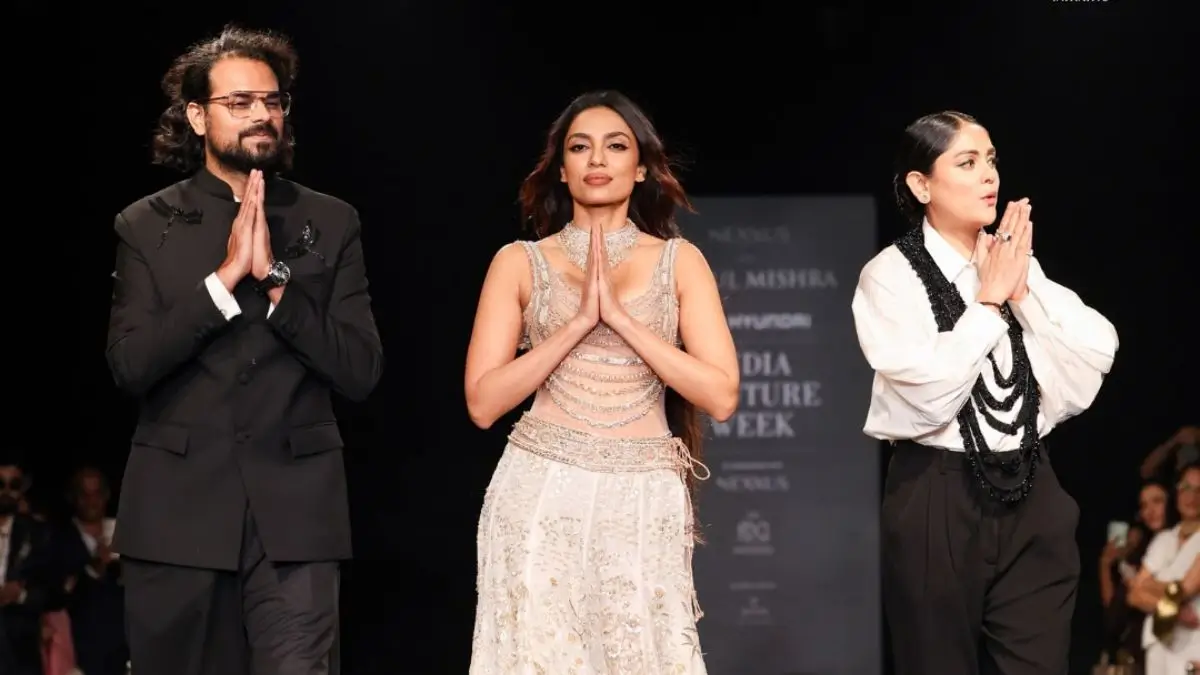
Img Src : India TV News
Celebrity appearances often dominate fashion coverage. They bring attention to a show, but they can also push the clothing and craftsmanship into the background.
The ICW 2026 presentation largely avoided that problem. The actor created the headline, but the transformation directed attention towards embroidery, ritual, sculpture and collective craft.
This is an interpretation based on the show’s structure. The celebrity did not arrive in a fully completed look and leave. The audience watched the clothing, adornment and performance create meaning together.
The finale showed how heritage can inform modern fashion without becoming a museum copy. Old artistic forms were rebuilt through contemporary silhouettes, movement and performance.
For readers, that is the show’s real value. It was not only about who wore the closing look. It was about how clothes can carry memory—and how a runway can make that memory move.
In the final moments, the audience did not simply see Sobhita Dhulipala wearing couture. It watched a character, a garment and an artistic idea emerge together.
That is what gave India Couture Week 2026 its impact. The celebrity, performance and craft supported one another.
By the end, the muse was no longer standing outside the collection as its star attraction. She had become part of the artwork itself.
Everything you need to know
Sobhita Dhulipala closed the India Couture Week 2026 finale for Rahul Mishra’s Devi: The Eternal Muse collection.
Sobhita underwent a live shringara-inspired transformation as attendants added an embroidered skirt, jewellery and decorative couture elements on stage.
The collection drew inspiration from Indian temple sculptures, sacred architecture, celestial figures and the visual depth of carved stone.
Rahul Mishra presented her as the living embodiment of the feminine force that has inspired Indian artists, artisans and storytellers across generations.
No. The collection was first presented at Paris Haute Couture Week before being reinterpreted for its Indian showcase in New Delhi.


Sep 15, 2026
TUI Staff
Sep 15, 2026
TUI Staff
Sep 14, 2026
TUI Staff
Sep 16, 2026
TUI Staff
Sep 16, 2026
TUI Staff
Sep 16, 2026
TUI Staff
Sep 16, 2026
TUI Staff

Stay informed with independent, fact-checked journalism on technology, environment, government, economy and more. India’s most trusted digital news platform.


Comments (0)
Be the first to comment!