
FCRA Bill Explained: Why Churches Fear Losing Control Over Foreign-Funded Assets
Oversight or Control?
 IN
Thu, Oct 22, 2026 | 03:48 AM IST
IN
Thu, Oct 22, 2026 | 03:48 AM IST

The government has moved to calm fears over the FCRA Bill after churches and Opposition parties warned that the proposed law could let the state take control of religious and charitable property.
In a detailed PIB clarification, the Centre said a place of worship’s religious character will be preserved “by law in all cases,” even if an organisation’s FCRA registration is cancelled, surrendered or not renewed. PIB also said the Designated Authority cannot convert, repurpose or secularise a religious institution.
That assurance matters most to minority-run schools, hospitals, churches and charitable bodies that depend on foreign donations. The fear is not only about funding. It is about whether institutions built over decades could lose control of assets if their foreign-funding licence lapses.
FCRA stands for the Foreign Contribution (Regulation) Act. It regulates how individuals, associations and companies in India receive and use foreign donations. PRS Legislative Research notes that the law is meant to ensure foreign contributions are not diverted toward activities harmful to national interest.
The FCRA Amendment Bill 2026 was introduced in the Lok Sabha on March 25, 2026. It creates a framework for the supervision, management and disposal of foreign contribution and assets belonging to organisations whose FCRA certificate ceases to exist. This can happen if registration is cancelled, surrendered, not renewed or denied renewal.
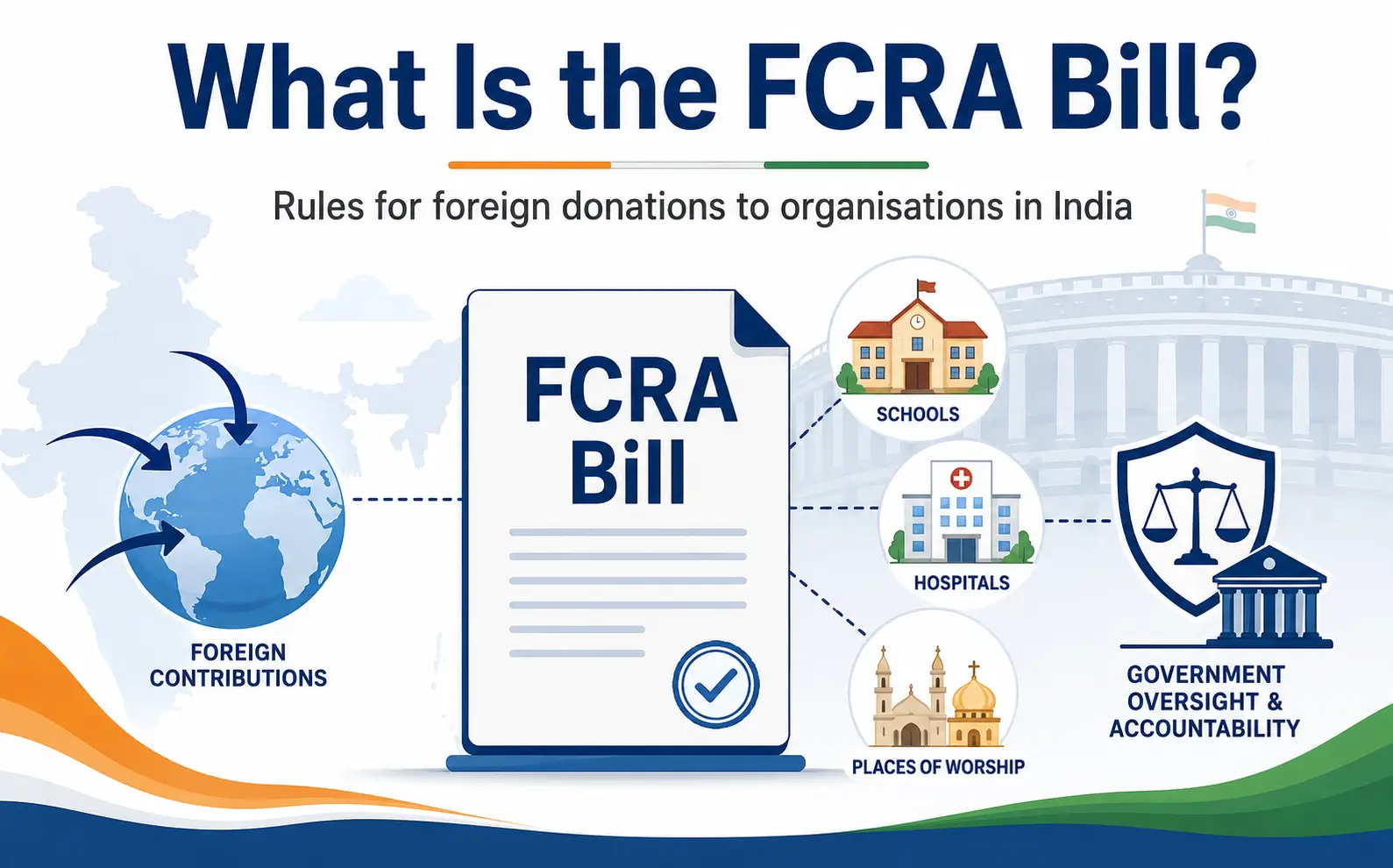
At the centre of the controversy is the proposed Designated Authority. PRS says this authority would manage foreign contributions and assets in cases where an organisation no longer has an active FCRA certificate.
PIB says this does not mean the government can seize an organisation’s entire property. According to the government, the authority would manage only assets created from foreign contributions, and only after registration has lawfully ceased. If the organisation gets its registration restored within the prescribed period, the unused funds and assets must be returned in full.
If registration is not restored, the assets may vest permanently in the authority and be used for public purposes. PIB says they can be transferred to departments such as education or health, or sold only where they cannot be directly used for public purposes. The proceeds would go to the Consolidated Fund of India, and PIB says no official can personally benefit.
The government’s strongest clarification is on places of worship. PIB says religious places will retain their character in all cases. It also says every order of the Designated Authority can be revised within 90 days and challenged before a District Judge.
PRS gives the legal detail behind this. If a permanently vested asset is fully or partly a place of worship, the Designated Authority must entrust its management to a person in the prescribed manner and ensure that the religious character of the place is maintained.
The Centre has also said the law does not target any religion or community. PIB states that faith-based welfare activities, religious education, maintenance of places of worship and charitable work by organisations of every faith remain eligible for foreign funding.
The clarification has not ended the concern. Indian Express reported that the Catholic Bishops’ Conference of India warned that the Bill could threaten the operational survival of minority and civil society organisations that depend on foreign contributions for social, educational and charitable work.
Opposition parties have also raised questions. Their concern is that if renewal is denied or delayed, assets created out of foreign funds could move into the Designated Authority’s control. PRS flags a similar issue, noting that organisations whose certificates are not renewed may lose assets created from foreign contributions, even if those assets were created in the past and the organisation now operates with domestic funds.
That is why churches and civil society groups are not fully reassured. The government is saying the Bill protects religious character. Critics are asking whether control over schools, hospitals and charitable institutions could still shift away from the original organisation.
The Centre has argued that regulating foreign funding is not unique to India. TOI reported that the government cited laws in the US, UK, Australia and Canada to say democracies across the world regulate foreign money because it can affect democratic institutions, elections and public discourse.
The government also says FCRA does not ban NGOs from receiving foreign funds. According to TOI, the Ministry of Home Affairs said 16,200 associations were actively registered in 2024-25 and received ₹22,963 crore in foreign contributions.
The Centre’s argument is that the amendment is about transparency, national sovereignty and accountability. Critics argue that the same language could give the executive too much control over civil society institutions.
The Bill has not become law. It remains before Parliament, and the government's Q&A, however detailed, is not itself a legal guarantee until the text is passed and tested in practice. For churches, schools and hospitals watching their foreign funding lines, the real test will come the first time a registration is actually cancelled and the Designated Authority has to act.
For now, the government is trying to say the Bill is about oversight, not seizure. Critics are saying oversight without enough safeguards can still become control.
Everything you need to know
The FCRA Bill deals with the supervision, management and disposal of foreign contributions and assets when an organisation’s FCRA registration is cancelled, surrendered or not renewed.
No. PIB states that a place of worship's religious character will be maintained by law in all cases, and the Designated Authority must ensure this even for permanently vested assets, per PRS Legislative Research.
No, the Bill was introduced in the Lok Sabha on March 25, 2026, and remains pending in Parliament, with churches, opposition MPs and the government still contesting its provisions.



Oct 19, 2026
TUI Staff
Oct 19, 2026
TUI Staff
Oct 17, 2026
TUI Staff
Oct 17, 2026
TUI Staff
Oct 19, 2026
TUI Staff
Oct 19, 2026
TUI Staff
Oct 17, 2026
TUI Staff
Oct 17, 2026
TUI Staff

Stay informed with independent, fact-checked journalism on technology, environment, government, economy and more. India’s most trusted digital news platform.








Comments (0)
Be the first to comment!