
Article 371: What Ladakh’s Seven Hill Councils Mean
Where Local Voice Meets Constitutional Change
 IN
Fri, Oct 16, 2026 | 12:35 PM IST
IN
Fri, Oct 16, 2026 | 12:35 PM IST

Ladakh is heading toward a major governance shift, with the administration announcing autonomous hill councils for all seven districts and a proposed UT-level body to tie the structure together. For a region long focused on land protection, local jobs, cultural identity, and stronger self-rule, the move has reopened the Article 371 debate in a big way.
This development matters because it is not just about adding more councils on paper. It raises bigger questions about how Leh Ladakh will be governed, who will control local development, and whether the new framework can finally address long-standing demands from the people of the region.
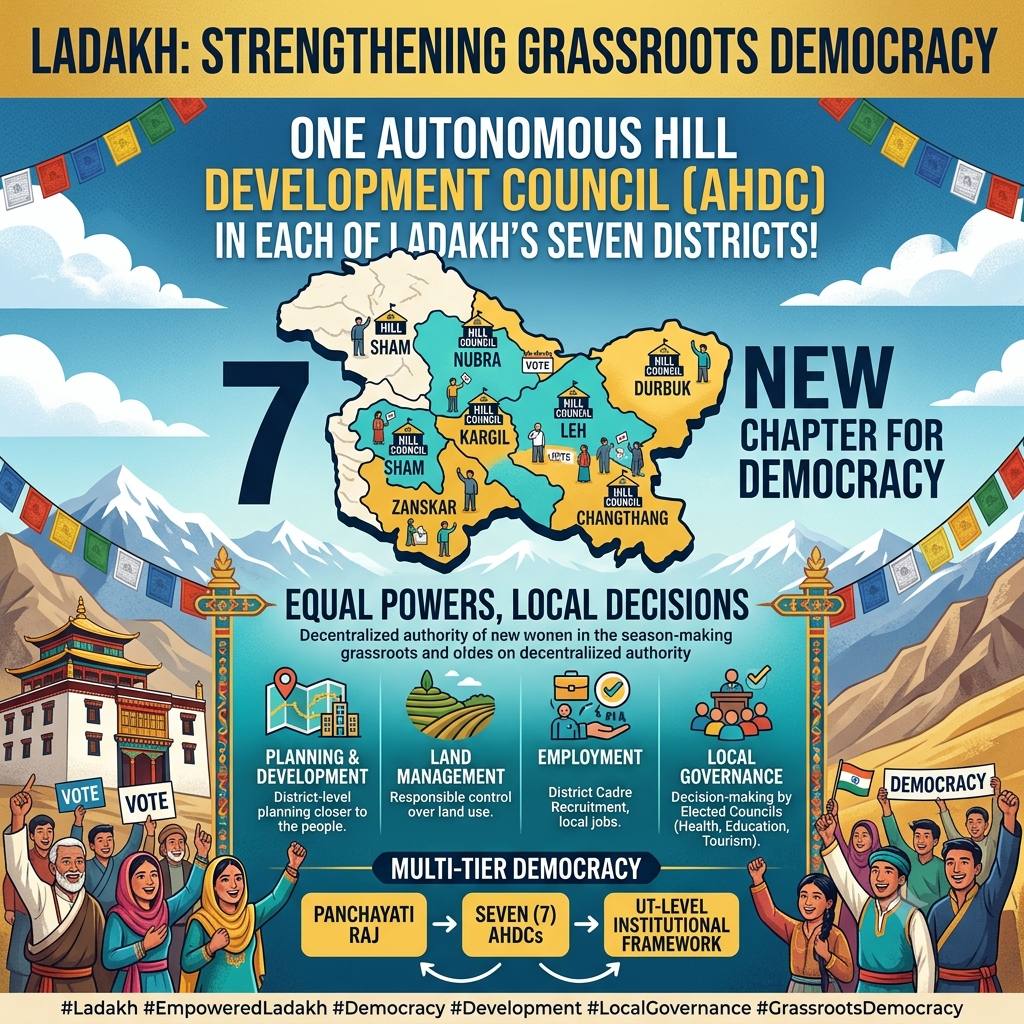
The Ladakh administration has announced that each of the seven districts will get its own autonomous hill development council. Until now, elected representation was mainly concentrated in Leh and Kargil, but the plan now extends local governance to the newly created districts as well.
The new districts include Sham, Nubra, Changthang, Zanskar, and Drass, along with Leh and Kargil. Alongside these district councils, a UT-level elected body is also being discussed, which would create a layered model of governance for the Union Territory.
Article 371 provides special constitutional safeguards for certain states and regions in India. These safeguards are meant to protect local interests, especially where culture, land, employment, and geography need special consideration.
In simple words, Article 371 is about giving a region more protection and flexibility in governance. For Ladakh, this is important because the area has unique cultural and environmental conditions. It is also a sensitive border region, which makes stable administration even more important.
The Ladakh administration has said that each of the seven districts will get its own autonomous hill council. This includes the existing councils in Leh and Kargil, along with councils for Sham, Nubra, Changthang, Zanskar, and Drass.
The ladakh autonomous hill development council model is expected to give districts more power over local matters. Officials have said these councils may handle land allotment, district cadre recruitment, development plans, and welfare work. This is why the change is being seen as a step toward stronger local self government.
The main reason Article 371 matters is that Ladakh has long demanded protection for land, jobs, and identity. Many local groups believe that without safeguards, outside influence could affect the region’s future.
The new council plan is being linked with the larger debate on Article 371 because both are about local control. If the framework is designed well, it could give people in leh ladakh more say in governance and development. It could also make local self government more meaningful at the district level.
Img Src : Twitter
The new councils are expected to have wide powers under the LAHDC Act. These may include authority over land ownership and land allotment, recruitment and promotions for district posts, and planning for development in each district.
They may also work on health, education, tourism, and welfare schemes. In addition, each district may have its own revenue base and dedicated council fund. If this happens, the ladakh autonomous hill development council system could become a much stronger local body than before.
For leh ladakh, this announcement may help reduce the gap between local needs and government action. Earlier, elected representation was mainly centered in Leh and Kargil. Now, the new districts may also get their own councils, which could bring decision-making closer to people.
This can support local self government in a practical way, especially in remote areas where local issues often need quick action. Roads, health care, education, and tourism planning can all benefit if district councils have real power. That is why many residents are watching this change closely.
This move could mark a shift from limited representation to more decentralised governance. Instead of power being concentrated in just two councils, all seven districts may now get a direct institutional voice.
That matters because Ladakh is geographically large, socially diverse, and difficult to govern from a single centre. A district-wise council system may bring decision-making closer to local communities and make development planning more responsive.
The proposed UT-level body is expected to act as an umbrella institution connecting the district councils. It could help coordinate policy, balance powers, and ensure that local governance works within a broader Ladakh framework.
At the same time, the exact structure is still being worked out. That means the final shape of power-sharing between the UT body and district councils remains one of the biggest questions in this story.
The Ladakh issue has been shaped by talks between the Union government, the Leh Apex Body, and the Kargil Democratic Alliance. These discussions have focused on representation, safeguards, and the future structure of governance in the region.
Sonam Wangchuk and other voices from civil society have also kept the pressure on, pushing for land protection, employment safeguards, and stronger local control. This is why the announcement of seven councils is being seen as more than an administrative update.
Even though the plan is important, some details are still not final. The UT-level body is still being discussed, and its exact role has not been fully decided. There may also be changes to the LAHDC Act and constituency boundaries before the new setup is complete.
The future scope of Article 371 safeguards is also still under discussion. So, while the direction is clear, the final framework is not yet fully settled. The next steps will show whether local self government in Ladakh gets more real authority or only a new structure on paper.
The coming talks will focus on how the UT-level body will work and how much power the district councils will get. Officials have said the model will be customised for Ladakh’s needs. That means the final design may be different from other parts of India.
For now, the main message is simple: Ladakh is moving toward a bigger and more local system of governance. If done well, the ladakh autonomous hill development council model could give the region stronger representation, better administration, and a more practical form of local self government. If not, the debate over Article 371 may continue.
Everything you need to know
It is a constitutional provision that gives special safeguards to some regions in India to protect local interests.
Ladakh will have hill councils in all seven districts.
They are meant to improve local governance, development, and decision-making.
It may give people in leh ladakh more local control and stronger representation.
The broad plan is announced, but the final structure and powers are still being worked out.






Oct 15, 2026
TUI Staff
Oct 15, 2026
TUI Staff
Oct 14, 2026
TUI Staff
Oct 15, 2026
TUI Staff
Oct 15, 2026
TUI Staff
Oct 15, 2026
TUI Staff
Oct 14, 2026
TUI Staff

Stay informed with independent, fact-checked journalism on technology, environment, government, economy and more. India’s most trusted digital news platform.





Comments (0)
Be the first to comment!