
RBI Repo Rate Hike: Rate Rises to 5.50% - What It Means for Home Loan EMI and FD Rates
India’s first rate hike since February 2023 puts inflation back at the centre of RBI policy and could raise borrowing costs.
 IN
Wed, Oct 07, 2026 | 03:54 PM IST
IN
Wed, Oct 07, 2026 | 03:54 PM IST


The Reserve Bank of India has raised its benchmark policy rate by 25 basis points to 5.50%, marking India's first increase in borrowing costs since February 2023 as inflation risks intensify despite strong economic growth. The decision was announced by Governor Sanjay Malhotra on October 7 after the three-day meeting of the RBI Monetary Policy Committee. All six members supported the increase from 5.25% to 5.50%, while the central bank also shifted its policy stance from “neutral” to “calibrated tightening”.
The repo rate hike could gradually make floating-rate home, auto and personal loans more expensive if banks pass the higher funding cost to borrowers. At the same time, deposit rates could eventually become more attractive if lenders raise interest rates on fixed deposits and other savings products.
So, why did RBI increase repo rate after holding rates steady through several reviews? The central bank said the inflation environment is no longer as benign as it was last year. Consumer inflation rose to about 4.8% in August, while core inflation also increased, signalling that price pressures may be spreading beyond volatile food and fuel categories.
The inflationary pressure has been reinforced by elevated crude oil and commodity prices, the continuing conflict in West Asia, a deficient southwest monsoon and El Niño conditions. RBI said these factors could continue affecting food, fuel and production costs over the coming quarters.
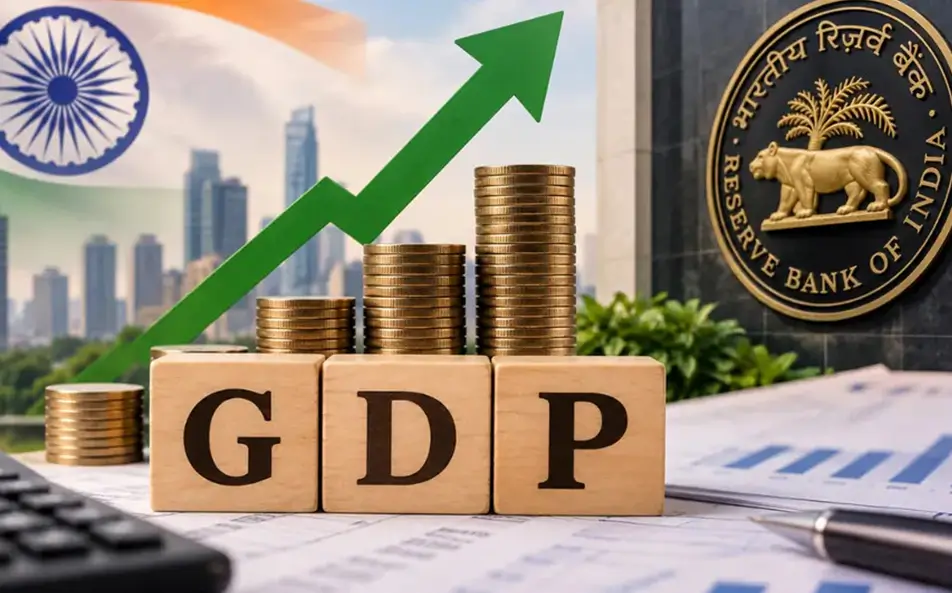
At the same time, India's economy has remained strong enough to give policymakers space to tighten monetary conditions. Real GDP expanded 7.8% in the April-June quarter, stronger than expected, while private consumption, investment and exports continued to support growth. That combination - stronger inflation risks alongside resilient economic activity - ultimately pushed policymakers towards higher rates.
The October RBI Monetary Policy produced changes not only to the repo rate but also to the broader interest-rate corridor and the central bank's policy stance.
| Policy measure | October 2026 decision |
|---|---|
| Repo rate | 5.50% |
| Change | +25 basis points |
| Standing Deposit Facility | 5.25% |
| MSF rate | 5.75% |
| Bank Rate | 5.75% |
| Policy stance | Calibrated tightening |
| FY27 GDP forecast | 7.1% |
| FY27 CPI inflation forecast | 5.2% |
The RBI Monetary Policy Committee unanimously supported the rate increase. However, only four members supported changing the stance to calibrated tightening, while Nagesh Kumar and Ram Singh wanted the stance to remain neutral.
This distinction matters because a policy stance indicates how the central bank views the likely direction of future action.
“Calibrated tightening” does not automatically mean another hike at the next meeting. The RBI's resolution says the stance effectively means rate cuts are off the table in the near term. Future action can involve either another increase or a pause, depending on inflation, growth and how widely price pressures spread. Governor Malhotra later described it as a milder, more data-dependent form of tightening rather than a predetermined series of aggressive increases.
That means discussions around future RBI interest rates will now focus heavily on upcoming inflation data, crude oil prices, food prices and global central-bank decisions. Economists quoted by Reuters expect further increases to remain possible, but estimates vary considerably. Those forecasts are analyst views rather than RBI commitments.
RBI has revised its inflation projection for the current financial year to 5.2%, up from 5.0%. Quarterly projections show pressure becoming particularly visible later in the year:
Core inflation is projected at 4.4% for FY27.
The central bank also noted that headline inflation could average almost 5.8% over the next three quarters. This is why the current inflationary pressure matters even though CPI remains within RBI's legally mandated 2%-6% tolerance band. The central bank's medium-term target remains 4%, and inflation has stayed above that target for several months.
Another reason policymakers were able to act is the strength of domestic activity. When people ask why did RBI increase repo rate despite concerns that higher borrowing costs could slow demand, the answer lies partly in India's stronger-than-expected growth. RBI lifted its FY27 growth projection from 6.7% to 7.1%. Its current projections are:
The central bank says private consumption, investment, services activity and credit flows remain supportive, although weak monsoon conditions and global uncertainty remain risks.
Strong growth provides the RBI with more room to focus on inflation without immediately risking a sharp economic slowdown.
Possibly, but not every borrower will see an immediate increase. A higher repo rate raises the cost at which banks can borrow short-term funds from the central bank. Banks may subsequently increase lending rates, particularly on loans linked to external benchmarks. For floating-rate home-loan borrowers, lenders can respond in several ways:
Mint reports that borrowers with externally benchmarked floating-rate loans are among those most directly exposed to changes in policy rates, although the timing depends on each lender's reset schedule. The repo rate hike does not mean every loan rate automatically rises by exactly 0.25 percentage points on October 7. Fixed-rate borrowers may see no immediate change, while new loans could become more expensive as lenders revise pricing.
Higher RBI interest rates can create a different effect for savers. If banks need to attract more deposits or face higher funding costs, they may raise interest rates offered on fixed deposits and other savings products. However, deposit-rate transmission is determined by individual banks and liquidity conditions. A policy increase does not guarantee that all banks will raise FD rates immediately or by the full 25 basis points.
The banking system is currently operating with significant surplus liquidity, which could reduce the urgency for some banks to aggressively raise deposit rates. Reuters reports that the central bank has chosen not to raise the cash reserve ratio at this stage and instead intends to use instruments such as bond sales and liquidity operations to manage excess funds.
Before the bi-monthly monetary policy announcement, some market participants had expected the RBI to announce additional liquidity-tightening measures. That did not happen. The central bank left reserve requirements unchanged. Malhotra said increasing reserve ratios would be among the least preferred options for withdrawing liquidity.
Instead, the RBI can use tools such as open-market bond sales, variable-rate reverse repo operations and foreign-exchange transactions. This allows policymakers to manage excess liquidity without imposing an immediate additional reserve burden on banks.
The October move is historically significant because it reverses several years of falling or stable borrowing costs. RBI last raised the repo rate in February 2023, when it increased the benchmark by 25 basis points to 6.50%. Rates remained unchanged for an extended period before cuts began in 2025. According to current reports, four reductions during 2025 lowered the repo rate by a combined 125 basis points, eventually taking it to 5.25%.
The October 2026 increase therefore represents the beginning of a new tightening phase. For the bi-monthly monetary policy cycle, that also changes expectations going into the next MPC meeting, scheduled for December 2-4, 2026. The detailed minutes of the October meeting are due on October 21.
The RBI has deliberately avoided promising a fixed path. Whether rates rise again will depend on how inflation evolves, particularly food, energy and core prices. Officials will also monitor whether supply-driven increases become embedded in consumer expectations and company pricing decisions. That is important because monetary policy has limited ability to directly lower international oil prices or improve rainfall, but it can try to prevent temporary shocks from producing persistent inflation.
The third reason why did RBI increase repo rate now is therefore preventive: policymakers are attempting to stop temporary supply shocks from becoming broader and longer-lasting price increases. The RBI Monetary Policy Committee has made clear that further decisions will depend on actual data rather than a predetermined schedule.
For households, the immediate implication is that the era of steadily falling borrowing costs has paused. New and floating-rate loans may become costlier, while savers could eventually see improved deposit returns.
For the economy, the central challenge is now balancing two objectives: preserving India's strong growth momentum while ensuring that the current inflationary pressure does not become entrenched. The October RBI Monetary Policy shows which risk the central bank considers more urgent for now: inflation has risen enough to justify India's first rate increase in nearly four years.
Everything you need to know
The RBI increased the policy repo rate by 25 basis points from 5.25% to 5.50% on October 7, 2026. The decision was unanimously approved by the six-member MPC.
The RBI cited a worsening inflation outlook, including higher food and fuel inflation, elevated energy prices, a deficient monsoon and signs that price pressures are becoming broader. August CPI inflation rose to 4.8%, while core inflation increased to 4.2%.
They may. Borrowers with floating-rate loans linked to external benchmarks are more exposed to policy-rate changes, but the timing and size of any EMI or tenure adjustment depends on the lender and the loan’s reset terms. The RBI hike does not mean every borrower’s rate automatically increases by exactly 0.25 percentage points immediately.
The RBI says it means rate cuts are off the table in the near term. Future action can be either another rate hike or a pause depending on inflation, growth and broader price pressures. The stance change passed by a 4-2 vote, with Nagesh Kumar and Ram Singh preferring neutral.
RBI now projects FY27 real GDP growth at 7.1% and CPI inflation at 5.2%. Inflation is projected at 4.9% in Q2, 6.0% in Q3 and 5.7% in Q4, with Q1 FY28 at 5.6%.






Oct 06, 2026
TUI Staff
Sep 28, 2026
TUI Staff
Sep 23, 2026
TUI Staff
Sep 22, 2026
TUI Staff
Oct 06, 2026
TUI Staff
Oct 05, 2026
TUI Staff
Oct 05, 2026
TUI Staff

Stay informed with independent, fact-checked journalism on technology, environment, government, economy and more. India’s most trusted digital news platform.




Comments (0)
Be the first to comment!