
Qdenga Approved: India's CDSCO Clears First Dengue Vaccine for Ages 4 to 60
India's first dengue vaccine, opening a new immunisation option alongside mosquito control in dengue-hit cities.
 IN
Tue, Oct 20, 2026 | 03:25 AM IST
IN
Tue, Oct 20, 2026 | 03:25 AM IST


India has approved its first vaccine for preventing dengue, marking a major regulatory step in the country’s fight against a disease that returns with seasonal mosquito outbreaks.
The Central Drugs Standard Control Organisation, or CDSCO, has granted marketing authorisation to Qdenga for people aged 4 to 60. However, the approval does not mean the shot has entered India’s public immunisation programme or become immediately available in hospitals. (Press Information Bureau)
India recorded more than 100,000 dengue cases in every year from 2021 to 2025. In 2024 alone, the country reported 233,519 cases and 297 deaths, according to the National Center for Vector Borne Diseases Control. These numbers show why another prevention option matters alongside mosquito control, early testing and clinical care.
The dengue vaccine India has approved is officially called the Dengue Tetravalent Vaccine (Live, Attenuated). Takeda GmbH manufactures it in Germany, while Takeda Biopharmaceuticals India will import it. (Press Information Bureau)
Qdenga is designed to protect against all four dengue virus serotypes. It uses weakened versions of the virus to train the immune system to recognise the infection. The product was developed through recombinant DNA technology and uses a dengue virus type-2 backbone.
Qdenga is a live, attenuated tetravalent vaccine built using recombinant DNA technology. It's produced in Vero cells, with genes for the surface proteins of all four dengue virus serotypes engineered onto a dengue type-2 backbone, PIB said. In simple terms, it's designed to train the immune system against all four strains circulating in India, not just one.
The approval rested on a Phase III safety and immunogenicity trial run specifically in the Indian population across the 4 to 60 age band, backed by earlier global trials in more than eight countries including Brazil, Thailand and Sri Lanka, per PIB.
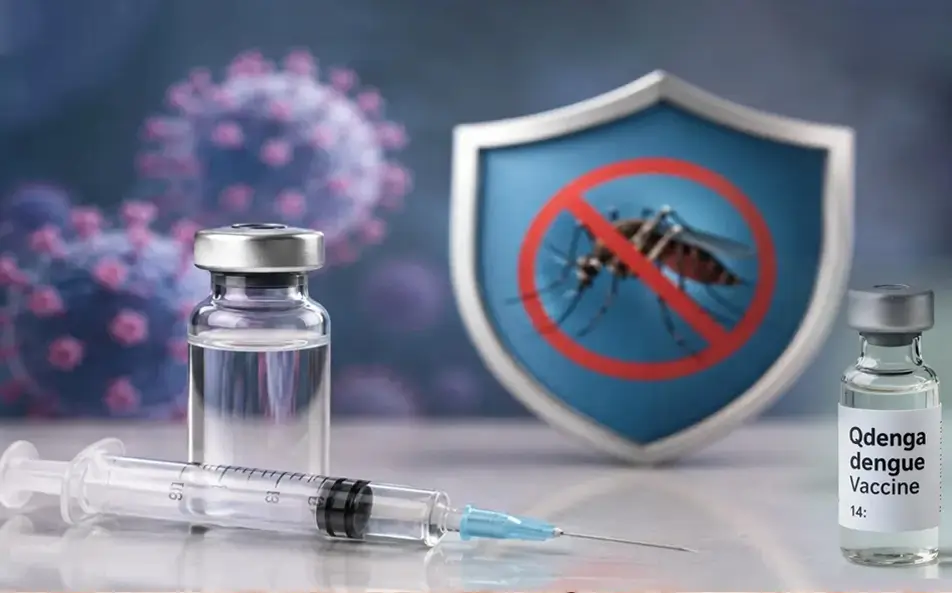
Img Src : tv9telugu
Qdenga isn't new globally. It already has regulatory approval in 42 countries, including the European Union, the United Kingdom, Switzerland, Indonesia, Malaysia and Thailand, and carries World Health Organization prequalification, PIB noted. More than 24 million doses have been distributed worldwide so far.
The Health Ministry said post-marketing surveillance from countries already using the vaccine has shown a favourable safety profile, with no significant safety concerns flagged to date, per the same PIB release. That real-world track record likely mattered for a first-of-its-kind approval in India.
Who Can Receive It?
CDSCO has approved the shot for people aged 4 to 60. The schedule includes two 0.5 ml injections given three months apart.
Takeda says it can be used regardless of whether a person has previously had dengue. This means pre-vaccination testing for an earlier infection is not required under the approved indication. (Reuters)
However, regulatory approval should not be treated as personal medical advice. Suitability may depend on a person’s health history, immune status, pregnancy and other clinical factors. People should consult a qualified doctor before vaccination.
India’s decision was supported by a Phase III study that examined safety and immune response in Indian participants aged 4 to 60. Regulators also reviewed evidence from Takeda’s wider clinical programme conducted across dengue-endemic and non-endemic countries.
The Health Ministry said international studies included participants from more than eight countries, including Brazil, Thailand and Sri Lanka. (Press Information Bureau)
The ministry also said post-marketing monitoring in countries already using the product had shown a favourable safety profile, with no significant new safety concerns identified at the time of the announcement. This does not mean side effects are impossible. Safety monitoring will continue as more people receive the shot.
The Health Ministry said the product had regulatory approval in 42 countries. More than 24 million doses had been distributed worldwide when the Indian approval was announced.
The World Health Organization prequalified the product in May 2024. WHO recommends its use mainly for children aged 6 to 16 who live in areas with a high dengue burden and intense transmission.
WHO’s public-programme recommendation is therefore narrower than India’s regulatory authorisation for people aged 4 to 60.
Prequalification allows eligible United Nations agencies to consider the product for procurement. It does not automatically place it in India’s Universal Immunisation Programme.
The dengue vaccine India will receive first is expected to be offered through private healthcare settings. Takeda told Reuters that it expects initial availability during the first half of 2027. (Reuters)
A price has not been announced. The Union government has also not announced national procurement, free public distribution or inclusion in routine immunisation schedules.
This distinction matters. Marketing authorisation allows the company to supply an approved product, but public access will still depend on manufacturing, pricing, distribution, medical guidance and government policy.
The bigger story for supply and pricing may be manufacturing. In February 2024, Takeda partnered with Hyderabad-based Biological E. Limited to produce up to 50 million doses of Qdenga a year in India, according to a Takeda Newsroom statement. It's part of Takeda's plan to hit 100 million doses annually worldwide by 2030.
That local manufacturing tie-up is what could eventually bring costs down and secure supply for India's own dengue-endemic states, rather than leaving the country dependent on imports alone.
Health officials have been careful to frame this as an addition, not a replacement. The approval is expected to work alongside vector control, surveillance, early diagnosis and case management already running under the National Vector Borne Disease Control Programme, according to a report by IANS via Prokerala. Draining stagnant water and clearing mosquito breeding sites, in other words, still matter.
India’s first dengue vaccine approval creates a new prevention route after years of relying mainly on mosquito control, surveillance and case management. It also gives doctors and public-health planners a possible additional tool against seasonal outbreaks of dengue fever.
But its immediate impact will depend on what happens next. Price, supply, clinical guidance and any decision on government procurement will determine how widely people can access it.
For now, Qdenga represents an important regulatory milestone rather than an instant nationwide rollout. Mosquito control, early testing and prompt medical care remain essential while India prepares for the product’s expected private-market launch.
Everything you need to know
Qdenga is approved by CDSCO for people aged 4 to 60 years. It is given as two injections, three months apart.
Qdenga is made by Takeda GmbH in Germany and imported by Takeda Biopharmaceuticals India. Takeda has partnered with Hyderabad-based Biological E. Limited to manufacture up to 50 million doses a year within India.
No. Health officials say the vaccine is meant to complement, not replace, existing measures like vector control, surveillance and eliminating mosquito breeding sites under the National Vector Borne Disease Control Programme.



Oct 19, 2026
TUI Staff
Oct 19, 2026
TUI Staff
Oct 17, 2026
TUI Staff
Oct 17, 2026
TUI Staff
Oct 19, 2026
TUI Staff
Oct 19, 2026
TUI Staff
Oct 17, 2026
TUI Staff
Oct 17, 2026
TUI Staff

Stay informed with independent, fact-checked journalism on technology, environment, government, economy and more. India’s most trusted digital news platform.





Comments (0)
Be the first to comment!