
India-China Border Breakthrough? First Corps Commander Talks Held in Arunachal Pradesh
New Arunachal talks could reshape military communication along the LAC
 IN
Fri, Oct 23, 2026 | 12:56 AM IST
IN
Fri, Oct 23, 2026 | 12:56 AM IST


India and China have opened a new high-level military channel along one of their most sensitive stretches of the Line of Actual Control. Senior commanders from the two armies met at the Wacha-Damai Border Personnel Meeting point in Arunachal Pradesh on September 6, 2026, in what multiple reports citing defence sources described as the first Corps Commander-level talks held in the eastern sector.
Lieutenant General Girish Kalia, commander of the Indian Army's Dimapur-based III Corps, or Spear Corps, led the Indian delegation. The talks focused on issues along the LAC and on maintaining peace and tranquillity in the region. For India China relations, the significance goes beyond one military meeting. Corps Commander-level dialogue became one of the main tools used to manage the Ladakh crisis after the deadly 2020 Galwan clash. Extending that level of military contact to Arunachal Pradesh gives the two sides another mechanism to prevent patrol encounters and differing perceptions of the LAC from escalating into larger confrontations.
The September 6 meeting took place at Wacha on the Indian side of the Wacha-Damai Border Personnel Meeting mechanism in the Kibithoo sector. Lt Gen Girish Kalia represented India, while his Chinese counterpart and other People's Liberation Army officers represented Beijing. Public reporting has not identified the Chinese commander by name. India's III Corps is headquartered at Rangapahar near Dimapur in Nagaland. Along with the Tezpur-based IV Corps, it is responsible for sections of the LAC running through Arunachal Pradesh. Reports following the meeting said discussions concentrated on managing outstanding issues in the eastern sector and maintaining peace along the frontier.
However, there is an important limitation. As of September 7, the Indian Army has not issued a detailed public statement describing specific agreements reached during the meeting. Hindustan Times reported that the Army did not comment on the development. That means claims about disengagement, troop withdrawals or resolution of particular friction points should not yet be presented as confirmed outcomes.
One point in the earlier reporting needs clarification. The Wacha-Damai mechanism itself was not created by the latest round of diplomatic talks. Wacha, near Kibithoo in Arunachal Pradesh's Anjaw district, sits opposite Damai on the Chinese side. The mechanism has been used for military contact for more than a decade. The Indian Express notes that regular meetings at Wacha/Kibithu opposite Damai were established in addition to existing eastern-sector meeting points such as Bum La in Arunachal Pradesh and Nathu La in Sikkim.
Historical reporting places the establishment of the Kibithu-Damai mechanism around 2014, with ceremonial and local-level meetings taking place there well before 2026.
What changed on September 6 was the level of representation. This was the first reported time that the existing Wacha-Damai channel hosted officers at the Corps Commander level.
That distinction makes the development important without overstating what was newly created.
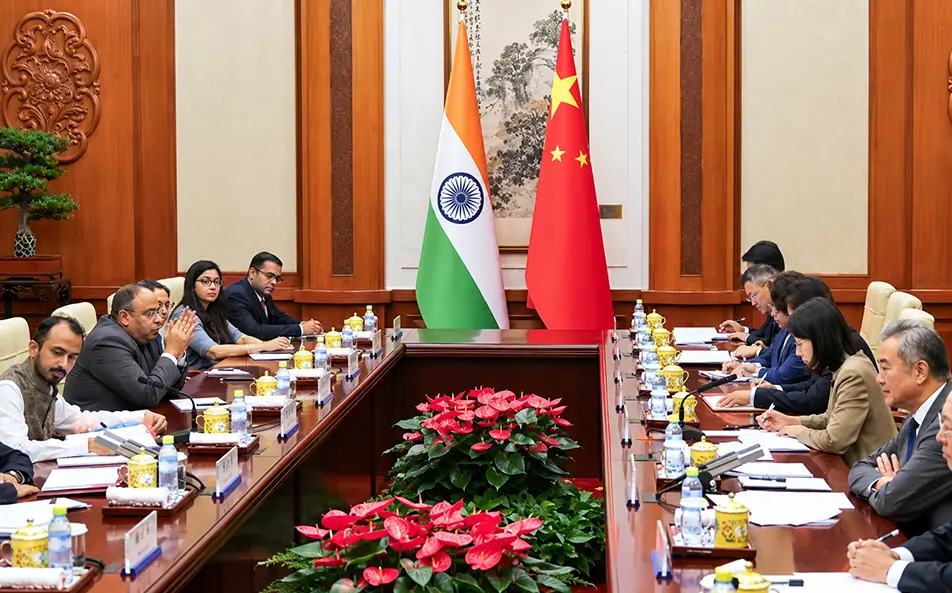
The meeting nevertheless fits directly into the wider effort to strengthen military communication along the India and China border. National Security Adviser Ajit Doval and Chinese Foreign Minister Wang Yi held the 25th round of Special Representatives talks on the boundary question in Beijing on August 25. The two sides announced an eight-point consensus aimed at improving border management. Among the most important measures was an agreement to establish two additional meeting points for General-level or Senior Highest Military Commander meetings, along with two additional military hotline channels in the eastern and middle sectors.
The agreement also said that situations on the ground should be addressed quickly through existing diplomatic and military mechanisms to prevent “misunderstanding and miscalculation” along the LAC. But the publicly available eight-point document does not identify Wacha-Damai as one of those two newly agreed meeting points. It is therefore safer to describe the September 6 talks as part of the broader expansion of senior military engagement rather than as proof that one of the newly announced meeting points has already become operational.
Military dialogue is only one layer of the current effort to stabilise India China relations. On August 6, officials from both countries held the 36th meeting of the Working Mechanism for Consultation and Coordination on India-China Border Affairs in New Delhi. India's Ministry of External Affairs said the two sides reviewed the situation along the LAC and agreed to continue using diplomatic and military channels, including the WMCC and local commander-level mechanisms, to resolve outstanding problems.
The ministry specifically said maintaining peace and tranquillity in border areas was essential for the overall development of bilateral ties. That language has become central to New Delhi's approach towards Beijing. India has repeatedly argued that broader relations cannot fully normalise while serious tensions persist along the frontier.
The eastern sector has its own history of confrontation. On December 9, 2022, Indian and Chinese troops clashed in the Yangtse area of the Tawang sector in Arunachal Pradesh.
Defence Minister Rajnath Singh told Parliament at the time that PLA troops had attempted to cross the LAC and change the status quo, triggering a physical confrontation with Indian soldiers. Personnel on both sides were injured, although India reported no fatalities or serious casualties among its troops. The two sides subsequently disengaged, and local commanders held a flag meeting two days later.
That episode demonstrated why reliable communication matters. A local patrol confrontation can become a military and diplomatic crisis even when neither government initially intends a wider escalation. The disputed frontier itself is not formally demarcated, and India and China continue to have different perceptions of the LAC in several areas. India's government has previously acknowledged that these differing perceptions can result in patrols encountering each other.
Following the 2020 Galwan crisis, Corps Commander-level meetings became closely associated with the Chushul-Moldo meeting point in the western sector. Those rounds were used extensively during negotiations over disengagement in eastern Ladakh. Indian government records show that the two countries held more than 20 senior military commander meetings as they worked through the problems that emerged in 2020.
The September 6 meeting represents an expansion of that model. Instead of using senior military talks principally to deal with one prolonged crisis in Ladakh, the two countries are now applying a comparable mechanism in the eastern sector. That does not settle the boundary. It creates a higher-level channel for managing it.
The timing also adds a diplomatic dimension. New Delhi is preparing to host the BRICS leaders' summit on September 12-13, 2026, only days after the Wacha-Damai meeting.
Chinese President Xi Jinping is expected to travel to India for the summit, although Reuters noted in late August that Beijing had not at that point formally confirmed every detail of the visit. It would go too far to say the Corps Commander meeting was deliberately scheduled to produce an outcome before the summit unless either government says so.
But the broader sequence is significant. Senior diplomatic talks took place in Beijing on August 25. Corps Commanders then met in Arunachal on September 6. And the leaders are expected to be in the same diplomatic setting in New Delhi days later. That shows how border management and the wider political relationship are increasingly moving in parallel.
No. This meeting should not be confused with a settlement of the boundary question. The two countries still disagree over their frontier, and the August Special Representatives meeting itself committed the sides to continuing negotiations towards a “fair, reasonable and mutually acceptable” solution. What has improved is the machinery available to stop those disagreements from becoming military crises.
More hotlines, local meetings, WMCC discussions, Special Representatives talks and now Corps Commander-level engagement in the east give commanders and diplomats more opportunities to communicate before events escalate. That is useful. It is not the same thing as resolving the dispute.
For more updates like this, follow The United Indian and stay informed with the latest news that matters.
Everything you need to know
On 6 September 2026, at the Wacha-Damai Border Meeting Point in Arunachal Pradesh, according to India Today. It was the first time such talks were held in the state.
Lieutenant General Girish Kalia, commander of the Indian Army's III Corps, known as the Spear Corps, led the Indian side, per defence sources cited by The New Indian Express.
The 25th round of India-China Special Representatives talks in Beijing in August 2026 produced an eight-point consensus, including new military hotlines in the eastern and middle sectors and additional meeting points for senior commanders, per Deccan Chronicle.




Oct 22, 2026
TUI Staff
Oct 22, 2026
TUI Staff
Oct 22, 2026
TUI Staff
Oct 22, 2026
TUI Staff
Oct 22, 2026
TUI Staff
Oct 22, 2026
TUI Staff
Oct 22, 2026
TUI Staff
Oct 22, 2026
TUI Staff

Stay informed with independent, fact-checked journalism on technology, environment, government, economy and more. India’s most trusted digital news platform.


Comments (0)
Be the first to comment!