
British Pub Culture Under Threat? Westminster’s Vertical Drinking Policy Explained
Pints, Pubs and Policy
 IN
Sat, Oct 03, 2026 | 09:34 PM IST
IN
Sat, Oct 03, 2026 | 09:34 PM IST

Standing outside a London pub with a pint is a familiar sight during British summertime. But a draft licensing policy in central London has sparked fears that one of the country's most recognisable social rituals is under threat.
Westminster City Council is reviewing its licensing rules for pubs, bars and other venues. One section encourages more seating and table service instead of premises built around what regulators call “high-volume vertical drinking” — essentially large numbers of customers drinking while standing. Critics say the approach risks changing British pub culture, particularly in Soho and the wider West End. The council insists that interpretation goes too far. “There is not, and never has been, a plan to stop people standing in pubs to have a drink,” Westminster said in a statement published after the backlash. So what is actually changing?
The controversy comes from Westminster's proposed Statement of Licensing Policy, which is currently under consultation. Its approach encourages venues to reduce excessive drinking and provide more places for customers to sit, including through table service rather than relying heavily on open standing areas. That language quickly became a debate over British pub culture. Standing at the bar, moving between groups of friends and spilling into outdoor areas are normal parts of many British pubs, particularly when the weather improves during British summertime. For Soho businesses, critics argue that requiring more seating could also reduce capacity in premises that are often small and located on narrow streets. Mayor Sadiq Khan has criticised the approach as overly restrictive and warned against policies that could weaken London nightlife. Downing Street has also defended standing in pubs as part of British social life.
The council's position is more limited than some headlines suggest. Westminster City Council says nobody with an existing pub licence is suddenly going to be told that customers must sit down. Its guidance says the issue primarily arises when assessing some new venues in areas that already have a very high concentration of licensed premises. In those cases, a business proposing a predominantly seated operation may have an easier time demonstrating that it will not worsen crowding, noise or antisocial behaviour. The council also says the terminology is not new. References to “vertical drinking” and cumulative impact have existed in Westminster licensing policy for more than a decade. That does not mean the concerns raised by pub operators are imaginary. The draft specifically discusses more seating and, in some situations, conditions such as waiter or waitress service. Hospitality groups argue that such conditions could change how traditional pubs operate even without an outright prohibition on standing.
Much of the argument centres on Westminster's West End Cumulative Impact Zone. The area includes Soho and other heavily visited parts of the West End, where hundreds of licensed premises operate close together. Westminster already applies tighter scrutiny to certain applications there because officials say the combined concentration of pubs, bars, clubs and late-night venues can contribute to crime, noise and pressure on local services. That means it would be misleading to say every new licensing application is automatically rejected. The presumption particularly affects specified higher-impact uses, including pubs and bars, and businesses can still present evidence showing why their proposal should be treated as an exception. The council also says it approves more than 98% of licensing applications across Westminster overall.
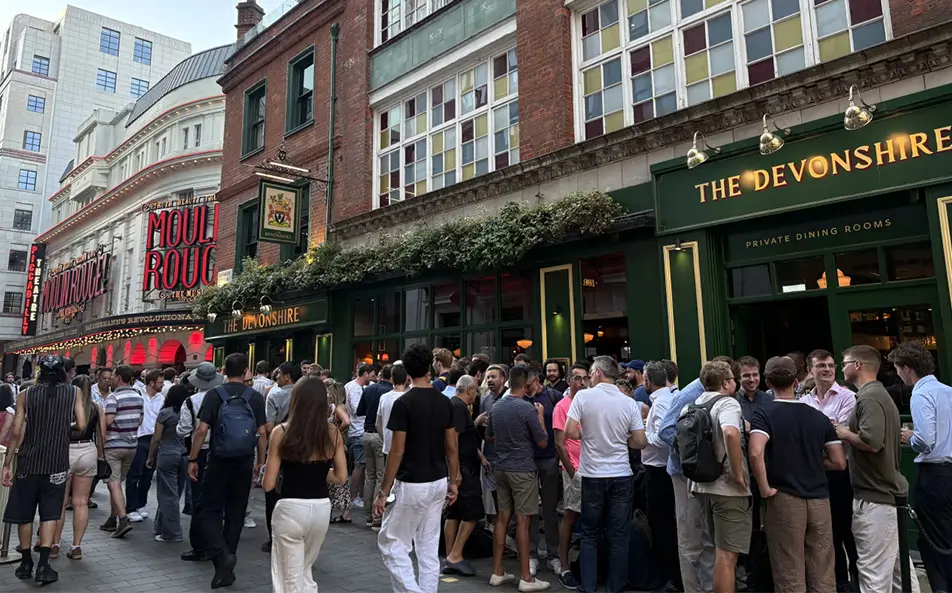
Few parts of London make the issue more visible than Soho. Its tightly packed pubs, restaurants, theatres and clubs depend heavily on people moving between venues rather than remaining seated in one place all evening. For supporters of Soho culture, crowds outside pubs are not automatically evidence that something has gone wrong. They are part of the neighbourhood's atmosphere. The problem for regulators is that the same density can also create noise, blocked pavements and complaints from residents. That puts Westminster City Council in an awkward position: protect London nightlife while also enforcing licensing objectives around public safety, nuisance and disorder. The council says its proposal is intended to strike precisely that balance. Its leader, Paul Swaddle, has described the issue as one of safety rather than preventing somebody from standing at a bar with a pint. Critics remain unconvinced that the distinction will always be so clear when individual licence conditions are imposed.
A separate alcohol debate is happening next door in Camden, but the rules there should not be confused with Westminster's licensing proposal. Camden Council approved a borough-wide Public Space Protection Order targeting alcohol-related antisocial behaviour. From July 2026, police and council enforcement officers can tell somebody to stop drinking alcohol in a public place and require them to surrender it. Refusing to comply can lead to a £100 fixed penalty notice, with 28 days to pay before prosecution may follow.
The order covers Camden's streets and public spaces except Hampstead Heath and is due to run for three years before review. But Camden stresses that this is not a blanket prohibition on having a casual drink in a park. The power is aimed at irresponsible drinking and antisocial behaviour. That distinction matters because Westminster and Camden are dealing with different problems through different legal mechanisms.
Westminster's policy is still a draft. The public consultation is scheduled to run until August 30, 2026, meaning the wording could still change before the new policy is adopted. For pub-goers, the clearest answer is that there is currently no ban on standing in Westminster pubs. Existing customers will not suddenly be ordered into chairs simply because the policy changes. But the backlash is not entirely based on nothing either. The draft does favour more seated operations in some circumstances, and individual new venues could face licensing conditions that limit standing areas or require table service. That is why the dispute has become bigger than a piece of licensing jargon. For defenders of Soho culture, standing with friends outside a pub is part of what gives the West End its character. For the council, high-density drinking has to coexist with residents, pedestrian safety and public order.
And for British pub culture, the argument has become a familiar one: how much regulation can be added before managing nightlife starts changing the thing people came out to enjoy in the first place?
Everything you need to know
No. Westminster City Council said in a statement that there is not, and never has been, a plan to stop people standing in pubs with a drink. The draft policy mainly affects new licence applications in the West End cumulative impact zone, not existing pubs.
Camden Council's Public Space Protection Order, in force from July 2026 for three years, lets police and officers tell people to stop drinking in public and surrender alcohol if the drinking is considered irresponsible or antisocial. It is not a total ban on drinking in parks, and breaches carry a £100 fixed penalty, reduced to £60 if paid within 14 days.
The draft is subject to consultation with the mayor's office, a requirement introduced under the 2026 English Devolution and Community Empowerment Act. The final wording had not been confirmed as of the BBC's August 2026 reporting.

Oct 03, 2026
TUI Staff
Oct 03, 2026
TUI Staff
Oct 03, 2026
TUI Staff
Oct 03, 2026
TUI Staff
Oct 03, 2026
TUI Staff
Oct 03, 2026
TUI Staff
Oct 01, 2026
TUI Staff

Stay informed with independent, fact-checked journalism on technology, environment, government, economy and more. India’s most trusted digital news platform.



Comments (0)
Be the first to comment!