
“AI in Class 6?” Mumbai Woman Shocked by These Class 6 AI Lessons
When AI enters the classroom, everything changes.
 IN
Sun, Oct 04, 2026 | 11:25 PM IST
IN
Sun, Oct 04, 2026 | 11:25 PM IST


Imagine opening a Class 6 textbook and finding Python, machine learning, Neural Networks and Artificial Intelligence staring back at you.
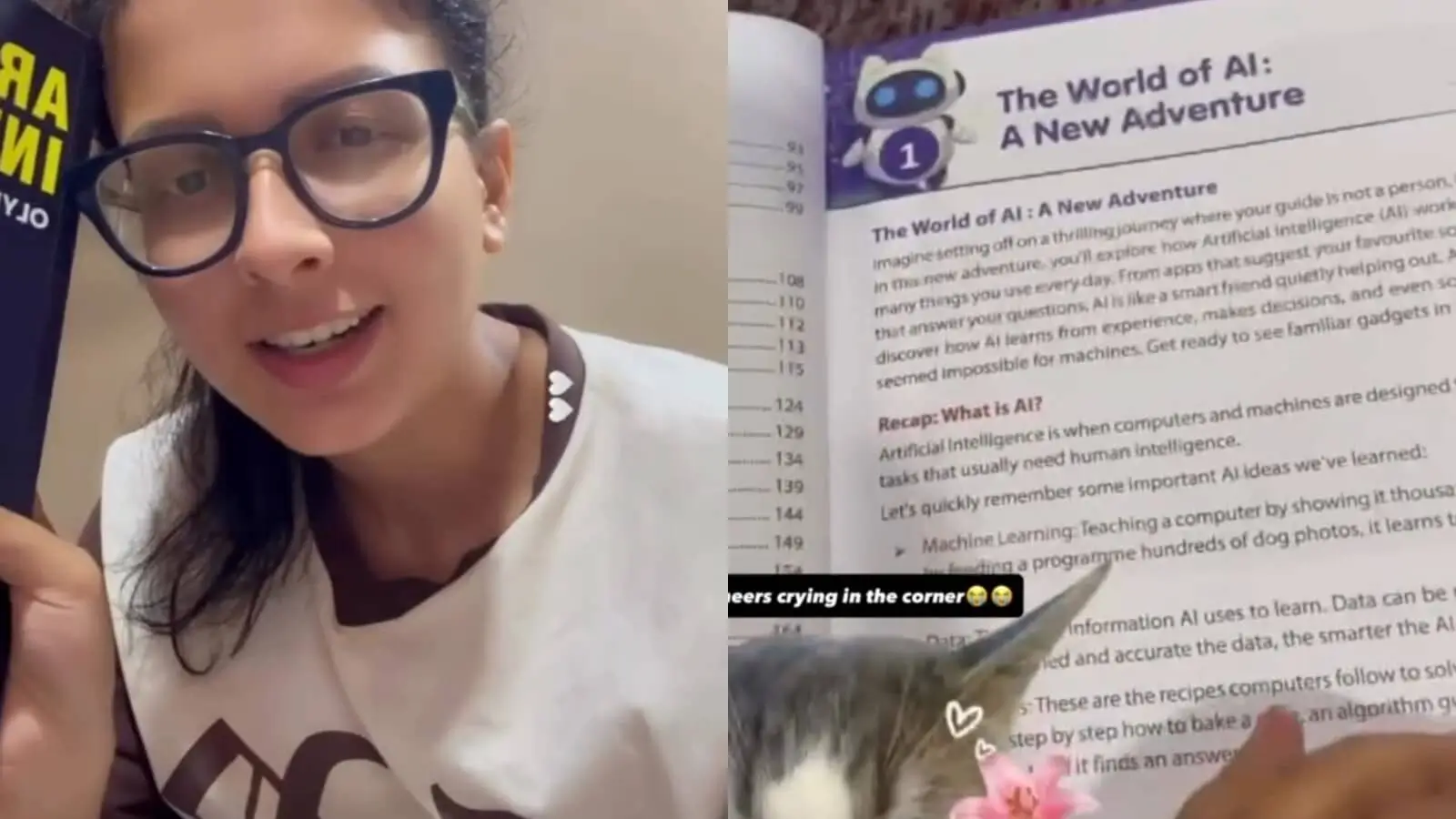
That is exactly what surprised Mumbai-based Khushi Jeswani when she came across a school textbook covering these topics. Her reaction, shared in an Instagram video, quickly caught attention online and sparked a larger conversation about how early children should start learning technology.
In her Instagram video, Jeswani flips through a Class 6 textbook and points out chapters covering Machine Learning with Python, Data and Visualisation, Neural Networks and AI, and Ethics and Safety.
Her reaction is instantly relatable.
“Guys, today I saw a Class 6 textbook. AI... everything we are learning now, like Python and AI, they already have all of that in Class 6,” she says in the video.
She then questions the presence of topics such as machine learning and Neural Networks in a school textbook.
Text displayed on the video reads “6th standard me AI kaha se aagayi”, roughly translating to, “How did AI make it into Class 6?”
The internet had plenty to say.
Some users praised the modern curriculum and argued that children need early exposure to technology. Others compared it with their own school years, when having a computer lab was considered a big deal.
One commenter recalled learning programming languages such as Fortran and COBOL. Others said their children had already started learning coding or AI concepts at younger ages.
The reactions reveal something bigger than surprise.
The technology children learn today is changing much faster than the technology many adults grew up with.
The chapter names can sound intimidating. But the title of a chapter doesn't tell us how deeply the subject is being taught.
The SilverZone Foundation's official Class 6 AI Olympiad syllabus includes Python Programming: Getting Started, Simple Machine Learning with Python, Data and Visualization: Telling a Story with Numbers, Neural Network and AI, Ethics & Safety in AI, and AI and the Internet of Things (IoT).
These topics closely match the subjects highlighted in Jeswani's video.
Still, this is where some context is needed.
The SilverZone material is linked to its AI Olympiad programme. It should not be treated as proof that every school in India has adopted the same syllabus.
Python is widely used in software development, data science and AI.
But Python for school students can start with simple programming concepts such as instructions, sequences, conditions and logical thinking.
A Class 6 student learning introductory Python is not necessarily doing the same work as a computer science student at university.
The aim can simply be to help children understand how instructions turn into actions and how code can be used to solve simple problems.
At a basic level, machine learning for kids can introduce the idea that computers can identify patterns in data and use those patterns to make predictions or decisions.
The concept can be demonstrated through simple, age-appropriate examples rather than complex mathematical models.
The same applies to Neural Networks.
Children can be introduced to the idea that some AI systems use networks designed to recognise patterns. That is very different from teaching the mathematics and architecture behind sophisticated deep-learning systems.
In other words, learning about AI is not the same as becoming an AI engineer.
The viral textbook is not the first sign of this shift.
CBSE has developed learning resources around Computational Thinking and Artificial Intelligence for Classes III to VIII. Its 2026–27 framework includes student and teacher handbooks for these grades.
Government documentation on the implementation of the National Education Policy also records that CBSE developed an AI skill module for Classes VI–VIII. The document notes that CBSE made AI modules available to schools and developed AI-integrated lesson plans across subjects for Classes VI–X.
This puts the viral incident into perspective.
AI education India is not simply a response to ChatGPT or the recent generative AI boom. The move towards introducing AI concepts in schools has been developing for years.
CBSE's current framework also shows that computational thinking and AI are now being considered across several school grades, rather than being restricted to senior secondary or college education.
For many adults, computers were once something you had to be introduced to.
Schools had dedicated computer rooms. Students often had limited access to machines. Programming was treated as a specialised skill.
Some students later encountered languages such as Fortran or COBOL.
Today's children live in a different digital world.
They use smartphones. They interact with recommendation systems. They ask voice assistants questions. They encounter chatbots, smart devices and AI-generated content.
That is why education technology in India is gradually moving beyond teaching students how to operate a computer.
The focus is increasingly shifting towards understanding the technology behind the screen.
In that sense, AI could become for today's children what basic computer literacy was for an earlier generation.
There is a good argument for early exposure - as long as the learning remains age-appropriate.
The SilverZone Class 6 AI syllabus includes technical topics as well as ethics and safety, showing that AI learning can cover responsible technology use alongside programming and applications.
Early exposure can help children develop:
But perhaps the most important part is curiosity.
Children growing up with AI will need to know more than how to use an AI tool. They will also need to question its answers.
Can AI be wrong?
Where does its information come from?
Can an algorithm be biased?
What happens to personal data?
Should every AI-generated answer be trusted?
Those questions make ethics and safety an important part of Artificial Intelligence education.
Img Src : Hindustan Times
Not necessarily. But earlier does not automatically mean better.
The quality of teaching matters more than the age at which a topic first appears in a textbook.
Schools need teachers who understand what they are teaching. Students need opportunities to experiment rather than simply memorise definitions. And schools need enough infrastructure to make technology education meaningful.
There is also the question of access.
India has thousands of schools with very different levels of infrastructure, connectivity and teacher availability. A technology-rich curriculum can only work well when schools have the resources and trained educators to support it.
There is another balance to maintain.
Children still need strong foundations in reading, mathematics, science, communication, creativity and social skills.
AI should strengthen those foundations, not replace them.
The goal isn't to make every 11-year-old sound like a computer science graduate.
It is to help children understand the technology that is already becoming part of their world.
The rise of Class 6 AI lessons points to a much larger change in the future of education.
The Government of India's education policy has already placed greater emphasis on computational thinking, coding and contemporary skills. CBSE's current CT & AI framework shows that this thinking is now reaching younger grades.
That could change how children think about technology.
Earlier generations largely learned how to use computers.
The next generation may learn how computers learn, process data and make predictions.
That shift also changes the role of education technology in India.
The classroom of the future may not simply teach children how to use new tools. It may teach them how those tools work, when they can be trusted and when they need to be questioned.
Khushi Jeswani's surprise makes sense. For many adults, Python, machine learning and Neural Networks belonged to a much later stage of education.
But today's children are growing up surrounded by intelligent digital systems.
So perhaps the more useful question isn't:
“Why are Class 6 students learning AI?”
It is:
“What should children learn about AI at Class 6?”
If Class 6 AI lessons focus on curiosity, problem-solving, experimentation, digital safety and responsible technology use, early exposure could be genuinely useful.
If children are simply asked to memorise technical terms for an examination, the opportunity is much smaller.
AI may eventually become as ordinary to today's schoolchildren as computers are to their parents.
The challenge for Indian education is not to make children grow up faster.
It is to make sure education keeps pace with the world they are growing into.
Editorial note: The viral video is the starting point for this story. Claims about school-level AI education and curricula have been cross-checked against official CBSE, Government of India and SilverZone sources. The article does not claim that every Class 6 student in India follows the same AI syllabus.
Everything you need to know
Class 6 AI lessons can introduce students to concepts such as Artificial Intelligence, Python, machine learning, data visualisation, Neural Networks, AI ethics and IoT at an age-appropriate level.
Yes. Some school programmes and educational initiatives introduce Python and AI concepts at the Class 6 level. However, the curriculum varies between schools and programmes, so it does not mean every Class 6 student in India follows the same syllabus.
Not necessarily. Machine learning for kids can be taught through simple, conceptual examples rather than the advanced mathematics and algorithms used at university level.
AI education in India is expanding as schools respond to growing demand for computational thinking, coding and digital skills. The aim is to help children understand technologies that are increasingly part of everyday life.
At an introductory level, students may learn the basic idea of how Neural Networks help AI systems recognise patterns. This does not necessarily involve the complex mathematics or engineering used to build advanced AI models.





Oct 01, 2026
TUI Staff
Sep 30, 2026
TUI Staff
Sep 30, 2026
TUI Staff
Sep 29, 2026
TUI Staff
Oct 03, 2026
TUI Staff
Oct 03, 2026
TUI Staff
Oct 03, 2026
TUI Staff
Oct 03, 2026
TUI Staff

Stay informed with independent, fact-checked journalism on technology, environment, government, economy and more. India’s most trusted digital news platform.






Comments (0)
Be the first to comment!