
Vande Bharat Sleeper Train 2026: Routes, Features and Fares Explained
India's first Vande Bharat sleeper train cuts hours off Rajdhani journeys for a fare premium of just 10-15%, and tickets sold out in under a day.
 IN
Fri, Oct 16, 2026 | 05:42 PM IST
IN
Fri, Oct 16, 2026 | 05:42 PM IST


India's first Vande Bharat sleeper train cuts hours off Rajdhani journeys for a fare premium of just 10-15%, and tickets sold out in under a day.India's first Vande Bharat sleeper train has moved from prototype to daily service. It is already changing how overnight travellers choose between speed and comfort on India's busiest rail corridors.
Prime Minister Narendra Modi inaugurated the service on the Howrah-Kamakhya route on 17 January 2026. The train covers roughly 1,000 km between Eastern and North-Eastern India and cuts journey time by about 3 hours compared with existing express trains on the same route, according to Redbus.in.
For the middle-class commuter and business traveller who has long relied on Rajdhani and Duronto trains, this matters. The Vande Bharat sleeper promises a faster, safer overnight ride, and the fare gap is smaller than many expected: just 10 to 15 percent above comparable Rajdhani tickets, per ConfirmYatra.
As of June 2026, the Vande Bharat sleeper operates on four major corridors beyond its launch route: Delhi-Mumbai, Delhi-Kolkata, Mumbai-Chennai and Kolkata-Chennai, per ConfirmYatra. More routes are being added through 2026-27, the outlet said. These are among the busiest overnight routes in the country, all currently served by ageing Rajdhani rakes.
Demand has been immediate. When booking opened on 19 January 2026 for the Howrah-Kamakhya service, every seat across all classes sold out in under 24 hours, the Press Information Bureau said. Commercial service began on 22 January from Kamakhya and a day later from Howrah.
The train has a maximum design speed of 180 kmph and runs commercially at up to 160 kmph, making it suited for semi-high-speed service on routes 800 to 1,200 km apart, according to Railway Supply. That cuts journey times by roughly 2 to 4 hours compared with Rajdhani rakes on similar routes, per ConfirmYatra.
Part of that speed comes from the design itself. The Vande Bharat sleeper is a self-propelled electric multiple unit built for overnight journeys, with power distributed through the train rather than concentrated in a single locomotive, according to The Current India. That setup allows quicker acceleration, a smoother ride and better energy efficiency than a conventional locomotive-hauled train, the outlet said.
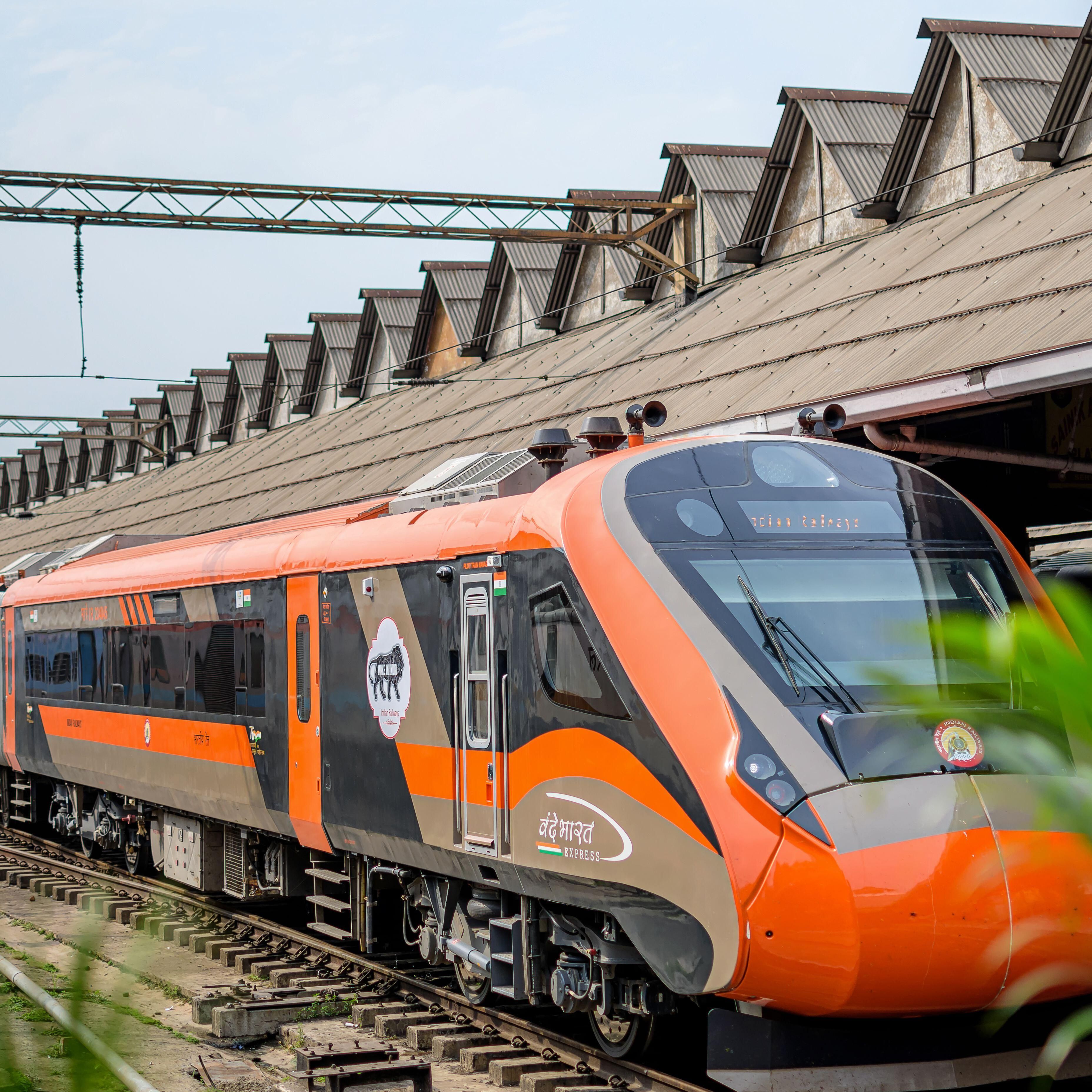
Each Vande Bharat sleeper trainset has 16 air-conditioned coaches: 11 AC Three-Tier coaches carrying 611 passengers, 4 AC Two-Tier coaches for 188 passengers, and 1 AC First Class coach for 24 passengers, adding up to 823 berths per trip, per Goodreturns.
Onboard, passengers get electric outlets and reading lights at every berth, CCTV cameras, automatic doors, bio-vacuum toilets and sensor-based water taps, according to Goodreturns. A Passenger Information System shows real-time speed, the next station and weather updates, the outlet said. Dinner and breakfast come included in the base fare, matching the Rajdhani model, with snacks and beverages available from the onboard pantry for extra cost, per ConfirmYatra.
The train runs on the indigenous Kavach Automatic Train Protection system, certified to Safety Integrity Level-4, alongside jerk-free semi-permanent couplers, anti-climbers and a crashworthy car body built to European standards, per DD News. Fire safety has also been upgraded, with barrier doors at each coach's end and aerosol-based fire detection, DD News reported.
Img Src : cntraveller
On the Howrah-Kamakhya route, fares start at Rs 2,300 for AC Three-Tier, Rs 3,000 for AC Two-Tier and Rs 3,600 for AC First Class, according to Railway Supply. Shorter sections cost less: a Kamakhya-Malda Town journey runs Rs 1,522 in AC-3, Rs 1,965 in AC-2 and Rs 2,409 in First AC, the outlet said. Meals are bundled into every fare.
Across corridors, the average fare works out to roughly 10 to 15 percent above equivalent Rajdhani tickets, per ConfirmYatra. Part of the reason fares stay close to Rajdhani levels is manufacturing cost control: each coach costs between Rs 8 crore and Rs 8.5 crore, lower than a metro coach at Rs 10 to 10.5 crore, Railway Minister Ashwini Vaishnaw has said, according to Goodreturns. For a traveller weighing a multi-hour time saving, better safety tech and included meals against a modest fare bump, the calculation increasingly favours the new train, particularly on long overnight hauls like Delhi-Mumbai or Mumbai-Chennai.
This is only the start. Indian Railways plans 12 Vande Bharat sleeper express trains by March 2027, with an earlier target of 30 new trains by the end of 2026, per Goodreturns. Vaishnaw told the Lok Sabha on 4 February 2026 that the Railways has planned to manufacture 260 rakes as part of its broader modernisation push, DD News and PIB reported.
A Bengaluru-Mumbai Vande Bharat sleeper service has been officially approved, according to Travel and Tour World. The 1,139-km journey is expected to be significantly faster than the current Udyan Express, which takes 22 hours today, the outlet said. Vaishnaw separately indicated the route could launch with two trainsets around July or August 2026, per India TV News, though an official launch date has not yet been confirmed.
Meanwhile, engineers at Integral Coach Factory Chennai are designing a 24-coach extended version with 1,224 berths and a dedicated AC pantry car, currently at prototype stage and expected to roll out by the end of 2026, per Railway Supply. The trains are being built domestically: BEML rolled out the first prototype in September 2024, and ICF Chennai is working alongside BEML, with full-scale production of 24-car trainsets set to start in 2026-27, according to PIB and Goodreturns. PIB has said the Vande Bharat fleet, sleeper and chair-car versions combined, is envisioned to scale to around 4,500 trainsets by 2047.
With 260 rakes planned and only a handful running today, most Indian travellers will still be booking Rajdhani tickets for a while yet. But as more corridors go live, including Bengaluru-Mumbai later this year, and manufacturing scales up at ICF and BEML, the sleeper Vande Bharat looks set to become the default overnight option on India's busiest routes, not a premium alternative.
Everything you need to know
As of June 2026, it runs on the Howrah-Kamakhya route plus four major corridors: Delhi-Mumbai, Delhi-Kolkata, Mumbai-Chennai and Kolkata-Chennai, according to PIB and ConfirmYatra.
Fares range from roughly Rs 1,200 to Rs 2,900 depending on class, about 10-15% higher than comparable Rajdhani fares, per Redbus and The News Boy.
Indian Railways plans 12 Vande Bharat sleeper express trains by March 2027, with a longer-term plan to manufacture 260 rakes, Railways Minister Ashwini Vaishnaw told the Lok Sabha on 4 February 2026, per DD News and PIB.


Oct 14, 2026
TUI Staff
Oct 08, 2026
TUI Staff
Oct 06, 2026
TUI Staff
Oct 15, 2026
TUI Staff
Oct 15, 2026
TUI Staff
Oct 15, 2026
TUI Staff
Oct 14, 2026
TUI Staff

Stay informed with independent, fact-checked journalism on technology, environment, government, economy and more. India’s most trusted digital news platform.


Comments (0)
Be the first to comment!