
Raksha Bandhan 2026: Date, Shubh Muhurat, Purnima Tithi & Everything You Need to Know
The date, rituals and stories to follow for Rakhi 2026
 IN
Sun, Oct 11, 2026 | 01:54 PM IST
IN
Sun, Oct 11, 2026 | 01:54 PM IST


One date. Two calendar days. A lunar eclipse. And a festival that continues to mean something different to every generation.
If you are wondering whether Rakhi falls on August 27 or August 28 this year, you are not alone. The confusion comes from the way the lunar calendar works, with Purnima Tithi beginning on one date and ending on another. Add Bhadra and a lunar eclipse to the mix, and the 2026 festival becomes particularly interesting.
So, when is Raksha Bandhan 2026? The festival will be celebrated on Friday, August 28, 2026. According to Drik Panchang, the Purnima Tithi begins at 9:08 AM on August 27 and ends at 9:48 AM on August 28.
The answer is August 28.
Raksha Bandhan is observed on the full moon, or Purnima, of the Hindu month of Shravana. This year, the Purnima Tithi stretches across August 27 and 28. However, the traditional rules governing Raksha Bandhan, including avoiding Bhadra, make August 28 the appropriate day for the ceremony.
This also explains why searches for Rakhi 2026 date may show August 27 in some calendars. August 27 marks the beginning of Purnima, but it is not the date chosen for the Rakhi ceremony.
In short:
These timings are based on Drik Panchang's location-specific calculations.
The Rakhi 2026 Muhurat Time varies slightly from city to city because sunrise and local Panchang calculations differ.
For New Delhi, Drik Panchang has mentioned the window for Raksha Bandhan 2026 date and time to be 5:57 AM to 9:48 AM on August 28, lasting 3 hours and 51 minutes.
Some major city timings are:
| City | Rakhi Muhurat |
| New Delhi | 5:57 AM–9:48 AM |
| Mumbai | 6:23 AM–9:48 AM |
| Pune | 6:19 AM–9:48 AM |
| Bengaluru | 6:08 AM–9:48 AM |
| Hyderabad | 6:01 AM–9:48 AM |
| Kolkata | Around 5:17 AM–9:48 AM |
Drik Panchang's city-specific pages confirm the Mumbai, Pune, Bengaluru, Hyderabad and Kolkata timings.
If you are celebrating outside these cities, it is better to check the Panchang for your exact location rather than applying one city's muhurat everywhere.
Purnima simply refers to the full moon Tithi. In 2026, it begins on August 27 at 9:08 AM and concludes on August 28 at 9:48 AM.
This is the key reason the Rakhi 2026 date in India can appear differently across online calendars. One calendar may highlight the date on which Purnima begins, while another identifies the festival's actual observance date.
The important distinction is between when the Tithi begins and when the festival is traditionally observed.
Bhadra is a period in the Hindu Panchang that is traditionally avoided for certain auspicious ceremonies. Drik Panchang notes that Raksha Bandhan rituals should not be performed during Bhadra and that the relevant Bhadra period in 2026 ends before sunrise on August 28.
It is important to understand this in the right context. Bhadra is part of traditional Hindu calendrical practice, not a scientific phenomenon. Families and communities may follow these customs differently.
For 2026, the practical takeaway is straightforward: the Bhadra period does not obstruct the Rakhi ceremony on August 28.
There is an unusual twist this year. A partial lunar eclipse will occur on August 28, 2026, the same day as Raksha Bandhan.
NASA lists the eclipse as a partial lunar eclipse lasting about 3 hours and 18 minutes. Its visibility is limited to parts of the Americas, Europe and Africa; it will not be visible from India.
Sutak is a traditional religious observance associated with eclipses. Since this eclipse will not be visible from India, many Panchang-based interpretations do not consider eclipse-related Sutak applicable to Indian observances.
However, religious practices can vary between families, communities and regional traditions. It is therefore better to treat this as a matter of custom and belief, rather than an absolute religious rule.
The eclipse itself does not change the date of Rakhi.
At its heart, Raksha Bandhan celebrates love, trust, care and the bond between siblings.
Traditionally, a sister ties a Rakhi around her brother's wrist, applies tilak, offers sweets and prays for his wellbeing. The brother, in turn, promises to stand by her and often gives a gift.
There are several traditional stories associated with the festival, including the stories of Krishna and Draupadi, Lakshmi and King Bali, and Indra and Indrani. These should be understood as religious and mythological traditions rather than as one definitive historical origin. The Government of India's Incredible India portal also highlights these cultural associations.
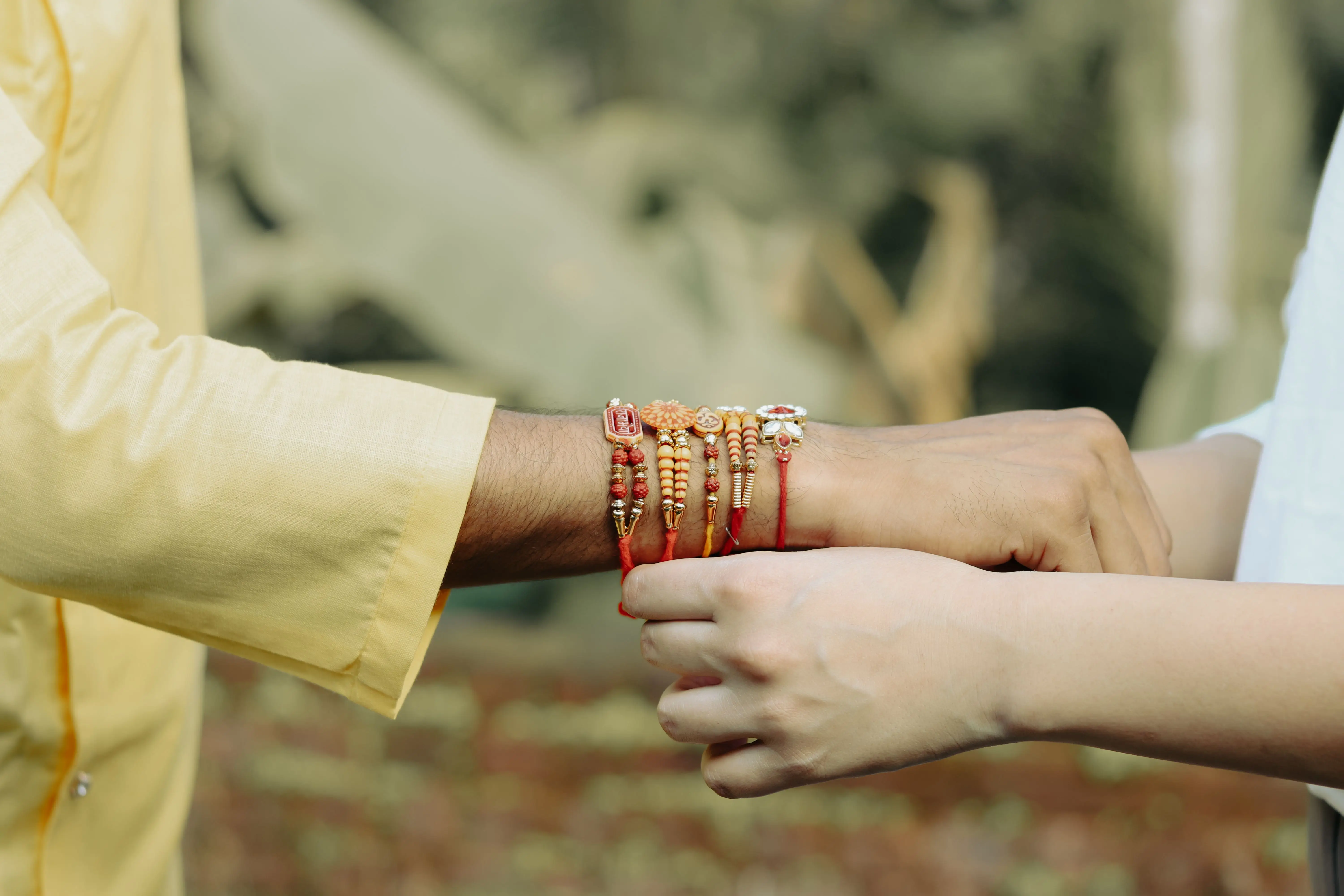
Img Src : Pexels
A traditional Rakhi thali includes:
The ceremony usually involves applying tilak on brother’s forehead, offering aarti, tying the Rakhi, sharing sweets and exchanging gifts.
But the festival is changing with the times. Siblings living in different cities or countries now send Rakhis by post, exchange gifts online and celebrate over video calls. More importantly, the old idea of protection is becoming increasingly mutual.
A sister can be her brother's strongest support system. A brother can stand beside his sister through difficult choices. And both can share responsibilities that have little to do with gender.
That may be the most relevant meaning of the festival today: protection is not always about shielding someone from the world. Sometimes, it simply means making sure they never have to face it alone.
Holiday rules vary by state, institution and local administration. Raksha Bandhan should therefore not automatically be described as a nationwide public holiday.
For example, Maharashtra's local holiday arrangements for Mumbai and Mumbai Suburban districts include August 28, 2026 in connection with Raksha Bandhan. Readers should still check their employer, school or local government calendar for confirmation.
As Raksha Bandhan 2026 brings families and siblings together, may the sacred thread serve as a reminder of the bonds that make life richer and stronger. Whether you celebrate with a traditional Rakhi ceremony, a heartfelt call from miles away, or simply by being there for each other, the spirit remains the same.
The United Indian wishes everyone a joyful, love-filled and memorable Raksha Bandhan. May every sibling bond grow stronger, and may the promise of standing by each other last far beyond the festival.
Everything you need to know
Raksha Bandhan 2026 falls on Friday, 28 August, not Thursday, 27 August. The Shravan Purnima tithi runs from 9:08 am on 27 August to 9:48 am on 28 August, and since the Udaya tithi (the Purnima present at sunrise) falls on the 28th, that is the recommended date, per India Today, Times of India and Economic Times.
In New Delhi, the recommended window to tie rakhi is roughly 5:57 am to 9:48 am on 28 August 2026, about three hours and 51 minutes, according to Hindustan Times. Bhadra, an inauspicious period, ends before sunrise that day, so the entire morning window is considered safe.
At the central government level, Raksha Bandhan 2026 is listed as a restricted holiday (RH), meaning it is optional rather than mandatory. It is a full state holiday in Gujarat, Madhya Pradesh, Uttarakhand, Sikkim, Rajasthan, Uttar Pradesh, Jammu and Kashmir, Kerala and Himachal Pradesh, per Economic Times.

Oct 09, 2026
TUI Staff
Oct 09, 2026
TUI Staff
Oct 09, 2026
TUI Staff
Oct 09, 2026
TUI Staff
Oct 09, 2026
TUI Staff
Oct 09, 2026
TUI Staff
Oct 09, 2026
TUI Staff
Oct 09, 2026
TUI Staff

Stay informed with independent, fact-checked journalism on technology, environment, government, economy and more. India’s most trusted digital news platform.

Comments (0)
Be the first to comment!