
Made in India Semiconductor Chips in Space: How ISRO Uses Them in Chandrayaan-3 and Aditya-L1
Indian Silicon, Space-Proven
 IN
Fri, Oct 09, 2026 | 05:01 AM IST
IN
Fri, Oct 09, 2026 | 05:01 AM IST

Made in India semiconductor chips are no longer confined to laboratories and technology demonstrations. Indigenous processors and other semiconductor devices are already being used across India's space programme, including on lunar and solar missions and inside ISRO launch vehicles. Union Electronics and IT Minister Ashwini Vaishnaw highlighted the achievement on National Space Day, August 23, saying, “Made in India chips are powering Indian Space Missions.”
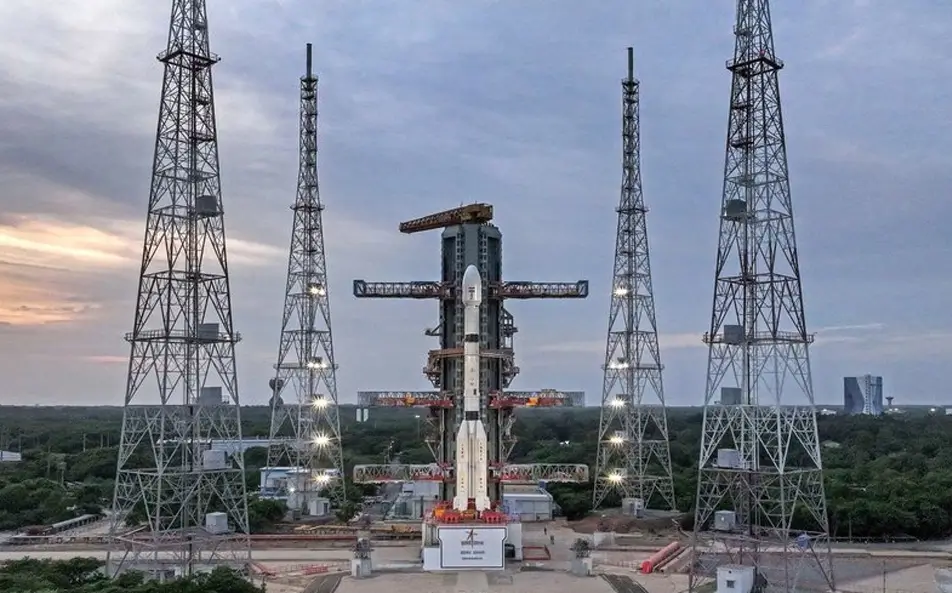
More importantly, the Department of Space subsequently put specific hardware behind that statement. An official government release says domestically developed chips have been used on Chandrayaan-3 and Aditya-L1, while indigenous Vikram processors are deployed in launch vehicles. That makes the development more than a semiconductor-policy talking point. India already has home-grown silicon with actual spaceflight heritage.
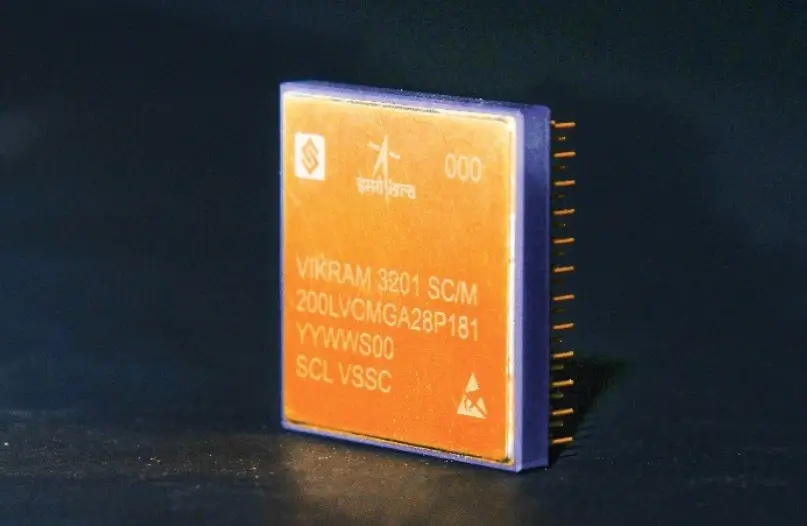
The government's August 23 release identifies three clear examples. The Chandrayaan 3 mission used an Indian-made camera-related chip developed at Semiconductor Laboratory, or SCL, to support the Vikram lander's imaging system. Aditya-L1, India's solar observatory, uses radiation-hardened analogue-to-digital converter chips developed by SCL. And ISRO's launch vehicles use the indigenous Vikram processor for onboard computing.
SCL manufactures a much wider range of specialised space components, including radiation-hardened chips, CCD and CMOS imagers, ASICs and sensors designed to measure acceleration, temperature, pressure and acoustic conditions. Those are very different requirements from ordinary consumer semiconductors. Electronics used in an Indian space mission must function reliably through vibration, extreme temperatures and, depending on the application, radiation exposure.
The Chandrayaan 3 mission provides one of the clearest demonstrations of India's existing capabilities. Reporting after the 2023 landing identified two SCL-made components associated with the mission. The VIKRAM1601 PE01 processor was used for navigation aboard the LVM3 launch vehicle that carried Chandrayaan-3 into space. SCL also fabricated the SC1216-0 CMOS Camera Configurator, which flew with the Vikram lander's imaging system. So describing the Chandrayaan connection simply as “a camera chip” is correct at a high level, but there is a broader indigenous semiconductor contribution behind the mission. SCL's own annual report lists both the Vikram 1601 processor and CMOS Camera Configurator under its Chandrayaan-3 contribution.
India's first dedicated solar observatory provides another example. The Department of Space says Aditya-L1 uses radiation-hardened ADC chips developed by SCL. SCL's annual report also lists radiation-hardened pipelined and Sigma-Delta ADC technologies in connection with the mission. An analogue-to-digital converter turns analogue signals from sensors into digital information that onboard electronics can process. That matters because it shows indigenous semiconductor work spreading beyond launch-vehicle computers into scientific spacecraft systems. For the Indian space programme, self-reliance therefore involves considerably more than producing one headline-grabbing CPU.
The processor drawing the most attention now is VIKRAM3201. It is India's first fully Make-in-India 32-bit microprocessor qualified for the harsh environmental conditions of launch vehicles. ISRO's Vikram Sarabhai Space Centre designed and developed the processor in collaboration with SCL. It was fabricated using SCL's 180nm CMOS process. The chip uses a custom instruction-set architecture and supports floating-point calculations and the Ada programming language. ISRO also developed key software tools—including its compiler, assembler, linker, simulator and development environment—in-house.
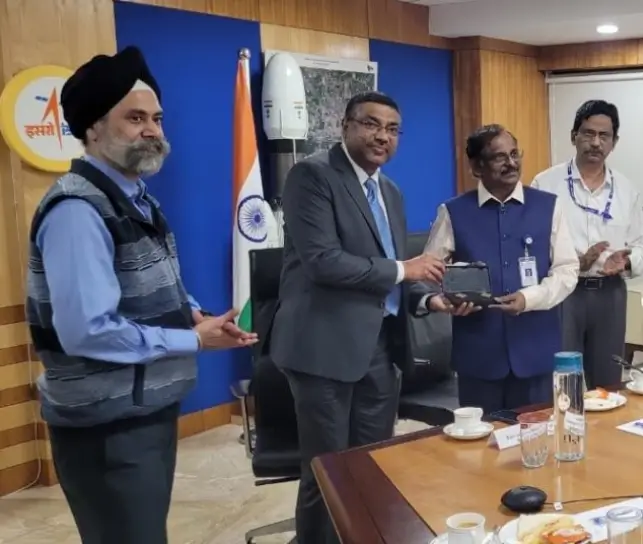
The first production lots were handed over in March 2025. That happened months before Ashwini Vaishnaw later presented the processor to Prime Minister Narendra Modi during SEMICON India 2025, so the September event should be described as a major showcase rather than the chip's original introduction.
The 16-bit VIKRAM1601 has a much longer operational history. ISRO says the processor has been flying in launch-vehicle avionics since 2009, while its fully Make-in-India version was inducted after SCL established its 180nm fabrication capability. A Department of Space parliamentary reply in February 2026 went further, stating that VIKRAM1601 had been inducted into the avionics systems of all ISRO launch vehicles. That is an important distinction for the story. India does not have to wait for VIKRAM3201 before it can claim domestically produced processors are flying on its rockets. An older indigenous generation is already operational across the fleet. The new 32-bit processor represents the next technological step.
A July statement by Ashwini Vaishnaw initially appears contradictory. After meeting Skyroot Aerospace executives, he posted that “Made in Bharat” chips for “our rockets” would arrive soon. But the context matters. Skyroot responded that it looked forward to the day India-built chips fly on its rockets. The exchange was therefore about extending indigenous semiconductor use into India's emerging private launch industry, rather than suggesting that existing ISRO launch vehicles depend entirely on imported processors. That distinction resolves much of the apparent contradiction.
Another significant development is IRIS, or the Indigenous RISC-V Controller for Space Applications. ISRO's Inertial Systems Unit and IIT Madras jointly developed the 64-bit controller using the SHAKTI RISC-V processor baseline. The complete chain—from design and fabrication to packaging, motherboard production, software and successful boot—was completed in India. SCL fabricated the processor using its 180nm technology. However, IRIS should not yet be placed alongside VIKRAM1601 as an operational mission processor. When IIT Madras announced the successful development in February 2025, ISRO Chairman V. Narayanan said a product based on the controller was planned for flight testing. It therefore represents the next pipeline of indigenous technology rather than established flight deployment.
India is not yet semiconductor-independent across every electronic component used in space. That remains an important caveat. But the evidence now shows that indigenous chips already perform real functions within the Indian space programme: launch-vehicle navigation and avionics, lunar imaging and solar-observation electronics among them. That is a stronger claim than saying India has simply designed prototype processors. For any future Indian space mission, the strategic goal will be to expand the number of critical components that can be designed, fabricated, qualified and supplied domestically.
VIKRAM1601 shows that such indigenous hardware can become operational across an entire launch fleet. VIKRAM3201 shows India now has a more capable 32-bit successor with spaceflight validation. IRIS shows another architecture moving through the development pipeline. So Made in India semiconductor chips are already in space. The next milestone is not proving that they can fly. It is ex
Everything you need to know
On August 23, 2026, Union IT Minister Ashwini Vaishnaw said Made in India semiconductor chips are powering Indian space missions, supporting lunar and solar exploration, satellites and launch vehicles, in a statement reported by The Tribune and The Times of India.
Vikram3201 is India's first fully indigenous 32-bit processor qualified for space applications, jointly developed by ISRO and its Semiconductor Laboratory (SCL) in Chandigarh. It was introduced at Semicon India 2025 and its first batch was validated in space during the PSLV C60 mission, per the Press Information Bureau and The Economic Times.
Not fully yet. The earlier 16-bit Vikram1601 chip is already used in avionics systems across all ISRO launch vehicles, per a PIB release, but Vaishnaw said in July 2026 that India's rockets will 'soon' get homegrown chips more broadly, indicating the rollout of newer processors like Vikram3201 is still ongoing.


Sep 30, 2026
TUI Staff
Sep 30, 2026
TUI Staff
Sep 28, 2026
TUI Staff
Sep 24, 2026
TUI Staff
Oct 08, 2026
TUI Staff
Oct 08, 2026
TUI Staff
Oct 08, 2026
TUI Staff
Oct 08, 2026
TUI Staff

Stay informed with independent, fact-checked journalism on technology, environment, government, economy and more. India’s most trusted digital news platform.




Comments (0)
Be the first to comment!