
India’s First Hydrogen Train Launched: Route, Stations, Speed and Key Features
India’s first hydrogen train brings fuel-cell technology, high-capacity travel and cleaner rail mobility to the Jind–Sonipat corridor.
 IN
Fri, Oct 16, 2026 | 12:32 PM IST
IN
Fri, Oct 16, 2026 | 12:32 PM IST


Prime Minister Narendra Modi flagged off India’s first indigenously developed hydrogen train at Jind railway station in Haryana on July 17, 2026. The 10-coach service will run on the Jind–Sonipat section as a clean mobility pilot, according to the Prime Minister’s Office and the Press Information Bureau.
Why it matters: Indian Railways can now test onboard hydrogen power, station-level refuelling and high-capacity passenger operations together. The results will show whether the technology can replace diesel on selected routes where overhead electrification may not work well.
PIB puts the route length at about 89 km. It says the train can carry around 2,600 passengers, operate at up to 75 kmph during the pilot and reach a design speed of 110 kmph.
The train has two Hydrogen Driving Power Cars and eight trailer coaches. One power car sits at each end. PIB says the train uses a 1,200 kW Hydrogen Fuel Cell propulsion system.
The PMO calls it one of the longest and most powerful hydrogen passenger trainsets developed so far, avoiding an unverified “world’s largest” claim.
The main corridor runs through:
Jind Junction → Gohana Junction → Sonipat
PIB says the section belongs to Northern Railway and will test the train under regular operating conditions. Its backgrounder lists these intermediate stations and proposed halts:
The word “proposed” matters. Northern Railway has not published a final commercial timetable confirming every stop, halt duration or arrival time. Station spellings also vary across reports, so the PIB list remains the safest reference for now.
PIB has approved a top operating speed of 75 kmph for the pilot. The design allows 110 kmph, but engineers will first study braking, battery use, hydrogen consumption and reliability.
For more on India’s rail upgrades, read TUI’s explainer on the Vande Bharat sleeper train.
The hydrogen powered train carries compressed gas in high-pressure cylinders inside its two Driving Power Cars. The gas enters a Proton Exchange Membrane system, where an electrochemical reaction produces electricity.
Inside the Hydrogen Fuel Cell, a catalyst separates hydrogen into protons and electrons. The electrons move through an external circuit and power the traction motors. Oxygen from the air then completes the reaction, leaving water vapour and heat as direct by-products.
India Today reports that lithium iron phosphate batteries support acceleration and store energy recovered through regenerative braking. This hybrid setup balances sudden power demand.
PIB says the train does not burn diesel and produces no direct carbon dioxide emissions while running.
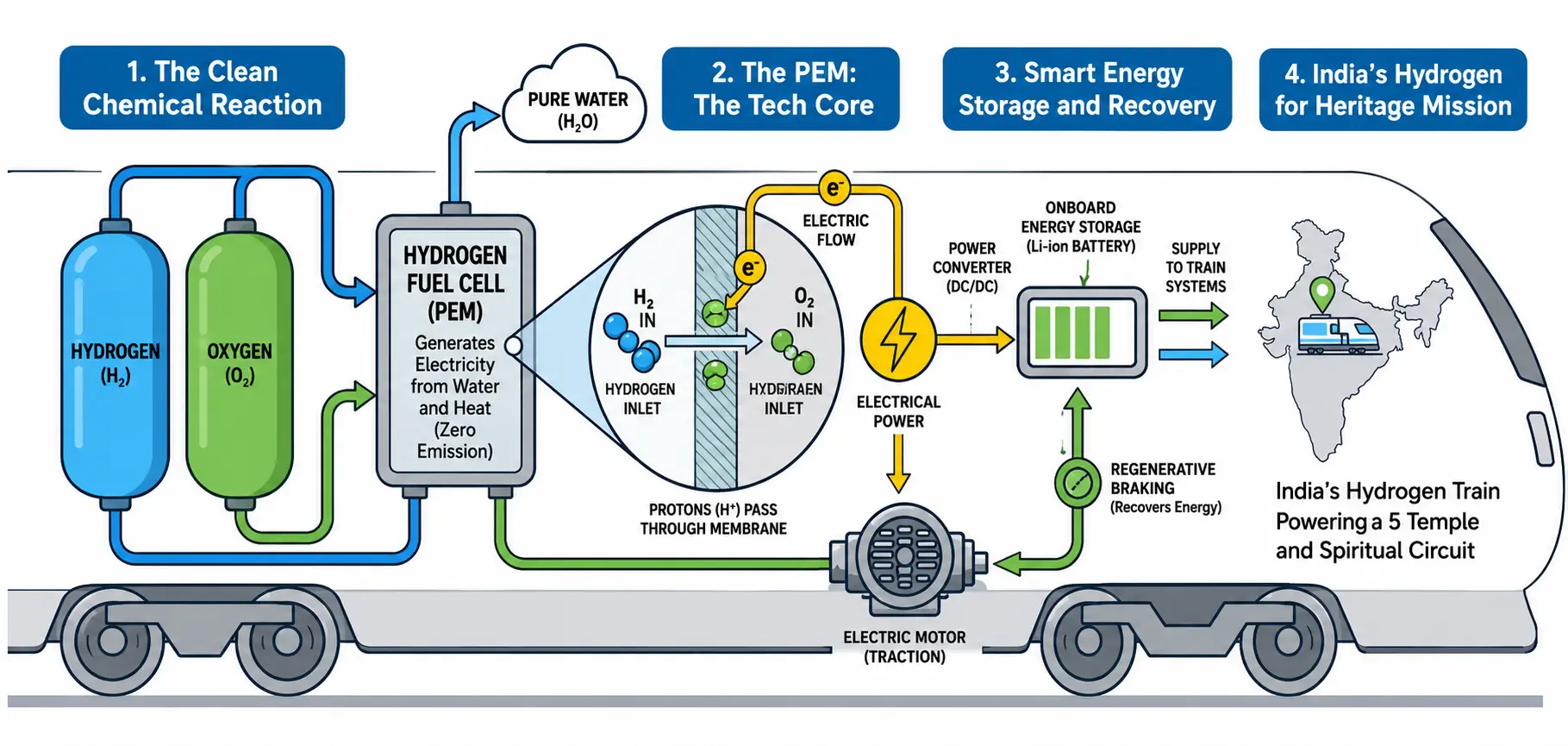
Img Src : Vision IAS
The project supports clean mobility because it removes tailpipe carbon emissions during operation. However, its total footprint depends on hydrogen production and the electricity used for electrolysis.
The US Energy Information Administration says electrolysis-related emissions vary with the power source. Renewable electricity creates a stronger environmental case than power from a fossil-fuel-heavy grid.
That distinction matters. “Zero direct operational emissions” is accurate. “Completely emission-free” ignores production, compression and transport.
PIB describes the Jind site as India’s largest railway hydrogen storage and refuelling facility. It can store nearly 3,000 kg of hydrogen and brings production, compression, storage and dispensing together.
The facility has a main compressor, a standby compressor, technical support and critical spares. PIB says the Petroleum and Explosives Safety Organisation has licensed its storage and dispensing system.
A hydrogen powered train needs dependable fuel, trained staff and maintenance systems before it can serve passengers regularly.
PIB says the train and plant use hydrogen-leak detectors, flame detectors, continuous ventilation, heat and smoke monitoring, and automatic shut-off systems.
The loco pilot can monitor the system in real time and use an emergency movement mode. Technical staff will accompany the service initially, while teams monitor refuelling around the clock.
PIB says the project follows NFPA-2 and the ISO 19880 series. TÜV SÜD, Germany, carried out an independent safety assessment. Indian Railways has also prepared its Shakurbasti maintenance facility in Delhi.
For wider context, see TUI’s report on railway safety technology.
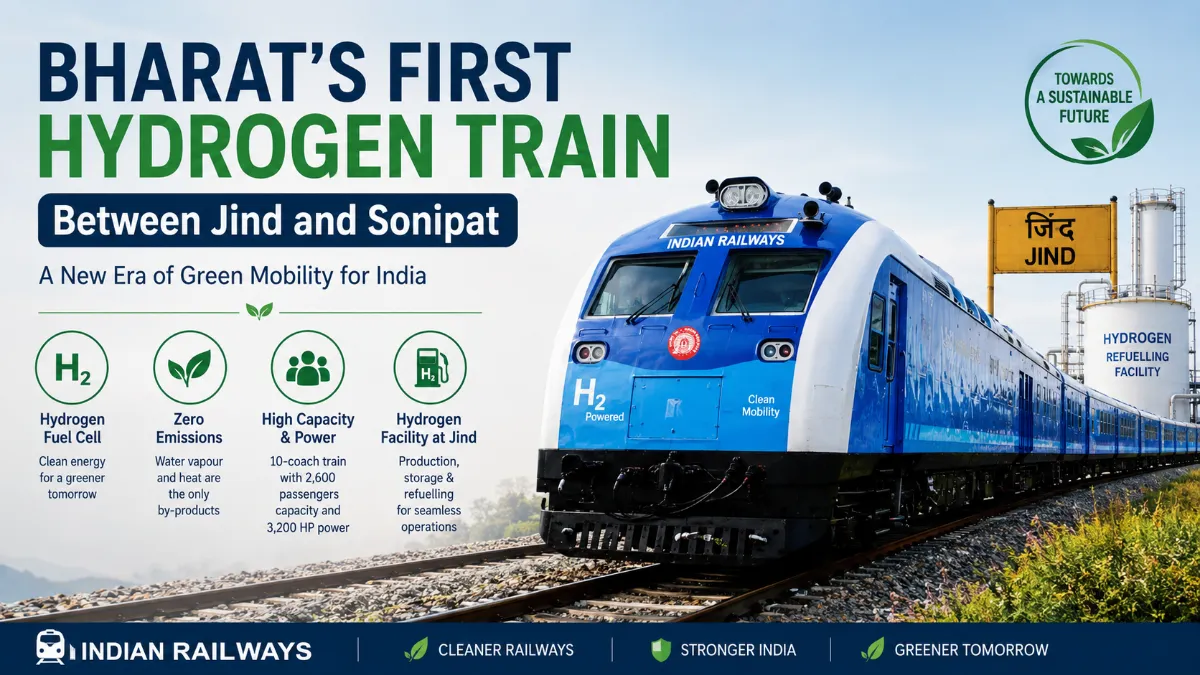
Img Src: : Sarkaritel
PIB says the Research Designs and Standards Organisation prepared the specifications and led approvals. Medha Servo Drives integrated the trainset, while the Integral Coach Factory worked on the exterior.
The project builds Indian expertise in Hydrogen Fuel Cell propulsion, storage, refuelling and maintenance. The government links it to the National Green Hydrogen Mission.
The government says more than 99% of India’s broad-gauge network has been electrified. Overhead electric trains will remain the practical choice on most busy routes because they draw power directly from the grid.
Hydrogen may suit heritage, remote or difficult-to-electrify sections where diesel still runs or overhead equipment creates problems. In that role, it would complement electrification rather than replace it.
The key test is whether hydrogen delivers enough environmental and operating value to justify production, storage, refuelling and specialist maintenance costs.
The government has confirmed the route, coach layout, capacity, pilot speed and proposed halts. It has not confirmed the regular timetable, ticket fares, booking date, train numbers or final station timings.
Passengers should wait for an official Northern Railway notification before relying on fare or schedule claims. TUI’s guide to the new IRCTC website beta explains the latest changes to the booking experience.
This hydrogen train is a serious operating test, not just a launch-day symbol. It combines onboard power generation, batteries, high-pressure storage, passenger capacity and station-level infrastructure.
Its future will depend on four results: safe operations, reliable service, affordable green hydrogen and a clear advantage over diesel on selected routes. If the pilot delivers them, clean mobility could gain a focused role where conventional electrification does not fit.
Everything you need to know
India’s first hydrogen train is an indigenously developed 10-coach passenger train that generates electricity onboard through a hydrogen fuel-cell system. Prime Minister Narendra Modi flagged it off at Jind, Haryana, on July 17, 2026.
The hydrogen train will operate on the approximately 89-km Jind–Sonipat section of Northern Railway. The main route connects Jind Junction, Gohana Junction and Sonipat.
The hydrogen train is approved to operate at up to 75 kmph during the pilot phase. Its design speed is 110 kmph, according to the Press Information Bureau.
The 10-coach hydrogen train can carry around 2,600 passengers. It consists of two Hydrogen Driving Power Cars and eight passenger trailer coaches.
The hydrogen train produces no direct carbon dioxide emissions while running. Its fuel-cell reaction releases water vapour and heat, but its overall carbon footprint depends on how the hydrogen and electricity are produced.



Oct 14, 2026
TUI Staff
Oct 08, 2026
TUI Staff
Oct 06, 2026
TUI Staff
Oct 15, 2026
TUI Staff
Oct 15, 2026
TUI Staff
Oct 15, 2026
TUI Staff
Oct 14, 2026
TUI Staff

Stay informed with independent, fact-checked journalism on technology, environment, government, economy and more. India’s most trusted digital news platform.




Comments (0)
Be the first to comment!