
Ganga Aarti Held on London's Thames River: An Ancient Ritual, a New River, One Powerful Message
An Ancient Indian Ritual Finds A New River
 IN
Mon, Sep 14, 2026 | 06:00 PM IST
IN
Mon, Sep 14, 2026 | 06:00 PM IST

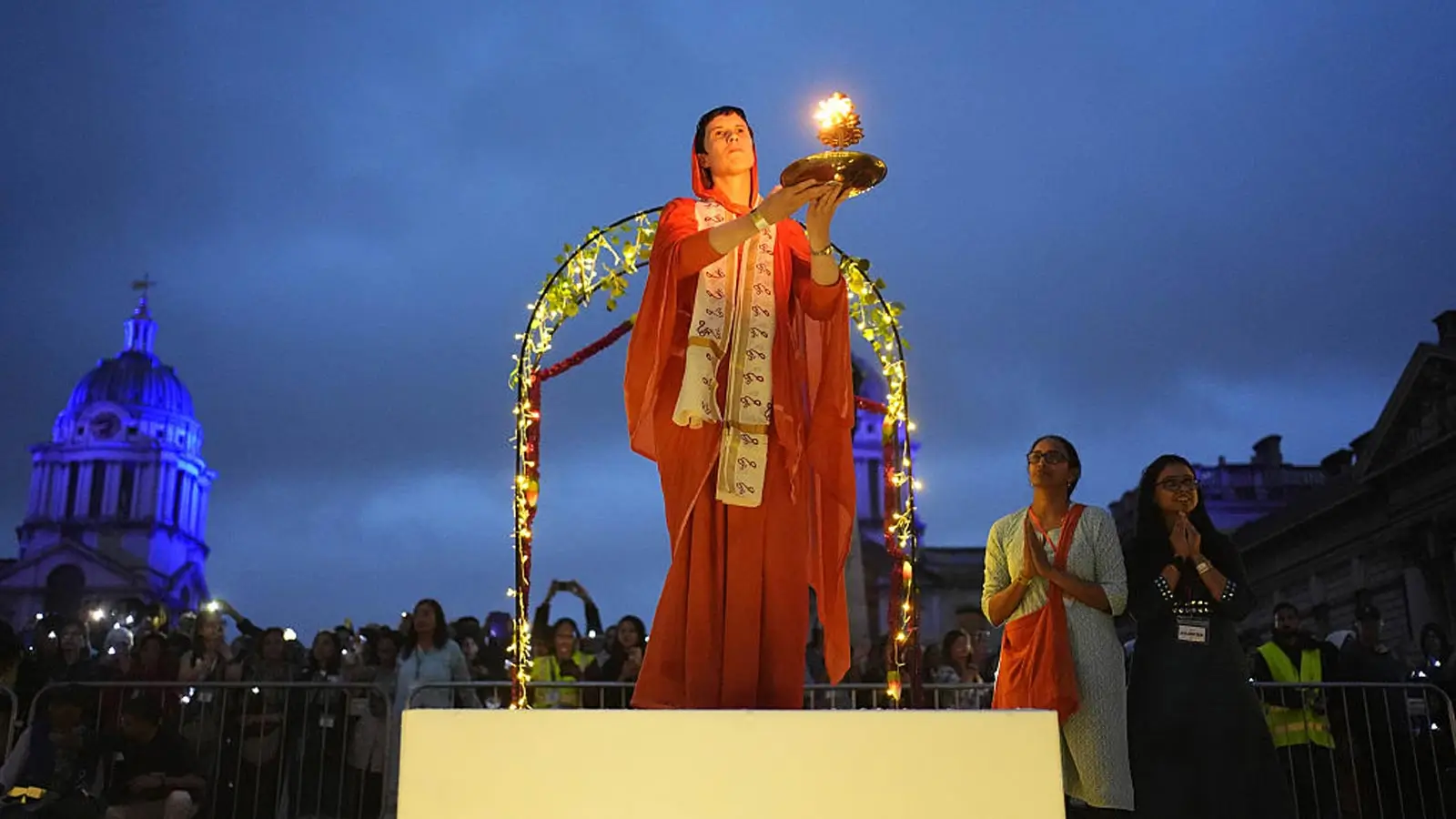
What happens when an ancient Indian river ritual meets one of London's most iconic waterways? On September 13, 2026, the glow of lamps, traditional music and prayers travelled from the banks of the Ganga to Greenwich, as London hosted its first-ever Ganga Aarti on the banks of the Thames.
Thousands gathered for the evening ceremony at the Old Royal Naval College, where an Indian spiritual tradition met British heritage, diaspora culture and a very modern environmental question: how do you carry a centuries-old tradition into a new setting without losing its meaning?
Organised by Chinmaya Mission UK in collaboration with Totally Thames, the event was also part of celebrations marking 75 years of the Chinmaya movement. But beyond the spectacle, its message was simple - gratitude for nature, respect for rivers, connection with heritage and the sharing of wisdom across borders.
The event, titled “Ganga Aarti on the Thames: A Ceremony of Light,” took place at the Old Royal Naval College in Greenwich.
According to the official event listing, the programme ran from 4 pm to 8 pm, with the main ceremony scheduled for 7:15 pm on the Royal Steps. The wider programme featured food, community stalls, live music and dance before the evening ceremony.
The Old Royal Naval College describes the event as a free, ticketed family celebration of Indian culture on the banks of the Thames. Registration was required for entry.
The setting was significant too. The venue sits within the Maritime Greenwich UNESCO World Heritage Site, putting an ancient Indian ritual against one of London's most recognisable historic landscapes.
Ganga Aarti is a traditional Hindu ceremony of light performed beside rivers as an expression of gratitude, reverence and devotion.
The ritual traditionally involves lamps, prayer, music and chanting. The Ganga is revered in Hindu tradition as sacred, life-giving and sustaining.
For devotees, the ceremony can become a moment of reflection and even spiritual awakening - a chance to pause and acknowledge the natural forces that make life possible.
The Old Royal Naval College described the London ceremony as a moment of unity, reflection and reverence for nature.
The symbolism is difficult to miss.
The Ganga and the River Thames have very different histories, yet both have shaped the communities and civilisations around them. The organisers described the London event as a meeting of “two ancient rivers” in a single act of offering.
For Britain's Indian and South Asian communities, the ceremony also offered a way to celebrate cultural roots thousands of kilometres from India.
That matters because traditions do not stay frozen in one place. They travel with families, communities and generations. They change their surroundings while carrying familiar values with them.
This wider role of diaspora communities as cultural bridges has also been explored by The United Indian in its coverage of the global Indian diaspora.
The symbolism goes beyond the physical river.
According to the organisers, the Ganga also represents the flow of knowledge within the Chinmaya tradition. That connects with the legacy of Swami Chinmayananda, whose teachings brought the wisdom of Vedanta from the Himalayas into everyday life.
That idea gave the London ceremony another layer. The journey from the Ganga to the Thames was not only about carrying a ritual across geography. It was also about carrying knowledge, philosophy and cultural memory across generations.
The event formed part of Chinmaya Mission's 75th-anniversary celebrations, making that idea of continuity especially relevant.
This is one of the most important details of the London ceremony.
Nothing from the ritual was placed, poured or released into the Thames.
Chinmaya Mission UK's official event information specifically states that flowers, idols and other offerings would not be placed in the river. Attendees were also asked not to put anything into the water.
The choice was deliberate.
Traditional river rituals can involve offerings being placed in water. In London, organisers chose to retain the spirit of reverence while keeping the Thames undisturbed.
That choice says something important about how traditions can evolve.
Respect for nature does not have to stop at prayer. It can also mean changing the way a ritual is performed when the surrounding environment requires it.
The United Indian has previously explored the cultural and ecological importance of India's rivers, including why protecting them matters beyond their religious significance.
Img Src : DD India
The evening was designed as a community celebration as much as a spiritual gathering.
The organisers invited people of all backgrounds, with no prior religious or cultural knowledge required. The programme combined food, music, dance, community activities and the evening ritual.
That inclusive approach matters.
For people familiar with Indian traditions, the event could offer a sense of connection. For others, it provided an opportunity to encounter a living tradition in an entirely different setting.
That is how cultural heritage stays relevant: not by being kept behind closed doors, but by being understood, experienced and passed forward.
The event's collaboration with Totally Thames placed the ceremony within a wider celebration of London's river.
The festival brings together arts, heritage, environmental initiatives and community programmes centred on the Thames. The Old Royal Naval College also described the event as part of Totally Thames 2026.
That context made the ceremony more than a standalone community gathering.
It became a meeting point between Indian heritage and London's own river culture.
The event's strong response has sparked discussion about whether the ceremony could return as a regular feature in future.
However, an annual continuation should be described as a possibility, not a confirmed commitment.
What is certain is that the event created a memorable cultural moment: an Indian river tradition beside a British river, welcomed into a historic London setting.
The most meaningful part of the ceremony may not have been the lamps themselves.
It was the idea behind them.
An ancient tradition travelled to a new river. Its setting changed, but its central themes remained: gratitude, community, knowledge, nature and connection.
For some, the evening offered spiritual awakening and a connection with heritage. For others, it was a first introduction to an Indian tradition. And for everyone gathered beside the river, it offered a moment to think about what waterways mean to the communities that grow around them.
From the Ganga to the Thames, the journey was thousands of miles long.
The message travelled just as far: honour what sustains life, carry wisdom forward, and let tradition evolve without losing its soul.
Everything you need to know
Ganga Aarti is a traditional Hindu ceremony of light, prayer, music and chanting performed beside rivers as an expression of gratitude and reverence.
The Ganga Aarti was held on the banks of the Thames at the historic Old Royal Naval College in Greenwich, London.
The ceremony brought an Indian spiritual tradition to London's iconic river, symbolising cultural connection, gratitude for nature and the flow of knowledge across borders.
No. The ceremony was conducted entirely on land, and organisers said that lamps, flowers, idols and other offerings would not be released into the Thames.
The Ganga Aarti was organised by Chinmaya Mission UK in collaboration with the Totally Thames Festival as part of celebrations marking 75 years of the Chinmaya movement.





Sep 14, 2026
TUI Staff
Sep 14, 2026
TUI Staff
Sep 11, 2026
TUI Staff
Sep 14, 2026
TUI Staff
Sep 14, 2026
TUI Staff
Sep 11, 2026
TUI Staff
Sep 11, 2026
TUI Staff

Stay informed with independent, fact-checked journalism on technology, environment, government, economy and more. India’s most trusted digital news platform.





Comments (0)
Be the first to comment!