
Scientists Discover Mega-Earth GJ 523b: A Planet 23 Times More Massive Than Earth
A massive young world challenging planetary formation theories
 IN
Thu, Oct 08, 2026 | 03:03 AM IST
IN
Thu, Oct 08, 2026 | 03:03 AM IST


What if a planet just 2.5 times wider than Earth packed more than 23 Earths’ worth of mass inside it?
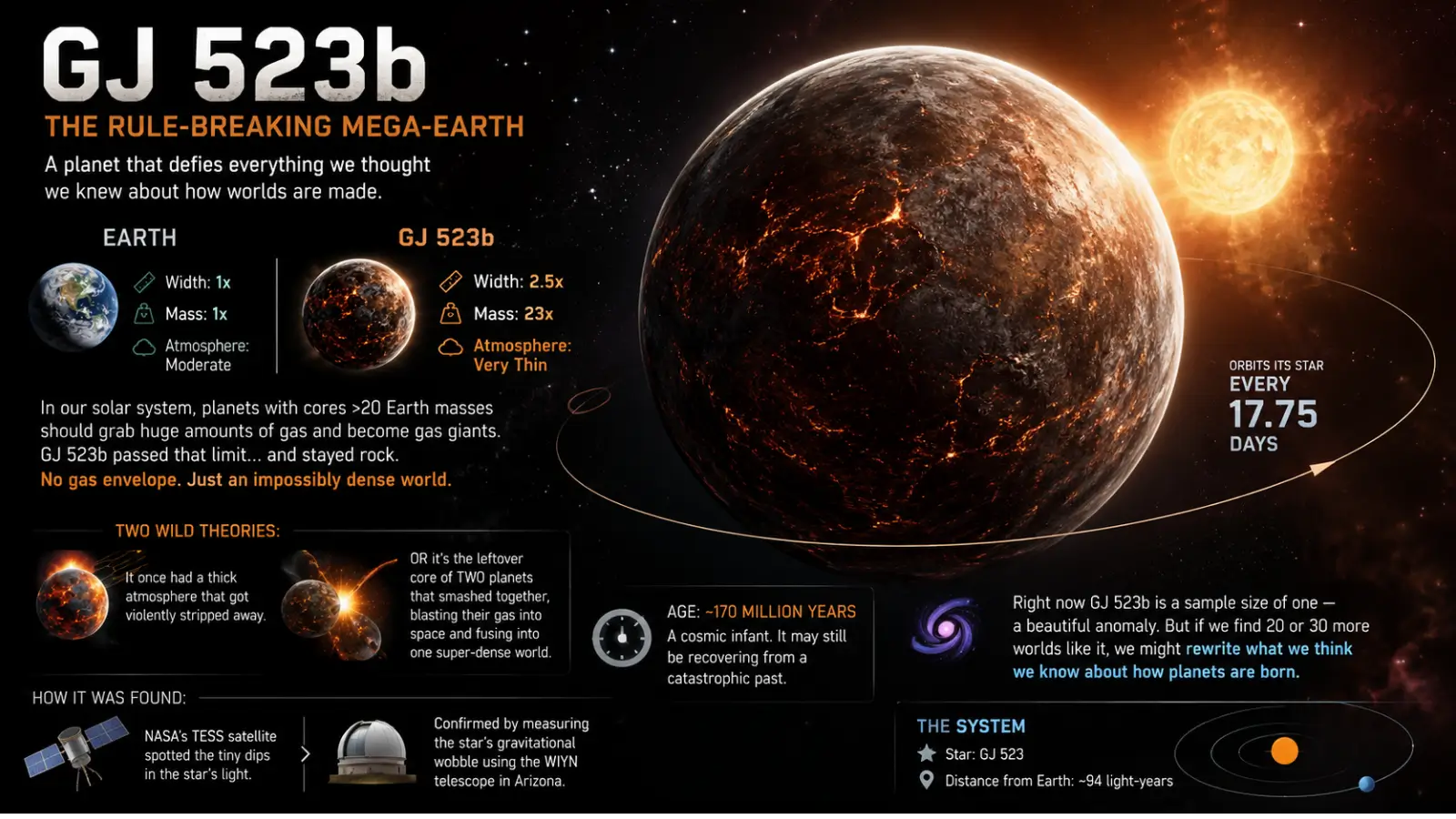
That is the strange case of GJ 523b, a newly characterised world that is forcing astronomers to take a closer look at how massive planets form. The planet is about 2.55 times Earth’s radius but has an estimated mass of 23.5 Earths. Even more surprising, its density suggests that it contains relatively little gas despite being massive enough for scientists to expect a substantial gaseous envelope.
The findings come from a research team led by Maxwell Kroft. The study was submitted to The Astronomical Journal and is currently available as a research preprint, so some of the explanations for the planet’s unusual history remain hypotheses rather than established facts.
GJ 523b is an exoplanet orbiting a mid-K dwarf star. It completes one trip around its host star every 17.75 days and has a radius of 2.55 ± 0.15 times Earth’s. Its measured mass is estimated at 23.5 ± 3.3 Earth masses, while its bulk density is about 7.8 ± 1.8 grams per cubic centimetre.
There is an important distinction here: 23.5 times Earth’s mass does not mean 23.5 times Earth’s size. Its radius is only about 2.55 times that of our planet.
That makes the comparison even more fascinating. Imagine taking more than 23 Earth masses and compressing them into a world only a little over twice Earth’s radius. Its unusually high density is one of the main clues that scientists are studying.
The planet’s system is also remarkably young. Researchers estimate its age at around 169 million years, with an uncertainty range of roughly 121 to 269 million years. In cosmic terms, that is practically a newborn compared with Earth’s age of about 4.5 billion years.
The phrase Mega-Earth can sound like an official category, but it is not a formal planetary class.
In the new study, researchers propose an observational classification for ultra-dense, sub-Neptune-sized planets like this one. Their suggested criteria are a radius of at least 2.1 Earth radii and a density of at least 5.5 grams per cubic centimetre. GJ 523b meets both conditions.
The term is useful because it describes a peculiar group of worlds that sit somewhere between familiar planetary categories. They are much larger and heavier than Earth-like rocky planets, yet their density can suggest a composition dominated by heavier materials rather than a huge envelope of hydrogen and helium.
So, “Mega-Earth” does not mean another Earth. It means an unusually massive and dense planet that shares some of the rocky characteristics associated with terrestrial worlds.
The discovery began with NASA’s Transiting Exoplanet Survey Satellite (TESS).
TESS searches for planets by monitoring stars for tiny, repeated changes in brightness. When a planet passes between its star and the telescope, it blocks a small fraction of the star’s light. This is known as the transit method.
Researchers then followed up the TESS candidate using the WIYN 3.5-metre Telescope at Kitt Peak National Observatory in Arizona. The team used the NEID spectrograph to measure the subtle movement of the host star caused by the planet’s gravitational pull. This is known as the radial-velocity method.
Together, the observations provided the crucial measurements:
Transit data → planet’s radius
Radial velocity → planet’s mass
Mass + radius → planet’s density
That combination revealed just how unusual this world is.
Here is where the story gets really interesting.
In the early stages of planetary formation, material in the disk surrounding a young star begins clumping together. Rocky and metallic particles can build increasingly large planetary cores. As those cores grow, their gravity becomes stronger.
Eventually, a sufficiently massive core can capture gases such as hydrogen and helium from the surrounding disk.
This is broadly consistent with the formation picture used for gas giants such as Jupiter and Saturn. The source reports note that cores reaching around the 20-Earth-mass range are generally associated with the ability to rapidly accumulate substantial gaseous envelopes.
And here is the puzzle:
GJ 523b is already about 23.5 Earth masses.
Yet its measured density points to a surprisingly low atmospheric mass fraction. In other words, this enormous planet does not appear to be carrying the thick gas envelope that scientists might expect from a world of its mass.
That is what makes the discovery so valuable. It is not simply a matter of finding a very heavy planet. It is about finding one that appears to have taken an unexpected route through planetary evolution.
At this stage, there is no single confirmed answer.
One possibility is that the planet formed with more gas and later lost much of it. Young stars can expose nearby planets to intense radiation and other energetic conditions capable of influencing their atmospheres. Whether that process could fully explain this particular planet remains an open question.
Another possibility involves a giant planetary collision. A sufficiently powerful impact could potentially remove a significant amount of a planet’s outer material while leaving behind a much denser remnant. However, this remains a proposed scenario, not proof of what happened to this planet. The researchers explicitly note that there is currently not enough information to determine its formation history definitively.
There is another clue that makes the system even more intriguing.
Researchers estimate a minimum orbital obliquity of about 71.4 degrees, suggesting that the planet’s orbit may be strongly tilted relative to the rotation of its host star. The study describes it as likely being on a near-polar orbit.
A young, extremely massive, unusually dense planet with a potentially polar orbit is certainly not an everyday planetary system.
This is where the discovery goes beyond one unusual world.
Scientists use planets as natural laboratories for testing ideas about how planetary systems evolve. Most planets do not fit perfectly into neat categories, and unusual examples can reveal where existing models need improvement.
GJ 523b raises several questions:
Answering these questions could improve our understanding of how planetary systems develop, particularly during their earliest stages.
For now, the biggest mystery is not whether GJ 523b exists. The observations strongly support its planetary nature and provide measurements of its size, mass and density.
The bigger unknown is how it ended up this way.
Scientists still need better information about its atmosphere, internal composition, formation history and orbital evolution. More observations could help distinguish between competing explanations and establish whether this planet is a rare exception or part of a broader population of ultra-dense worlds.
That is also why it is important not to oversell the discovery. Scientists have not concluded that GJ 523b “should not exist.” Instead, its combination of properties challenges some conventional expectations and gives researchers an unusual case to investigate.
GJ 523b is fascinating because it refuses to fit neatly into the usual boxes.
It is far more massive than Earth, yet only around 2.5 times wider. It is young, extremely dense and apparently has a surprisingly small gaseous envelope. Its orbit may also be dramatically tilted.
Most importantly, it gives scientists another opportunity to ask a fundamental question: What actually determines whether a planet becomes a rocky world, a gas-rich planet or something in between?
For readers on Earth, the discovery is a reminder that our galaxy is full of planetary systems that can look very different from our own.
And sometimes, the most valuable worlds to discover are not the ones that look familiar. They are the ones that make scientists stop and say, “This isn't what we expected at all.”
Editorial note: The underlying research paper was submitted on March 25, 2026, and is listed as submitted to The Astronomical Journal. Formation scenarios discussed above should therefore be understood as scientific possibilities, not confirmed conclusions.
Everything you need to know
GJ 523b is an unusually dense exoplanet with about 23.5 times Earth's mass and 2.55 times Earth's radius. Scientists have proposed classifying it as a “Mega-Earth.”
GJ 523b is called a Mega-Earth because of its unusual combination of high mass, large radius and exceptional density. The term is informal rather than an official planetary classification.
GJ 523b was first identified as a transiting planet candidate by NASA's TESS mission. Astronomers later used the WIYN telescope and NEID spectrograph to measure its mass.
Despite having about 23.5 Earth masses, GJ 523b appears to contain relatively little gas. Scientists would normally expect a planet this massive to accumulate a substantial hydrogen-helium envelope.
No. Despite being called a Mega-Earth, GJ 523b is very different from Earth. The term refers mainly to its unusual mass, size and density, not habitability or Earth-like conditions.






Oct 07, 2026
TUI Staff
Oct 06, 2026
TUI Staff
Oct 05, 2026
TUI Staff
Oct 05, 2026
TUI Staff
Oct 07, 2026
TUI Staff
Oct 06, 2026
TUI Staff
Oct 05, 2026
TUI Staff
Oct 05, 2026
TUI Staff

Stay informed with independent, fact-checked journalism on technology, environment, government, economy and more. India’s most trusted digital news platform.






Comments (0)
Be the first to comment!