
Coal or Conservation? Why Ramappa Temple Has Become the Centre of Telangana’s Mining Debate
An ancient legacy caught between coal and conservation.
 IN
Tue, Sep 22, 2026 | 10:47 PM IST
IN
Tue, Sep 22, 2026 | 10:47 PM IST


A proposed coal mine near an 800-year-old monument has triggered a question Telangana cannot ignore: how much development is worth the risk of disturbing history, water and local livelihoods?
What happens when a coal reserve lies close to a temple that has survived centuries of political change, natural disasters and shifting landscapes?
That is the question now surrounding Ramappa Temple, Telangana’s celebrated Kakatiya-era monument and a globally recognised heritage site. A proposed open-cast coal mining project near Venkatapur in Mulugu district has raised concerns among heritage conservationists, environmental experts and local residents.
The proposed project by Singareni Collieries Company Limited (SCCL) is expected to extract approximately 40.4 million tonnes of coal over nearly 19 years. However, its proximity to Ramappa Temple and the historic Ramappa Lake has triggered a growing “Save Ramappa” campaign.
Although SCCL has maintained that technical studies indicate the project can be conducted safely, conservationists fear that blasting, deep excavation and groundwater disruption could affect the temple’s structural stability and the surrounding heritage landscape.
As of September 2026, the project has been put on hold pending detailed scientific and environmental assessments.
The proposed PV Narasimha Rao open-cast coal mine is located near Venkatapur in Mulugu district, roughly five kilometres from the Ramappa Temple region.
The project reportedly covers forest land, agricultural land and government-assigned land. While coal extraction could contribute to the region’s industrial and economic activity, its location has raised questions about the possible impact on:
The central concern is not simply whether mining is possible. It is whether mining can take place without creating long-term risks for a monument and ecosystem that cannot be replaced once damaged.
Ramappa Temple, Telangana is officially known as the Kakatiya Rudreshwara Temple. Constructed around 1213 AD during the reign of Kakatiya ruler Ganapati Deva, the temple was commissioned by Recherla Rudra, a military general.
The monument is popularly named after Ramappa, the master sculptor associated with its construction.
The temple is renowned for its:
On 25 July 2021, the monument was inscribed on the UNESCO World Heritage List under the name Kakatiya Rudreshwara Temple (Ramappa), recognising its outstanding cultural value.
This recognition placed the monument within the larger conversation around a unesco world heritage site in india and increased attention on the need to protect its physical and cultural surroundings.
The biggest concern raised by heritage experts involves blasting, deep excavation and vibrations caused by heavy mining machinery.
According to reports, the proposed mining operation could involve excavation reaching approximately 300 metres. M. Panduranga Rao of the Kakatiya Heritage Trust has warned that such activity could generate soil tremors and affect the monument’s stability.
The concern is particularly significant because the temple’s foundation is an important part of its architectural identity.
A 2025 report titled Impact of Opencast Mining of Singareni Collieries on UNESCO Inscribed Ramappa Temple & the Great Heritage of Ramappa Lake reportedly highlighted geological faults, joints and existing structural concerns in the region.
The report was also said to have referred to:
These concerns have been raised by heritage representatives and should not be interpreted as proof that mining will certainly damage the temple. However, they underline the need for independent and transparent scientific assessment before any final decision.
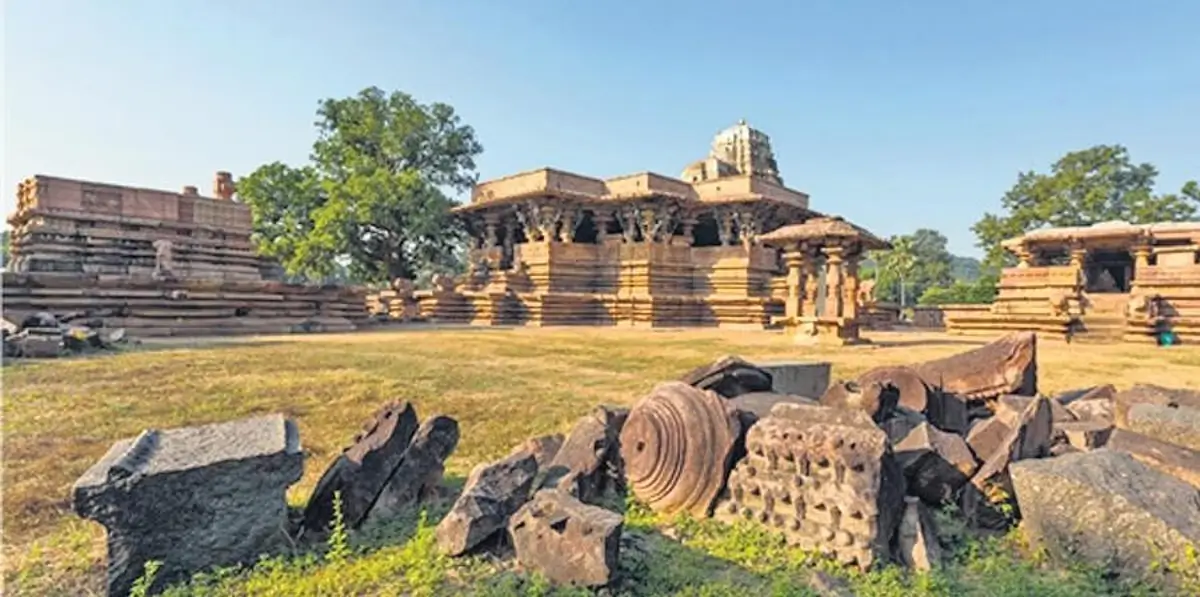
Img Src : The New Indian Express
One of the most remarkable features of ramappa temple unesco world heritage significance is its unique foundation system.
The temple was constructed over a confined sand-filled foundation, often described as a sandbox technique. The compacted sand helped distribute the weight of the structure and may have allowed the temple to absorb seismic shocks more effectively.
This innovative engineering is considered one of the reasons the monument has endured for more than eight centuries.
However, conservationists argue that the foundation cannot be studied in isolation. Its performance is also connected to the surrounding soil, groundwater and geological conditions.
Deep excavation and changes in underground water movement could potentially alter these conditions. This is why experts have called for:
Experts and heritage activists have specifically urged authorities to commission detailed studies before granting final approval to the mining proposal.
The debate is not limited to the temple.
Located near the monument, Ramappa Lake is a historic Kakatiya-era irrigation structure. Built as an earthen-bounded reservoir, it continues to play an important role in the agricultural and water systems of the region.
Reports estimate that the lake has a storage capacity of around three TMC and supports farmland in surrounding areas.
Conservationists fear that mining-related changes to the region’s geology or groundwater system could affect:
The lake and temple are therefore closely connected. Together, they represent the Kakatiya dynasty’s achievements in architecture, water management and landscape planning.
According to heritage activists, protecting Ramappa Temple Telangana also means protecting the lake and the environment that sustain its historical significance.
Singareni Collieries Company Limited has reportedly maintained that the proposed mining activity would not threaten the temple.
A senior SCCL official cited by Hindustan Times stated that the monument lies outside the applicable buffer zone. The official also claimed that studies conducted with IITs and other agencies indicated that controlled blasting would produce vibrations below the temple’s tolerance levels.
This position contrasts with the concerns raised by heritage conservationists.
According to conservation representatives, the possible danger may not come only from one major blast. Repeated low-intensity vibrations over several years could also have cumulative effects on an already sensitive structure.
The disagreement makes independent verification especially important. Technical findings should be made available for review by conservation experts, environmental authorities and affected communities.
Opposition to the mining project gained momentum after Ramappa Temple received UNESCO recognition in 2021.
Residents of Palampet, farmers and heritage activists formed protection groups under the banner of “Save Ramappa”. The Kakatiya Heritage Trust and the Palampet Special Development Authority have raised objections to the proposed mining activity and its possible impact on the temple and lake.
The project had reportedly been deferred earlier in 2021 but was later pursued again, bringing the issue back into public discussion.
For local communities, the temple is more than a tourist attraction. It represents regional identity, religious traditions, cultural memory and a source of livelihood through tourism.
In September 2026, Mulugu District Collector Bhorkhade Hemant Sahadeorao stated that the mining proposal would not be rushed.
The administration indicated that further consideration would depend on comprehensive scientific studies, environmental safeguards and heritage-related assessments.
The proposed next steps include:
The Collector also stated that conservation would remain a top priority and that no decision would be taken without adequate safety evaluation.
The debate surrounding Ramappa Temple reflects a difficult challenge faced by many developing regions: balancing economic requirements with the responsibility of protecting cultural and environmental assets.
Coal remains important for India’s energy and industrial needs. At the same time, heritage monuments, historic reservoirs and traditional landscapes cannot be recreated once permanently damaged.
The immediate question is not whether development should be rejected without examination. It is whether the proposed mine can be scientifically demonstrated to operate without compromising the temple, Ramappa Lake or nearby communities.
Until independent studies provide clear answers, calls for caution are likely to continue.
For now, the future of this unesco world heritage site in india depends on transparent decision-making, credible scientific evidence and a development approach that recognises the value of history alongside the demands of the present.
Everything you need to know
Ramappa Temple is in the news due to concerns surrounding a proposed open-cast coal mining project near Venkatapur in Telangana.
Yes, Ramappa Temple, officially known as Kakatiya Rudreshwara Temple, was inscribed on the UNESCO World Heritage List in July 2021.
The proposed mining site is reportedly located approximately five kilometres from the Ramappa Temple region.
Activists are concerned that blasting, deep excavation, groundwater disruption and geological changes could affect the temple, Ramappa Lake and nearby communities.
As per the latest reports, the project has been put on hold pending detailed scientific, environmental and heritage impact assessments.




Sep 21, 2026
TUI Staff
Sep 21, 2026
TUI Staff
Sep 21, 2026
TUI Staff
Sep 19, 2026
TUI Staff
Sep 21, 2026
TUI Staff
Sep 21, 2026
TUI Staff
Sep 21, 2026
TUI Staff
Sep 19, 2026
TUI Staff

Stay informed with independent, fact-checked journalism on technology, environment, government, economy and more. India’s most trusted digital news platform.

Comments (0)
Be the first to comment!