
Kanwar Yatra Haridwar : 5 Crore Pilgrims, 7,000 Tonnes of Waste Left Behind
5 crore pilgrims. 7,000 tonnes of waste. A question India cannot ignore.
 IN
Mon, Sep 28, 2026 | 08:57 PM IST
IN
Mon, Sep 28, 2026 | 08:57 PM IST


Nearly 5 crore pilgrims came to Haridwar during the 2026 Kanwar Yatra. They came for Ganga jal, carried their kanwars, walked for miles and returned home after one of India's biggest annual religious journeys.
But once the crowds left, Haridwar had another massive journey ahead: cleaning up nearly 7,000 tonnes of additional waste.
Discarded clothes, slippers, plastic, bottles and other material were left across the city and its ghats. At Har Ki Pauri, bottles reportedly containing urine were found inside women's changing rooms, adding another disturbing layer to the aftermath.
For a city that normally generates around 200–250 tonnes of garbage a day, this is not just a weekend cleanup. It is a huge civic and environmental challenge. The Hindu reported that around 1,700 tonnes of waste had accumulated during the final two days of the Yatra alone.
And perhaps the bigger question is this: Can India's mega pilgrimages grow in scale without leaving an equally massive environmental footprint?
Nearly 5 crore pilgrims visited Haridwar during Sawan to collect water from the Ganga as part of the Kanwar Yatra. NDTV reported that at least 7,000 tonnes of garbage had been moved to dumping grounds after the pilgrimage.
The number becomes easier to understand when compared with Haridwar's normal waste generation. At around 200–250 tonnes a day, 7,000 tonnes is roughly equivalent to 28–35 days of the city's usual garbage output.
That does not mean every pilgrim contributed to the waste, and the available reports do not establish that. The problem is the cumulative pressure created when millions of people pass through the same locations within a short period.
The administration responded with a special cleanup drive from August 12 to 18, deploying around 1,000 additional sanitation workers and more than 80 vehicles. Cleaning teams worked around the clock, with the ghats receiving priority.
The waste reportedly included discarded clothes, slippers, plastic items, water bottles and Kanwar-related structures. NDTV reported visuals showing discarded clothing, plastic and Kanwar structures scattered across the ghats.
For Haridwar, this creates a challenge far beyond simply making the streets look clean again. Waste has to be collected, segregated, transported and processed, often in areas located close to the Ganga and other environmentally sensitive spaces.
This is where Kanwar Yatra waste management becomes important. A cleanup after the event is necessary, but preventing waste from accumulating in the first place is far more effective.
Har Ki Pauri is where the story took a particularly disturbing turn.
According to The Hindu, bottles reportedly containing urine were found inside women's changing rooms set up by the civic body at Har Ki Pauri. NDTV also reported visuals of cleaners removing bottles said to contain urine.
However, there is an important distinction that should not disappear amid the outrage.
The reports do not establish that Kanwariyas were responsible for the bottles. Haridwar Municipal Commissioner Nandan Kumar reportedly said the act may have been carried out by anti-social elements. Officials were examining CCTV footage around the ghats and considering measures to prevent such incidents in the future.
That nuance matters. Reporting an unpleasant incident does not require collectively blaming millions of devotees for something whose perpetrators have not been established.
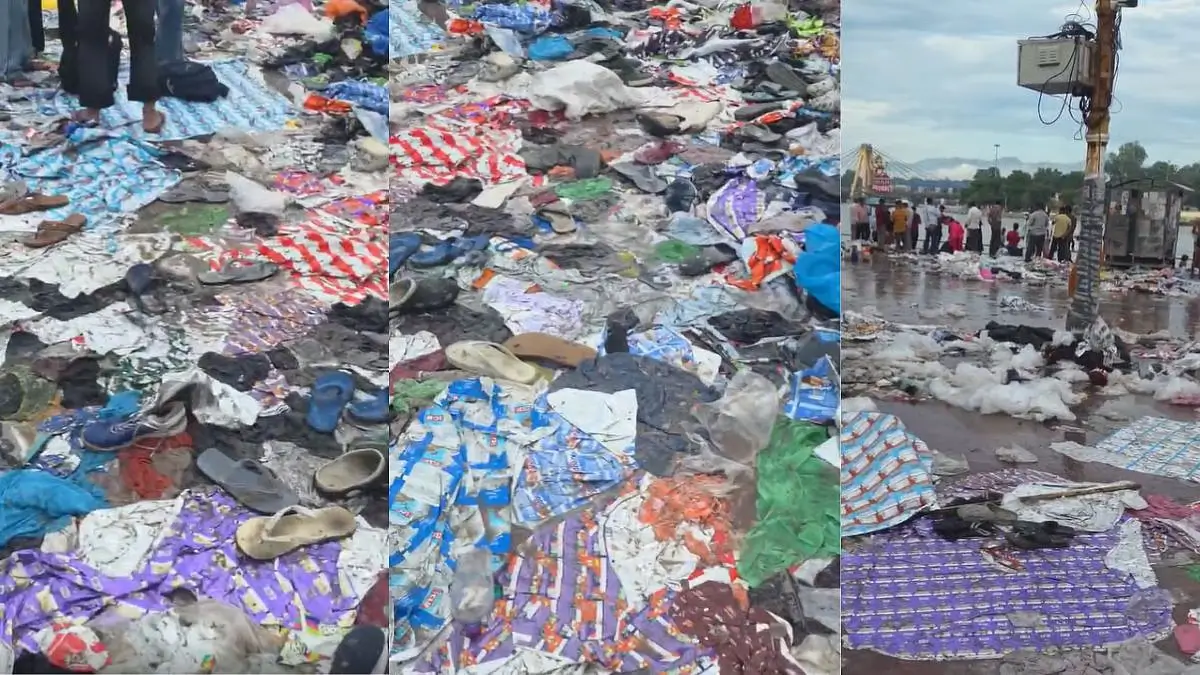
Img Src : Free Press Journal
Har Ki Pauri is one of Haridwar's most important religious sites and is traditionally regarded as the place where the Ganga emerges from the mountains and enters the plains.
For devotees, it is much more than a public space. It is a place of prayer, ritual and spiritual significance.
That makes the waste problem particularly uncomfortable. A pilgrimage centred around reverence for the Ganga should ideally leave behind a cleaner, more protected sacred landscape - not a larger sanitation burden.
While pilgrims return home, sanitation workers begin another demanding phase of the journey.
Around 1,000 additional workers were deployed for the special cleanup, supported by more than 80 vehicles. Teams worked across ghats, roads and parking areas, with reports saying that some crews worked through the night.
The public sees the mountains of garbage. What is less visible is the labour involved in removing them.
Collection, segregation, transportation and disposal all require manpower, vehicles, time and municipal resources. That is why effective Kanwar Yatra waste management cannot begin after the crowds disappear. It has to be planned before they arrive.
The environmental concern also extends beyond Haridwar.
NDTV reported that an estimated 57,000 pilgrims visited Gangotri during Sawan. After the pilgrimage, discarded clothes, plastics and other waste were found in the area. The Forest Department subsequently conducted a special cleanliness drive and collected 57 sacks of waste.
Gangotri is associated with the source of the Ganga and lies within a sensitive Himalayan ecosystem. NDTV reported that it is also a designated plastic-free zone, making the reported accumulation of plastic particularly concerning for the region's forests, flora and fauna.
This is an important part of the Uttarakhand latest news story. The environmental footprint of a mega pilgrimage does not necessarily stop at the city where most visitors gather. It can extend along the entire pilgrimage route, from fragile mountain landscapes to busy riverfronts.
The answer cannot simply be to blame pilgrims.
India's major religious gatherings are deeply woven into its cultural and spiritual life. The real challenge is making these gatherings more environmentally responsible as their scale continues to grow.
Pilgrims can carry reusable bottles, avoid leaving clothes or plastic behind, use designated collection points and treat riverbanks and ghats with care.
Authorities, meanwhile, need to think beyond post-event cleaning. Better waste segregation, strategically placed collection points, reduced single-use plastic, stronger enforcement and adequate sanitation infrastructure can reduce the burden before it becomes a crisis.
Religious organisations can also influence behaviour at scale. Shri Ganga Sabha, which manages religious activities at several Haridwar ghats, has said it plans to launch an awareness campaign next year encouraging Kanwariyas not to leave waste and bottles behind.
The latest Uttarakhand latest news should therefore be viewed as more than a post-Yatra cleanup story.
It highlights a growing need for planned, large-scale Kanwar Yatra waste management - one that focuses on prevention rather than simply sending more workers in once the event is over.
That could mean educating pilgrims before they begin their journey, reducing disposable material, increasing collection infrastructure, segregating waste at source, recycling wherever possible and monitoring environmentally sensitive locations throughout the Yatra.
The Ganga is central to the spiritual meaning of the Kanwar Yatra. Protecting the river and the landscapes around it should be part of that responsibility.
Because a successful pilgrimage should not only be measured by how many people make the journey.
It should also be measured by what they leave behind.
Everything you need to know
Authorities reported around 7,000 metric tonnes of additional waste associated with the Kanwar Yatra period.
Reports said bottles reportedly containing urine were found inside women's changing rooms, along with discarded clothes, slippers and plastic items.
No. The available reports do not establish that. The Haridwar Municipal Commissioner reportedly said anti-social elements may have been responsible, and officials were examining CCTV footage.
Better advance planning, waste segregation, adequate collection points, reduced plastic use, public awareness and greater participation from religious organisations can help reduce the waste burden.
NDTV reported that around 57,000 pilgrims visited Gangotri during Sawan and that a Forest Department cleanup collected 57 sacks of waste after the Yatra.



Sep 28, 2026
TUI Staff
Sep 28, 2026
TUI Staff
Sep 28, 2026
TUI Staff
Sep 28, 2026
TUI Staff
Sep 28, 2026
TUI Staff
Sep 28, 2026
TUI Staff
Sep 25, 2026
TUI Staff

Stay informed with independent, fact-checked journalism on technology, environment, government, economy and more. India’s most trusted digital news platform.






Comments (0)
Be the first to comment!