
India at the Olympics: From Norman Pritchard to Neeraj Chopra - 124 Years of Glory, Struggle & Sporting History
124 years of struggle, glory and unforgettable Olympic moments
 IN
Sat, Oct 24, 2026 | 08:02 PM IST
IN
Sat, Oct 24, 2026 | 08:02 PM IST


One athlete in 1900. Six hockey golds in a row. A 16-year individual-medal drought. And then Neeraj Chopra, Manu Bhaker and a new generation rewriting the story.
India's Olympic journey is anything but ordinary. It began in Paris in 1900 with Norman Pritchard and has travelled through the golden age of Indian hockey, decades of disappointment, breakthrough performances by individual athletes and the emergence of a much broader sporting culture.
More than 120 years later, the question is no longer whether India can win Olympic medals. It is how many sports can India compete in - and how far can its athletes go?
Here is the story of that remarkable transformation.
India's Olympic debut came at the 1900 Paris Games, where Norman Pritchard won silver medals in the 200 metres and 200 metres hurdles. The Indian Olympic Association also identifies him as India's first Olympic representative.
There is an important historical caveat. Olympic records have long debated whether Pritchard should be counted as an Indian or British Olympian because he competed for the London Athletic Club. The IOC's own historical statistics have noted this disagreement.
India returned to the Olympics in 1920, sending its first Olympic team. The Indian Olympic Association was formally established in 1927, with Sir Dorabji Tata as its founding president and Dr A.G. Noehren as secretary.
Then came 1928.
At Amsterdam, India's men's hockey team won gold, beginning a run of dominance that continued through the 1956 Melbourne Games.
For decades, Indian hockey was almost synonymous with Olympic success.
India won six consecutive hockey gold medals from 1928 to 1956, with legends such as Major Dhyan Chand becoming global sporting icons. The 1932 and 1936 teams continued the winning streak, while the 1948 London triumph carried an added emotional weight: independent India won Olympic gold after defeating Great Britain.
The run eventually ended at Rome 1960, when India settled for silver. It later won gold again in 1964 and, famously, the final hockey gold of its historic golden era at Moscow 1980.
But while hockey was carrying India's Olympic hopes, another story was quietly beginning.
At Helsinki 1952, wrestler K.D. Jadhav won bronze, becoming independent India's first individual Olympic medalist.
It was a significant shift. Until then, India's Olympic success had overwhelmingly been a team story built around hockey. Jadhav showed that an Indian athlete could stand on the podium alone.
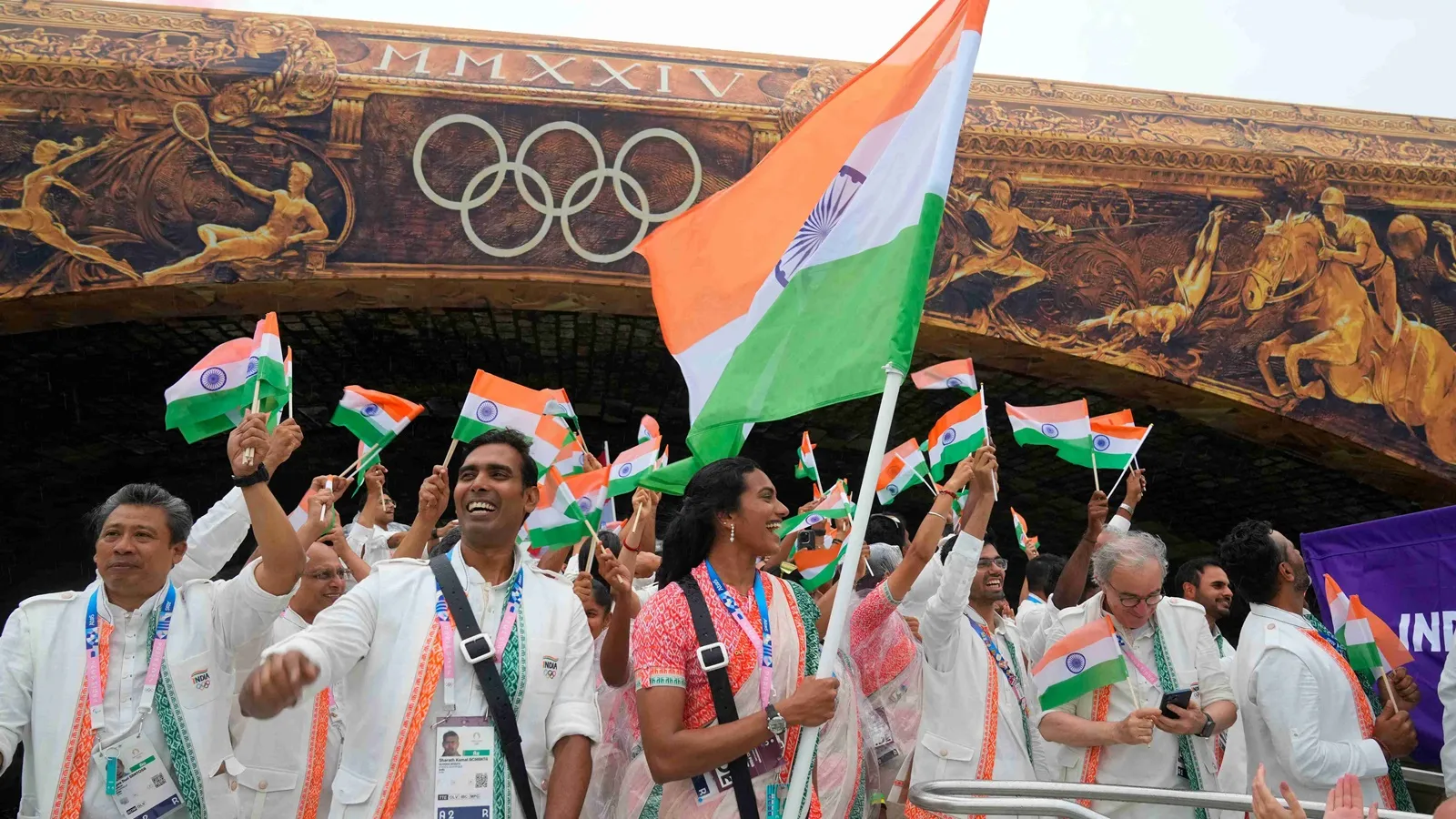
Img Src : The Indian Express
After the 1980 hockey gold, India entered a difficult Olympic period.
The breakthrough came at Atlanta 1996, when tennis player Leander Paes won bronze. His medal ended a nearly 16-year wait for an individual Olympic medal.
Four years later, Karnam Malleswari made another piece of history at Sydney 2000 by winning bronze in weightlifting—the first Olympic medal won by an Indian woman.
Then came Athens 2004, where shooter Rajyavardhan Singh Rathore won silver, before Beijing 2008 delivered one of India's biggest Olympic milestones.
Abhinav Bindra won gold in the men's 10m air rifle, becoming India's first individual Olympic gold medalist. The IOC identifies Bindra and Neeraj Chopra as India's two individual Olympic gold medallists.
London 2012 marked another turning point.
India won six medals, spread across shooting, wrestling, badminton and boxing. Sushil Kumar won silver and became the first Indian since independence to win two individual Olympic medals. Saina Nehwal won India's first Olympic badminton medal, while Mary Kom won bronze in boxing.
The important change was not simply the number six. It was the range of sports.
India was slowly moving beyond its dependence on hockey.
At Rio, P.V. Sindhu won silver in badminton, while Sakshi Malik won bronze in wrestling.
Sindhu's medal was particularly significant. It made her the first Indian woman to win an individual Olympic silver medal and set the stage for an extraordinary career.
By this point, India's Olympic story was increasingly being shaped by women athletes - from Malleswari and Mary Kom to Sindhu and Malik.
Tokyo 2020 gave Indian sport one of its defining moments.
India won seven medals- one gold, two silver and four bronze, then its best-ever medal haul at a single Summer Olympics.
The headline belonged to Neeraj Chopra.
His javelin throw gold made him India's first Olympic champion in athletics. The IOC describes Chopra as India's first-ever track-and-field Olympic gold medallist.
But Tokyo was bigger than one gold.
Mirabai Chanu won silver in weightlifting. Ravi Dahiya won silver in wrestling. P.V. Sindhu, Lovlina Borgohain and Bajrang Punia won bronze, while the men's hockey team returned to the Olympic podium with bronze.
It was a sign that India's medal ambitions were becoming increasingly multi-sport.
Paris 2024 produced six Indian medals: one silver and five bronze.
Neeraj Chopra added a silver in javelin to his Tokyo gold.
Shooting became one of India's biggest stories. Manu Bhaker won two bronze medals, one in the women's 10m air pistol and another with Sarabjot Singh in the mixed team event. Swapnil Kusale added another shooting bronze.
The men's hockey team won another bronze, while wrestler Aman Sehrawat also reached the podium.
Manu Bhaker's double-medal performance was particularly significant. From Karnam Malleswari's historic breakthrough in 2000 to Bhaker's two medals in Paris, the growth of Indian women in Olympic sport is impossible to ignore.
So, what does the overall picture look like?
According to Olympedia's country medal table, India has won 41 Olympic medals: 10 gold, 10 silver and 21 bronze. Hockey remains India's biggest medal-producing sport, followed by wrestling and shooting.
| Sport | Gold | Silver | Bronze | Total |
| Hockey | 8 | 1 | 4 | 13 |
| Wrestling | 0 | 2 | 6 | 8 |
| Shooting | 1 | 2 | 4 | 7 |
| Athletics | 1 | 3 | 0 | 4 |
| Badminton | 0 | 1 | 2 | 3 |
| Boxing | 0 | 0 | 3 | 3 |
| Weightlifting | 0 | 1 | 1 | 2 |
| Tennis | 0 | 0 | 1 | 1 |
These figures show perhaps the biggest change in the journey of India at the Olympics : the medals are no longer coming from just one sport.
The most encouraging part of India's Olympic story is its changing shape.
Hockey once carried almost the entire medal burden. Today, India has Olympic medals in eight sports, with shooting, wrestling, athletics, badminton, boxing, weightlifting and tennis joining hockey in the medal record.
That diversification matters.
It means the future of India at the Olympics is no longer tied to the fortunes of a single team. The next chapter could come from a javelin thrower, shooter, wrestler, badminton player—or an athlete competing in a sport that has not yet produced an Indian Olympic medal.
From Norman Pritchard in Paris to Neeraj Chopra in Tokyo, India's Olympic story has taken 124 years to reach this point.
And perhaps the most exciting thing about that story is that it is still being written.
Everything you need to know
India first appeared at the 1900 Paris Olympics, when Norman Pritchard won two silver medals. India has competed at every Summer Olympics since 1920.
India has won 41 Olympic medals: 10 gold, 10 silver and 21 bronze.
Men’s field hockey leads India’s Olympic medal tally with 13 medals, including eight golds.
Wrestler K.D. Jadhav won bronze at the 1952 Helsinki Olympics, becoming independent India’s first individual Olympic medalist.
Among India’s modern multi-medallists are Sushil Kumar, P.V. Sindhu, Neeraj Chopra and Manu Bhaker, each having won multiple Olympic medals.
Oct 23, 2026
TUI Staff
Oct 23, 2026
TUI Staff
Oct 23, 2026
TUI Staff
Oct 23, 2026
TUI Staff
Oct 23, 2026
TUI Staff
Oct 22, 2026
TUI Staff
Oct 22, 2026
TUI Staff

Stay informed with independent, fact-checked journalism on technology, environment, government, economy and more. India’s most trusted digital news platform.

Comments (0)
Be the first to comment!