
Election Commission Row: 14 Internal Objections Put CEC Gyanesh Kumar Under Spotlight
Internal records raise fresh questions over SIR procedures, while the ECI says all final decisions were unanimous.
 IN
Fri, Sep 25, 2026 | 03:53 PM IST
IN
Fri, Sep 25, 2026 | 03:53 PM IST


The Election Commission is facing renewed political and institutional scrutiny after a media investigation reported that the two other members of the three-person poll panel repeatedly objected to decisions and orders during the nationwide Special Intensive Revision of electoral rolls. The Indian Express reported that Election Commissioners Sukhbir Singh Sandhu and Vivek Joshi recorded objections at least 14 times over 10 months, including concerns over voter registration, deletion and restoration, changes to Form 6 and control of electoral-roll databases. Several of the objections were copied to CEC Gyanesh Kumar.
The disclosures have intensified the Opposition’s earlier vote chori and vote theft accusations, with Leader of Opposition Rahul Gandhi demanding Kumar’s resignation. The poll body, however, has pushed back strongly, saying internal observations are part of normal institutional deliberation and that all final decisions during the period were taken unanimously. The controversy therefore involves two separate questions: what the internal records show about decision-making inside the poll panel, and whether those disagreements establish the broader electoral manipulation alleged by Opposition parties. So far, the latter has not been established by a judicial finding.
The latest row began after The Indian Express published details of written objections attributed to Sandhu and Joshi. According to the investigation, both commissioners said on different occasions that decisions or communications had gone out in the name of the full panel without their knowledge or approval.
The objections covered four particularly sensitive areas:
One of Sandhu’s notes reportedly called a change connected with Form 6 “unauthorised and illegal”.
The Commission’s official response presents a different interpretation.
It said written notes, questions, technical suggestions and differing views are standard parts of decision-making inside a constitutional institution. It maintained that its official orders have legal sanction and that the final decisions taken during the period were unanimous. That disagreement between the media investigation and the institution’s explanation is now at the centre of the controversy.
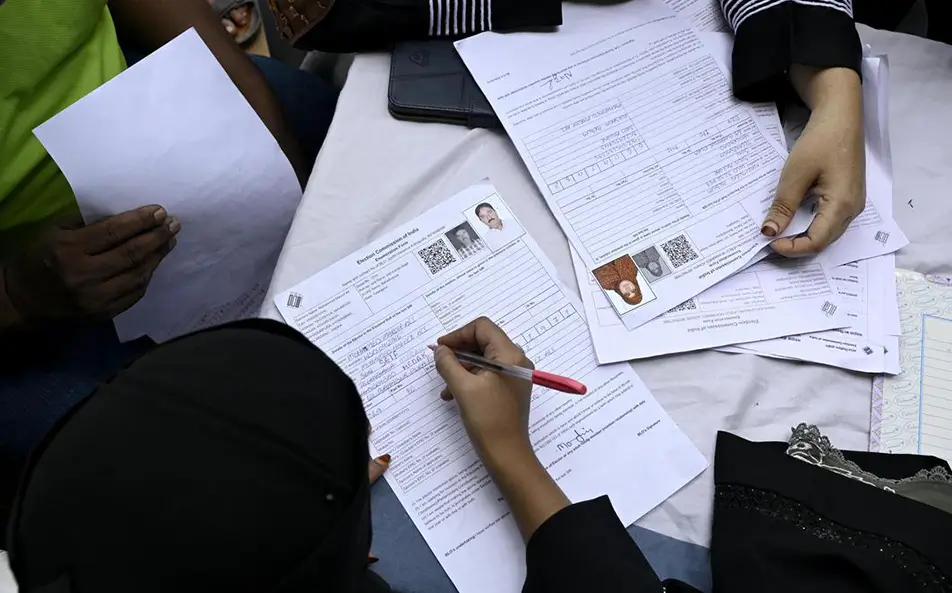
One significant dispute involved Form 6, which citizens use to apply for inclusion on electoral rolls. The Indian Express reported that a new question was added asking applicants whether they or their parents or grandparents appeared in the electoral roll used during an earlier SIR. According to the report, Vivek Joshi had warned that the form could not be changed in that manner without corresponding changes to the rules. Sandhu later reportedly described the addition as unauthorised and said it should be removed.
Another dispute concerned the increasing centralisation of electoral-roll technology. Traditionally, Electoral Registration Officers exercise statutory control over voter registration and deletion within individual constituencies. Sandhu and Joshi reportedly raised concerns that access to ERONet and its successor ECINet was becoming increasingly controlled from Delhi.
Joshi reportedly proposed an audit to ensure nobody other than authorised statutory officers could alter voter databases. The Election Commission says its digital platforms operate under strict security controls intended to prevent unauthorised manipulation and that statutory officers continue to exercise their powers under election law.
The Goa episode is one of the most concrete issues highlighted in the investigation. Following a Supreme Court direction, Electoral Registration Officers reportedly reviewed voters who had been flagged because of “logical discrepancies”. Officials determined that 97 voters were eligible for inclusion.
However, according to The Indian Express, the software did not initially provide the functionality required to reverse the earlier exclusion. Goa election officials reportedly sent eight communications over seven days seeking access to the necessary feature, but it was not activated before publication of the final list.
As a result, the 97 voters were left off that roll, according to the report. The episode has become particularly significant because the broader SIR debate concerns whether administrative and technological processes can wrongly exclude otherwise eligible citizens.
Another disagreement centred on the West Bengal revision. The Supreme Court had earlier intervened in the handling of voters flagged for logical discrepancies and directed judicial officers and appellate tribunals to review contested cases. The poll body later told the Supreme Court that millions of appeals had been filed.
Sandhu reportedly questioned who authorised appeals filed on behalf of the ECI against voters whom judicial officers had restored to the rolls. He also asked who had actually filed those appeals. These internal questions do not themselves establish manipulation of election results. The Indian Express noted that in West Bengal constituencies where SIR deletions exceeded winning margins, the seats were divided relatively evenly between the BJP and Trinamool Congress, providing no simple evidence that the deletions systematically benefited one party.
The latest Rahul Gandhi CEC confrontation intensified after publication of the internal-objection report. At a September 24 press conference, Gandhi demanded Kumar’s resignation and urged him to “turn approver”. He alleged that India’s electoral system had been compromised and repeated Congress’s broader allegations surrounding electoral-roll manipulation. The Congress leader has repeatedly used the phrase vote chori while accusing the ruling BJP and electoral authorities of interfering with voters’ rights.
Those accusations remain contested.
The ECI has rejected allegations that it manipulates elections, while BJP leaders have argued that Gandhi has not produced evidence establishing his broader claim that election outcomes were rigged. The latest Rahul Gandhi CEC dispute therefore combines the newly reported internal disagreements with older political claims that extend beyond what the 14 objections themselves demonstrate.
No judicial or independent institutional finding cited in the current controversy has established systematic vote theft by the ECI or BJP. The internal documents reported by The Indian Express raise questions about procedure, approval and electoral-roll management. They do not by themselves demonstrate that election results were deliberately changed.
This is an important distinction.
Evidence that commissioners questioned a procedure is different from evidence proving a coordinated conspiracy to alter an election. Gandhi and other Opposition leaders argue that the objections strengthen their concerns about electoral integrity. The BJP and ECI reject that conclusion. For that reason, the vote theft allegation should remain attributed to its political proponents rather than presented as an established fact.
The Chief Election Commissioner does not legally operate as the sole decision-maker. Section 18 of the Chief Election Commissioner and Other Election Commissioners Act, 2023 states that Commission business should, as far as possible, be conducted unanimously. If the CEC and other commissioners disagree on a matter, the question is to be decided according to the majority opinion. The procedure and allocation of Commission business itself can be regulated by unanimous decision.
This legal framework is why the reported objections matter. If substantive decisions were taken without approval from a majority of the three-member body, that would raise legal and institutional questions. The ECI’s position, however, is that the notes being highlighted reflected discussion before final decisions and that its eventual official decisions were unanimous.
Sandhu and Joshi have not publicly issued separate statements contradicting the institution’s formal response.
In its response, the Election Commission said focusing on selected notes over a 10-month period gives only one part of the overall picture. It said commissioners and officers are encouraged to make suggestions and raise queries to improve electoral processes. The poll panel also stated that the numerous instructions, reforms and SIR-related actions undertaken over the past year resulted from unanimous decisions by the full Commission.
That response does not dispute that internal observations existed. Instead, it disputes the interpretation that those observations demonstrate institutional breakdown or unilateral decision-making. That difference will likely remain central to further political and legal scrutiny.
Opposition parties are also preparing another attempt to seek Kumar’s removal from office. India Today reported that INDIA bloc parties were discussing a fresh motion in both Houses of Parliament following the internal-dissent controversy. The process is sometimes described politically as “impeachment”, but the Constitution uses a more specific standard.
Article 324 states that a Chief Election Commissioner may be removed only in the same manner and on the same grounds as a judge of the Supreme Court. A political demand for resignation or announcement of a proposed motion therefore does not itself remove a CEC.
The constitutional procedure would need to be completed.
The BJP has defended the poll panel and rejected Gandhi’s interpretation of the controversy. Party spokesperson Sudhanshu Trivedi questioned Gandhi’s claims and argued that the final decisions of the ECI were unanimous. Other ruling-alliance figures have taken a somewhat different tone.
Union minister Chirag Paswan said Kumar and the ECI should firmly explain their position so that public confidence in the electoral system is not damaged. This illustrates that even among government allies, the emphasis is not identical: BJP leaders have focused heavily on rejecting Congress’s allegations, while Paswan stressed the need for a clear public explanation.
The latest controversy gives the public new information about disagreements inside one of India’s most important constitutional institutions. It shows, according to documents reported by The Indian Express, that two commissioners repeatedly questioned procedures involving voter registration, deletion, software access and institutional approval. It also shows that CEC Gyanesh Kumar received or was copied on several of those concerns.
What it does not yet establish is that those disputed procedures were designed to benefit a particular party or that election results were deliberately falsified. The vote chori narrative advanced by Congress is a political conclusion drawn from a wider set of allegations. The reported internal notes provide additional material for scrutiny but are not themselves proof of that wider claim..
Everything you need to know
The Indian Express reported that Election Commissioners Sukhbir Singh Sandhu and Vivek Joshi recorded objections at least 14 times over 10 months. The issues included changes to Form 6, control of electoral-roll databases, voter restoration and deletion processes, and SIR-related decisions.
The ECI says individual notes, questions and differing views are normal parts of deliberation in a multi-member constitutional body. It maintains that all final decisions, including those concerning the SIR, were taken unanimously.
Opposition leaders, including Rahul Gandhi, have cited the reported internal objections while renewing criticism of the Election Commission’s handling of electoral rolls. Gandhi has demanded Kumar’s resignation and urged him to “turn approver”. The BJP and ECI reject the broader allegations of electoral manipulation. Hindustan Times
No. The reported documents raise questions about procedure, approval and management of electoral rolls, but they do not by themselves establish that election results were deliberately manipulated or that any party benefited through a coordinated scheme. Your draft correctly keeps that distinction explicit. Pasted markdown
Yes. Opposition parties are preparing a fresh parliamentary motion seeking Kumar’s removal following the internal-objection controversy. A political demand or proposed motion does not itself remove the CEC; the constitutional removal procedure must be completed. The Indian Express




Sep 24, 2026
TUI Staff
Sep 23, 2026
TUI Staff
Sep 22, 2026
TUI Staff
Sep 21, 2026
TUI Staff
Sep 24, 2026
TUI Staff
Sep 23, 2026
TUI Staff
Sep 22, 2026
TUI Staff
Sep 21, 2026
TUI Staff

Stay informed with independent, fact-checked journalism on technology, environment, government, economy and more. India’s most trusted digital news platform.


Comments (0)
Be the first to comment!